The Days are Getting Longer

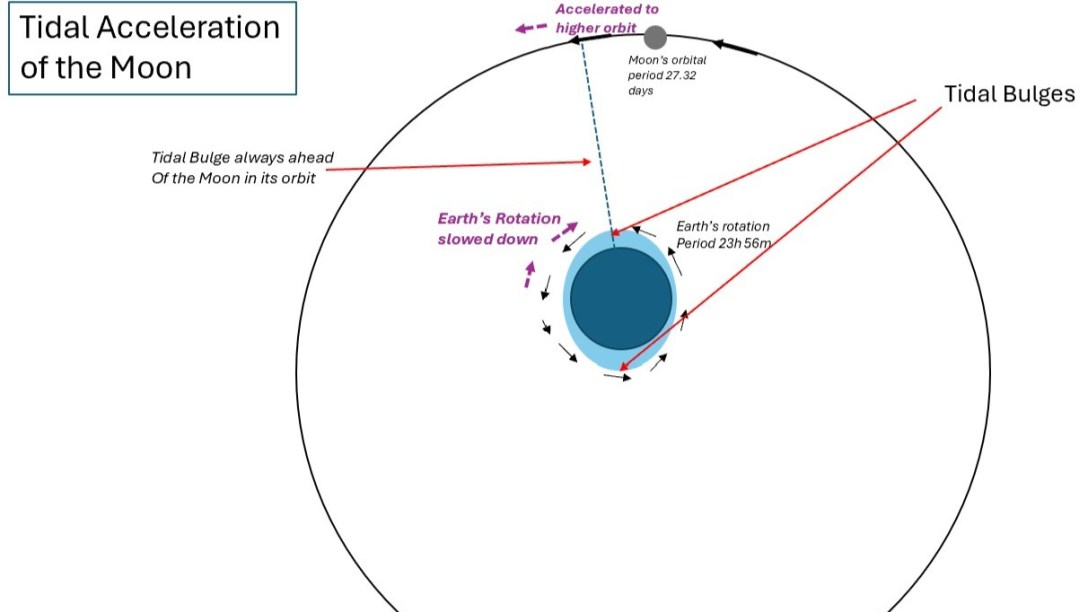
Tidal Friction From the Mon slowing the Earth's rotation

The Moon's gravitational influence creates tides on Earth, with tidal bulges occurring on both sides of the planet. This interaction gradually slows Earth's rotation, lengthening days and causing the Moon to drift away at about 3.8 cm per year. Past proximity may have facilitated the emergence of early life due to stronger tidal forces.

Earth’s Nearest Neighbour

Introduction Welcome to the latest post from Explaining Science. To mark the 45th anniversary of the first manned Moon landings, for the next few posts I have decided to write about the Moon. I hope you have enjoyed reading my previous posts and will enjoy this one too. As always, please let me know if… Continue reading Earth’s Nearest Neighbour

Pluto may be wearing a dark belt of moon dust

An interesting blog post I found today. Did you know that Pluto, which is only one sixth the mass of the moon, used to be classified as a planet? However, in 2006 it was re-classified as a dwarf planet by the International Astronomical Union.

Understanding ‘The Acid Test’: Its Scientific Roots

  Updated 23 November 2025 Definition The term "the acid test", to test the real worth of something, is widely used. The definition and example given in the Cambridge On-line English dictionary are succinct: The true test of the value of something. It looks good, but will people buy it? That's the acid test.  The origin… Continue reading Understanding ‘The Acid Test’: Its Scientific Roots

How Would We Get to Enceladus ? (a brief overview)

 Updated 10 December 2025 This post continues my previous two posts on Saturn's icy Moon Enceladus which many scientists now believe is the most likely place in the solar system, other than the Earth, to harbour life. and discusses how we might get there   Image from NASA There are two possibilities . (a) the… Continue reading How Would We Get to Enceladus ? (a brief overview)