
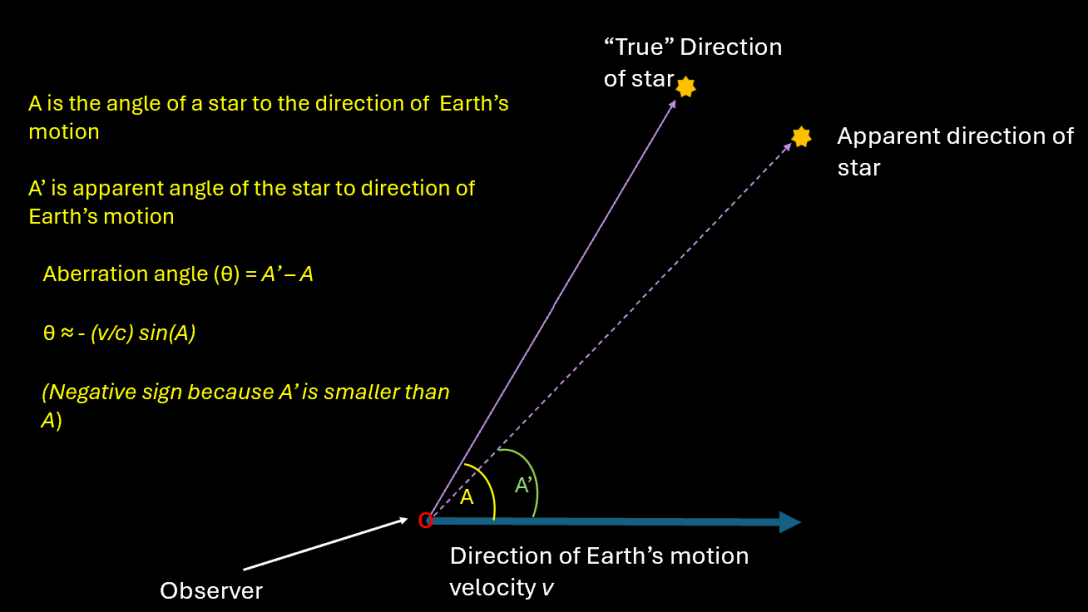
Stellar aberration was discovered by James Bradley in 1727. He observed unexpected star position shifts, confirming the heliocentric theory and enabling light speed measurement. Today, it's explained by Einstein's theory of relativity.
Stellar aberration was discovered by James Bradley in 1727. He observed unexpected star position shifts, confirming the heliocentric theory and enabling light speed measurement. Today, it's explained by Einstein's theory of relativity.

In a previous post I talked about the advantages of solar electricity compared to other renewable source of electricity. In this post I’ll move away from my normal scientific topics and discuss the costs of small scale solar energy and how it compares with other renewables. Whats is 'the LCOE'? When comparing the relative costs… Continue reading Solar energy costs
As shown in the graph and table below, most renewable electricity is generated by hydroelectric power. Solar energy lies in third place behind wind. Electricity generated from renewable sources. From Our world in data (2018). The ‘Others’ category includes biofuels (e.g. burning wood, animal and agricultural wastes), geothermal energy and wave/tidal power) Despite only being… Continue reading Advantages of solar energy

Telescopes, developed first in the early 17th century, are instruments using lenses to magnify distant objects. Galileo refined early designs for astronomical observations, notably discovering Jupiter's moons and the phases of Venus, supporting heliocentrism. Further advancements led to Keplerian telescopes, and modern reflectors surpassed refractors in size and clarity.
Discusses the intriguing mathematical question of whether 196 is a Lychrel number, defined as a number that never results in a palindrome through repeated "reverse and add" processes. Despite extensive computational attempts, no palindrome has been found for 196, making it a leading candidate for a Lychrel number.

