Distances in Cosmology

What do we mean by disatnces in cosmology

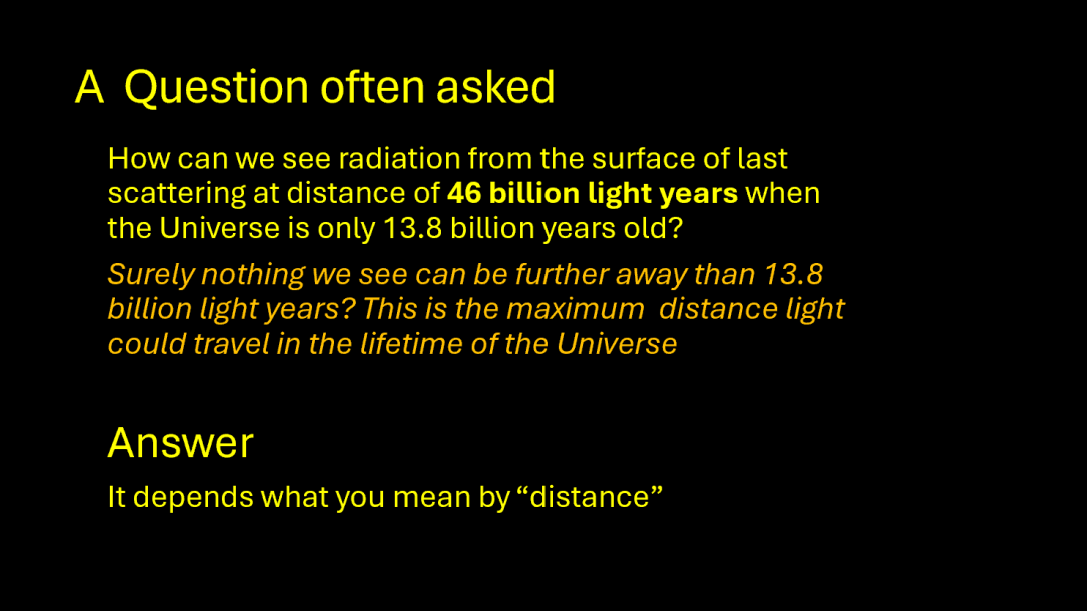
Discusses the nuances of distance measurement in cosmology., focusing on the cosmic microwave background (CMB) and its proper distance of 46 billion light years from Earth. It clarifies concepts such as light travel distance, proper distance, comoving distance, and various astronomical distance metrics, emphasizing the expansion of the Universe
Jim Peebles winner of the Noble Prize 2019

I was interested to hear that Jim Peebles, at the age of 84,  has won a half share of the 2019 Noble Prize for physics for theoretical discoveries in physical cosmology. Jim Peebles (1935-) Image from Wikimedia commons In the early 1960s Peebles and his colleague Robert Dicke had predicted the existence of the microwave… Continue reading Jim Peebles winner of the Noble Prize 2019

How the Cosmic Microwave Background Changed Our Understanding of the Universe

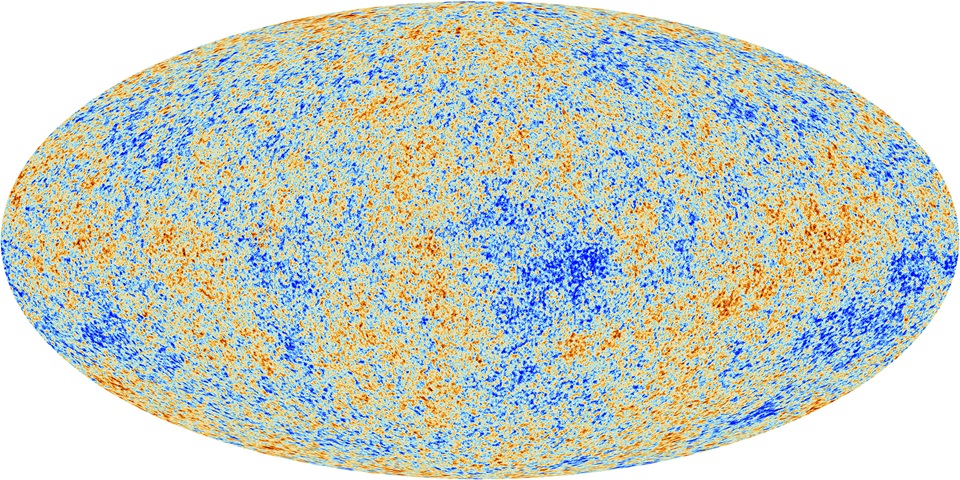
Map of the Cosmic Microwave Background from the ESA Planck Satellite

Updated 4 February 2026 As The accidental discovery of the cosmic microwave background (CMB) by Penzias and Wilson in 1964 proved to be one of the greatest scientific discoveries of the early twentieth century and since then has made a huge contribution to our understanding of the Universe. One of the first things it achieved… Continue reading How the Cosmic Microwave Background Changed Our Understanding of the Universe

The Discovery of the Cosmic Microwave Background

Revised 1 February 2026 In 1964 two young American radio astronomers, Arno Penzias and Robert Wilson, made an accidental finding which would win them both the Nobel prize and turned out to be one of the greatest scientific discoveries of the twentieth century. The story started when Penzias and Wilson were given observing time on a large radio telescope at… Continue reading The Discovery of the Cosmic Microwave Background