
In 2014 NASA’s Curiosity rover detected methane on Mars. [1] This was a puzzle because Mars doesn’t have an ozone layer to shield its surface from ultraviolet radiation and any methane in the atmosphere would be broken up within 600 years. If the findings were correct and methane exists in the Martian atmosphere there must be some process occurring which is constantly replenishing it.
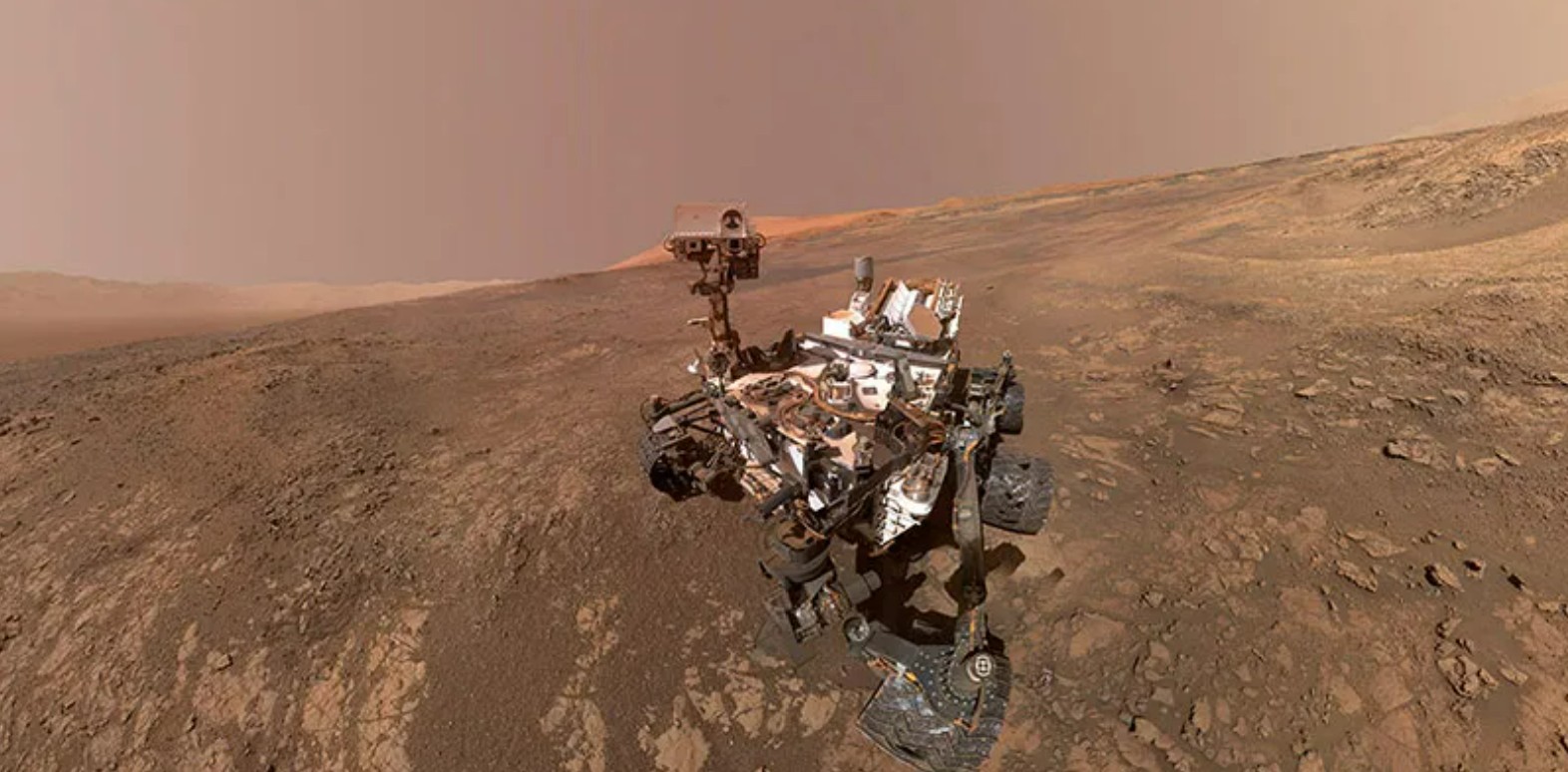
A selfie taken by Curiosity
On Earth more than 90% of methane in the atmosphere is produced by living organisms [2] There are over 50 species of microorganisms known as methanogens that live off organic matter and produce methane as a waste product. These microorganisms are found not only in wetlands (producing what is known as marsh gas) and in the soil but also in the guts of many animals such as cows and humans.
However, the existence of methane does not necessarily mean that it is biological in origin. For example, there could be a large reservoir of methane locked away in the ice below the Martian surface and as the temperature varies some of the ice may melt, releasing the methane into the atmosphere
The Curiosity Detection of Methane
Curiosity landed at the 150 km diameter Gale Crater south of the Martian equator.
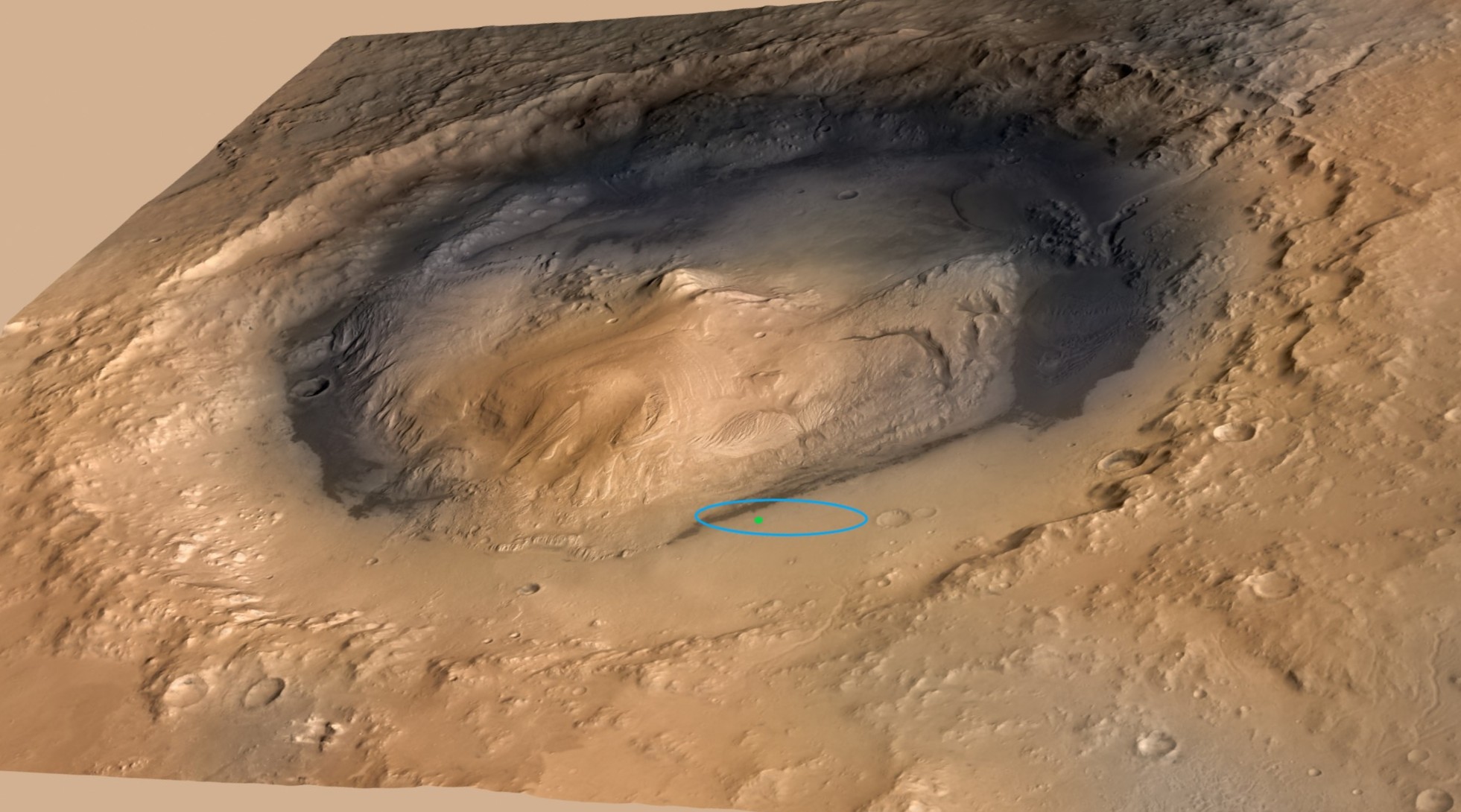
Thr Blue dot shows the landing site of Curiosity
The Low Background Level of Methane
It measured a very low background level of methane in the Martain atmosphere there averaging around 0.4 parts per billion.
Seasonal Methane Cycles
In 2018, NASA announced that this background methane isn’t constant; it ebbs and flows with the seasons – peaking in the late summer and dropping in the winter. This suggests that the methane might be seeping out from underground reservoirs or being released from surface rocks as they warm up.
The Big Spike in Methane Concentration
A large spike in methane concentration , up to 7 parts per billion was measured over a period of several weeks during late 2013 and early 2014, in the first Martian Southern Hemisphere early autumn. This spike was not repeated during Curiosity’s second Martian year. However, in 2019 an even larger spike in methane concentration of 21 part per billion was observed. [3]
ExoMars TGO and the Methane Mystery
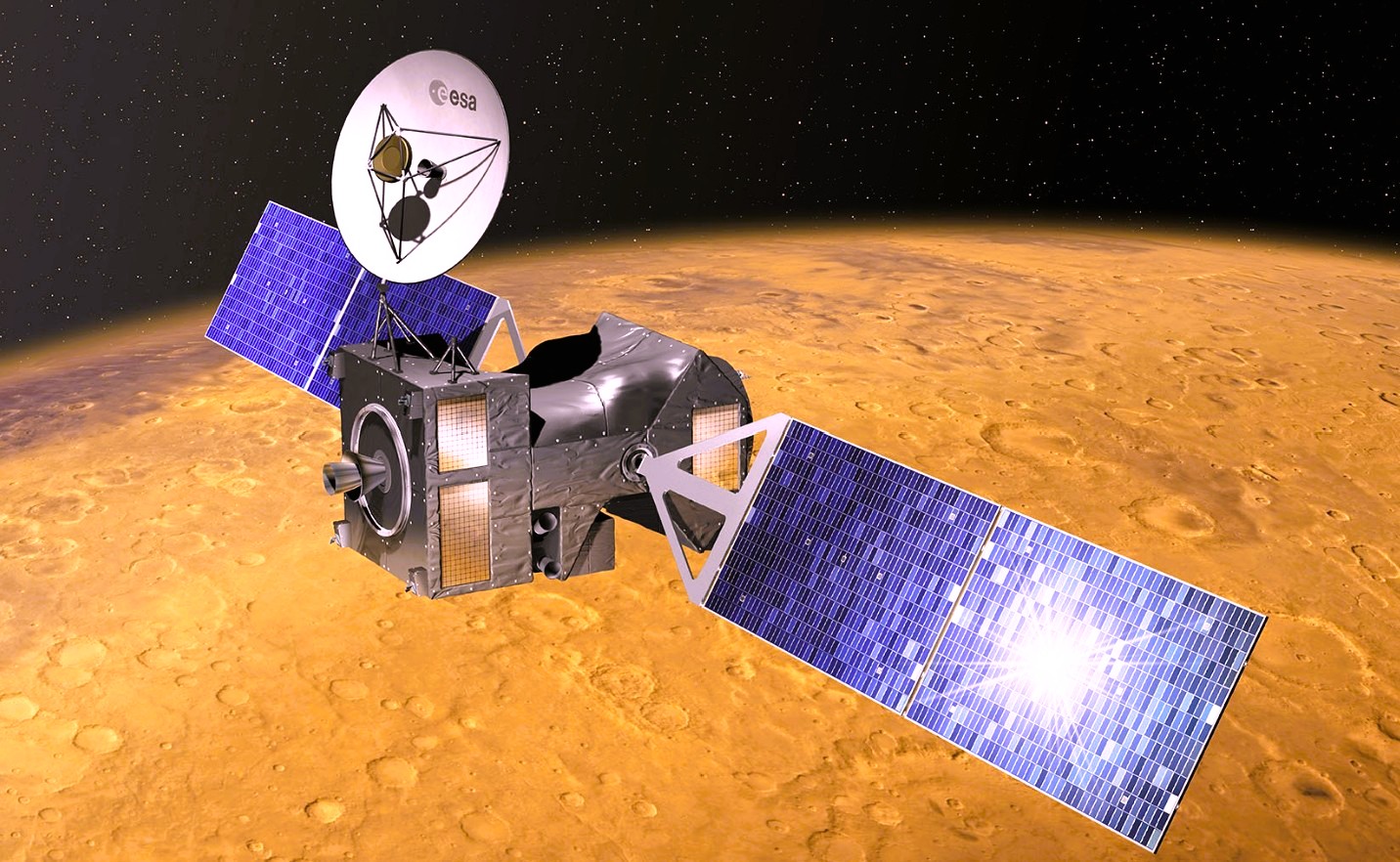
ESAs ExoMars TGO
ESA’s Trace Gas Orbiter spacecraft was launched to Mars in 2016 and the main scientific operations started in April 2018. One year later, the science team reported the surprising results that TGO had detected no methane whatsoever. In 2024 it was announced that there was no detectable methane on Mars with an global upper limit on the methane concentration of 50 parts per trillion. [4]
The mission is still operational and at the time of writing this post (March 2026) no methane has been detected whatsoever.
The mystery of the Martian methane continues!
For more information on this mission see my post ExoMars TGO Tracking methane on Mars
Related Posts
I hope you have enjoyed this post. Some other related posts which may be of interest are:
- The possible origin of methane on Mars
- The proposed Schiaparelli landing on Mars
- What went wrong with ESA’s failed Schiaparelli Mars landing
- The NASA Juno mission to Jupiter
References
[1] Cermak, A. (2018). Methane Background Levels at Gale Crater, Mars. [online] NASA Science. Available at: https://science.nasa.gov/resource/methane-background-levels-at-gale-crater-mars/ [Accessed 3 Mar. 2026].
[2] ESA (2014) The enigma of methane on Mars, Available at:http://exploration.esa.int/mars/46038-methane-on-mars/ (Accessed: 04 March 2026).
[3] NASA. (2019). Curiosity’s Mars Methane Mystery Continues – NASA. [online] Available at: https://www.nasa.gov/missions/mars-science-laboratory/curiosity-rover/curiositys-mars-methane-mystery-continues. (Accessed: 04 March 2026).
[4] Montmessin, O., Korablev, O., Trokhimovskiy, A., Olsen, K., Lefèvre, F., Baggio, L., Fedorova, A., Irbah, A., Lacombe, G., Patrakeev, A. and Duxbury, N. (2024) . THREE MARTIAN YEARS OF SEARCHING FOR METHANE ON MARS. [online] Available at: https://www.hou.usra.edu/meetings/tenthmars2024/pdf/3145.pdf [Accessed 5 Feb. 2026].

 Explaining Science
[…] Source link […]
LikeLike
Pure speculation, I know but is there any non-biological process that could create methane?
LikeLiked by 2 people
Possible could be some geological processes creating the methane, which I discuss in the body of the post
LikeLiked by 1 person
Awesome! You know what else creates methane don’t you. Cows. Just saying. 😉
Cows on mars YES!!!
LikeLiked by 4 people
An an interesting thought !! 😉
LikeLike
Reblogged this on Peuples Observateurs Avant Garde Togolaise et Africaine.
LikeLiked by 2 people