
Although a small number of extremely wealthy space tourists have paid millions of dollars for orbital spaceflight, by their very nature only a handful of people can take part in these spaceflights each year.
It looks like Virgin Galactic will start commercial spaceflights aimed a larger audience soon. According to the Virgin Galactic Website Galactic 01, their first commercial pace Mission, i.e where the passengers have paid for their spaceflight, will take place sometime between June 27 and June 30 2023. The next flight Galactic 02 is planned to take place in August and assuming that these flights are successful, Virgin Galactic will fly one mission a month to an altitude of at least 80 km. This the boundary of space as recognised by the U.S. Air Force and NASA. Although the Fédération Aéronautique Internationale (FAI) use a higher definition of 100 km, which is more widely accepted outside the US.
Back in 2014 I wrote a post on this topic. At the time many believed that Virgin Galactic would start offering commercial space flights in 2015. However there were numerous delays on the way. Now with these space flights now about to start, I thought it would be interesting to re-blog this post.
**Revised original post
The era of mass space tourism is about to begin. Virgin Galactic’s VSS Unity is about to launch. It is based upon SpaceShipOne, an experimental spacecraft which won a $10 million dollar prize for being the first privately built spacecraft to reach to an altitude of 100 km.
The experience
Passengers will board VSS Unity at the purpose-built Spaceport America in New Mexico. It will be attached to a rather strange looking twin hulled carrier aeroplane called Virgin Mother Ship (VMS) Eve. This is named after the Virgin group founder Richard Branson’s late mother Evette Branson (1924-2011)
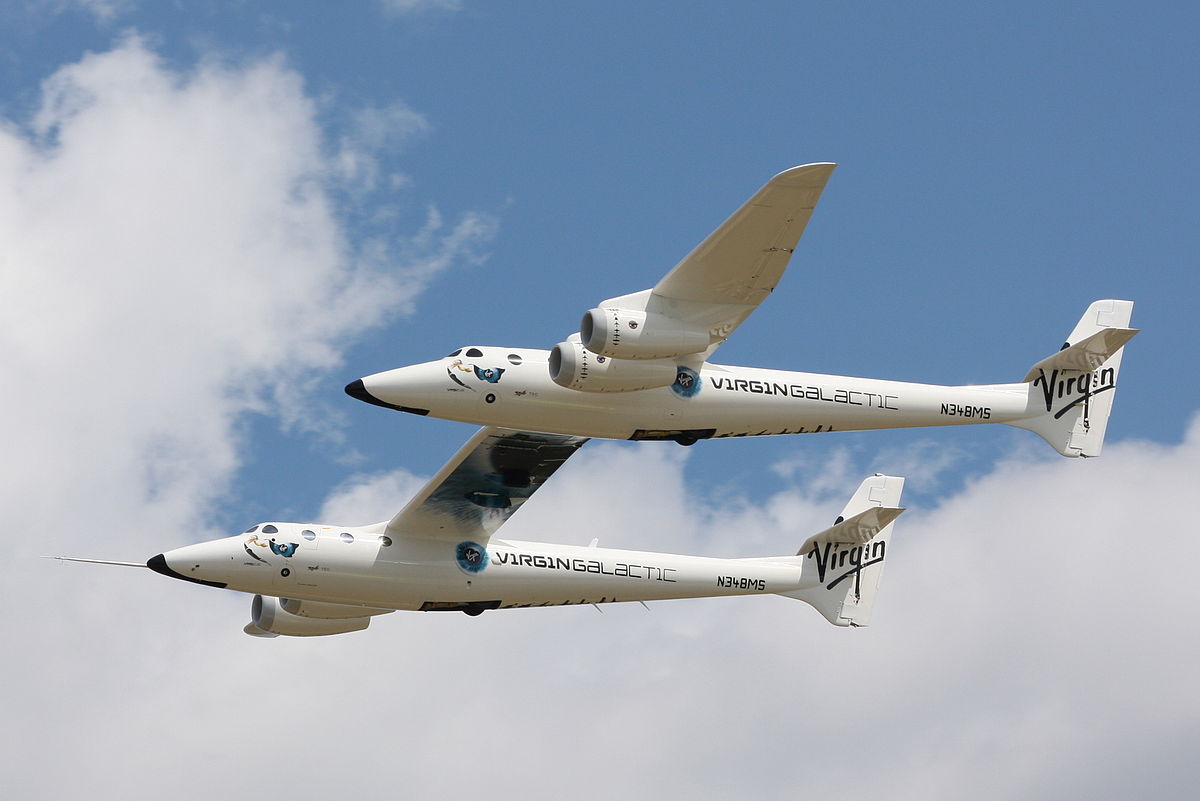
After take off, VMS Eve, will steadily climb to an altitude of 51,000 feet (15.5 km) – about 50% higher than a commercial aeroplane reaches on a long flight. From this altitude passengers will notice that the sky overhead will be dark blue because there is so little atmosphere above them. Also, because they are so high up, they will be able to see significantly further than they can on a normal jet flight, a distance of around 440 km to the horizon. VSS Unity will separate from VMS Eve, and its rocket motor will then ignite.
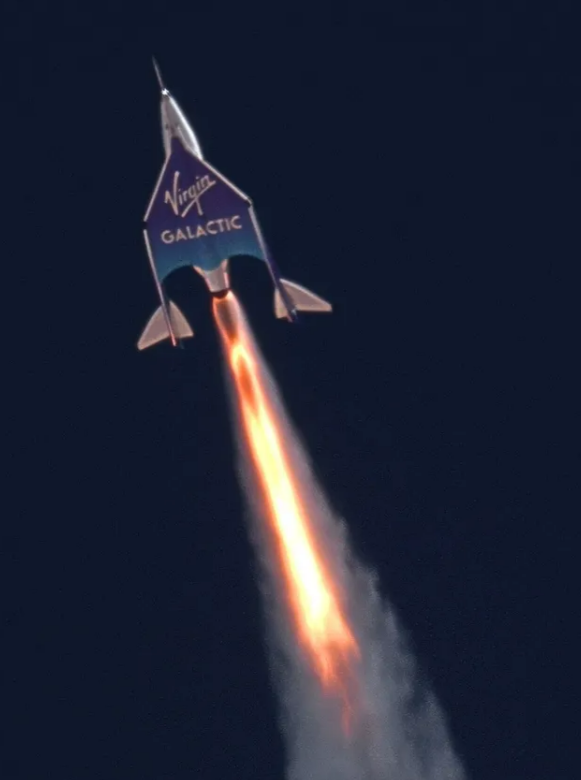
When this happens, the passengers will immediately feel a very strong acceleration, or g-force, which will pin them back into their seats. The force will be around 3-g so a human would weigh three times a much as they do on earth, making it a great effort to move any part of their body. After only 70 seconds SpaceShipTwo will be travelling at 2,500 mph (4000 km/h). The rocket motor will then cut out and the passengers will suddenly go from being pinned to their seat by the strong g-force to being completely weightless.
They will be able to get out of their seats, float around the cabin, look out of the windows and take in the view. The spacecraft will continue to coast upwards, being slowed all the time by the Earth’s gravity. After a further two minutes it will cross the 100 km boundary into space. Its peak altitude will be around 110 km. (*** Back in 2014 Virgin Galactic claimed that the spacecraft would reach a peak altitude of around 110 km; this has now been scaled back to “above 80 km”) If the passengers look outside the window at this point they will notice that the sky will be black even though the sun is shining. This is because there is so little atmosphere above them. They will be able to see about 1200 km to the horizon, so if it were flying over London passengers would be able to see the Orkney Islands, off the North cost of Scotland, out of the window on one side and Barcelona, in Northern Spain, on the other side. This particular scenario, however, is a very long way in the future, as of course the flights will be over New Mexico.
After it reaches peak altitude VSS Unity will start falling back to Earth. Initially it will be in free fall but as it gets lower and lower and encounters traces of the Earth’s atmosphere, it will start to experience atmospheric friction, which will reduce the acceleration. The wings of the spacecraft, which are hinged, will tilt upwards, further increasing the drag and slowing the spacecraft down. The passengers will no longer be weightless but will be subject to a gradually increasing g-force. When it reaches an altitude of 15 km, the wings will tilt back to their normal position, which will make it more streamlined, reducing the drag. The spacecraft will continue to gradually descend, gliding back to land on a runway.

The whole experience from take off to landing on the runway will last around three hours. The passengers will be weightless for around five minutes and will spend only two minutes above 80 km altitude
How much will it cost?
Virgin Galactic originally quoted a price of $250,000. However in 2021 this was raised to $450 000, (with a $150 000 deposit needed to secure the booking!). Passengers must also be in reasonable health and fit enough to withstand the g-forces during the rapid acceleration. Despite the hefty price tag, there are already over 800 confirmed bookings, Brad Pitt, Angelina Jolie and Katy Perry are among them.
I’m sure most of you will agree that this is a sky-high price tag for a three hour experience, even for the very rich. For a quarter of that cost you could travel around the world for 112 days and nights on the cruise ship Queen Mary 2, staying in the most luxurious cabin – with your very own private butler.
One reason why the price is so high is that Virgin Galactic need to recover their development costs of around $500,000,000. It is also a matter of supply and demand – the fact is that there are passengers able and willing to pay this amount, and initially Virgin Galactic will be the only company offering this service. They eventually plan to have a fleet of five spacecraft each of which will fly twice a day. When this happens – and as other companies enter the market – it is likely than the price will come down significantly. If Virgin Galactic were to charge $25,000 per ticket and to fly twice a day, 300 days a year, carrying six passengers, this would still generate $450,000,000 in revenue. At this price a whole new market could open up and it might appeal to people of more limited means as the experience of a lifetime.
How Safe is it ?
Going into space is a risky business, and the technology behind VSS Unity is relatively unproven. The Space Shuttle flew 135 missions between 1981 and its retirement in 2011, and two of those mission ended in failure – with the death of all of the crew. The chances of a shuttle astronaut being killed on a space flight was therefore around 1 in 67. Until the technology becomes more established it is impossible to say what the risks will be. However they will undoubtedly be far higher than travelling in a commercial jet airliner As a vote of confidence (or was it self-publicity? 😉 ) Richard Branson took part in the first fully crewed test flight of VSS unity in 2021

 Explaining Science