
In 2023 September 23 is the date of the September equinox and is also the first day of autumn (or the first day of spring if you’re one of my readers in the Southern Hemisphere). In this post I’ll talk about the equinoxes and discus the commonly held, but incorrect, view that they are the two days in the year when all places on Earth have exactly 12 hours of daylight and 12 hours of darkness.
What is an equinox?
The origin of the word equinox comes from two Latin words aequus (equal) and nox (night). This definition suggests that at an equinox the length of the day and night are equal. However, the precise astronomical definition of an equinox is slightly different.
.

The diagram above shows the Earth going around the Sun in its orbit.
- At the December solstice (point A in the diagram) the North Pole is tilted further away from the Sun than at any other time of the year, and the South Pole is tilted nearest the Sun. In the Northern Hemisphere the period of darkness is longest compared with the period of daylight, and in the Southern Hemisphere the reverse applies.
- At the June solstice (point C) it is exactly the opposite of the winter solstice – the North Pole is now tilted nearest to the Sun. So, the Northern Hemisphere experiences the longest period of daylight.
- There are two times a year (B and D in the diagram) when the neither the North Pole nor the South Pole are tilted towards the Sun and these times are the equinoxes. If we take two places with the same latitude, one of which is north of the equator and the other one south of the equator and roughly the same longitude (for example Tokyo and Adelaide, South Australia) they will both have the same amount of daylight at the equinox.
On what date do the equinoxes occur?
There is a widely-held view that the equinoxes are exactly six months apart. This isn’t quite true. The Earth moves in an elliptical orbit around the Sun. It has further to travel in its orbit between the March equinox and the September equinox than in the return leg of its journey from September to March. The two equinoxes are therefore not exactly half a year apart. The time between the March equinox and the following September equinox is around 186 days, whereas the time between the September equinox and the following March equinox is only 179 days.
For 2023/24 the dates and time of the equinoxes are
- 20 March 2023 at 21:25
- 23 September 2023 at 06:50
- 20 March 2024 at 03:07
- 22 September 2022 12:44
All times are in GMT (which is more correctly known as UTC). So, depending on your time zone, the equinoxes will occur at a different time and even on a different date.
Are there 12 hours of daylight at an equinox?
Daylight is usually defined as the interval between sunrise and sunset. For two reasons there are actually slightly more than 12 hours of daylight at the equinox everywhere in the world.
- Firstly, the definition of sunrise is when the first light from the Sun’s rays reaches above the horizon, not when the centre of the Sun is above the horizon. The diagram below shows the path of the Sun’s disc around sunrise at the equinox in London. In the early morning, the time when the half of the Sun is above the horizon and half below the horizon is 6:48 am, shown as B in the diagram, but sunrise is about a minute before this time.

Similarly, in the early evening the time when half of the Sun is above the horizon and half below the horizon is 6:56 pm, B in the diagram, but sunset – when the last light from the Sun’s rays is above the horizon – is about a minute after this time.
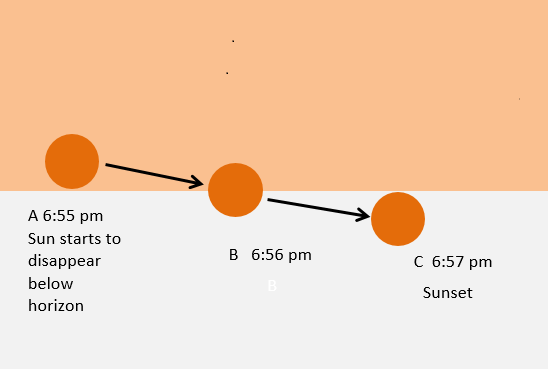
- Secondly, when the Sun is just below the horizon the Earth’s atmosphere bends the Sun’s rays, causing them to appear just above the horizon. This bending of light is known as refraction and has the effect of slightly extending the hours of daylight.
Taken together, these two effects mean that there are slightly more than 12 hours of daylight at the equinox. The date on which there (almost) exactly 12 hours of daylight and 12 hours of darkness is called the equilux (although this term is not widely used and is so rejected by my spelling checker 😉 ). In London the equilux occurs on 25 September, three days after the equinox. For other locations on the Earth it will occur on different dates
When does Autumn (Fall) begin?
Although I started this post by saying that September 23 is the first day of the Northern Hemisphere autumn, there is an alternative definition of autumn (Fall to my readers in the US) used by meteorologists and widely used by the public as well. Meteorological autumn consist of the months of September, October and November and so starts on September 1 and finishes on November 30. Similarly, meteorological winter is December/January/February, spring is March/April/May and summer June/July/August. To many people, it makes more sense for the middle of December with its low temperatures and short hours of daylight to be in winter than in autumn!


 Explaining Science
Great explanations! Thank you!
LikeLike
you’re welcome
LikeLike
Am I reading it right that sunrise and sunset are each exactly 1 minute in length? Anyway, I’ve long thought that the beginning of the new year should be around the first day of spring when everything officially starts to comes alive after a long period of sleep, not in the middle of winter as it is now. Am I out in left field on that?
LikeLike
At the latitude of London, It is roughly two minutes from when the bottom of the Sun disappears below the Horizon to when the last rays from the top of the Sun disappear below the horizon.
At higher latitudes it takes a longer time and at lower latitudes it takes a shorter time
LikeLiked by 1 person
The 25th of December is inexorably linked to the 25th of March (The Annunciation day), the 84th day in the Roman calendar.
LikeLiked by 2 people
🙂
LikeLike
Nice work Steve! as usual, well-phrased & useful diagrams.
Please excuse a totally non-scientific comment:
Presumably the builders of Stonehenge had a year that started and finished exactly at the solstice. It’s curious that (the Western world at least) adopted a starting point that differed by a few days. The creators of the Julian calendar would certainly have been aware of the difference. In far more recent history, Christmas celebrated an event whose real date we don’t know, so for simplicty it could have been made to coincide with the end of the year.
LikeLike
Thank you David for your interesting comment
LikeLike