
In 2025, for most people in the world the June solstice will fall on 21 June. For those of us living in the the Northern Hemisphere, it is the day of the year when there is the most daylight.
The origin of the word solstice is from two Latin words: sol, which means Sun, and sistere, to stand still. On the days around the solstice, the Sun stops getting higher, appears to stand still at the same height for a few days, and then gets lower in the midday sky. Strictly speaking this is only true for locations north of 23.44 degrees (the Tropic of Cancer) as the video at the end of this post describes.

Maximum height, or elevation, of the Sun, measured in degrees above the horizon.. The graph is for a location 50 degrees latitude North, which is the same latitude as the southern tip of England.
The fact that the Sun’s elevation changes gradually, around the solstice, also means that the amount of daylight changes very little from day to day at this time
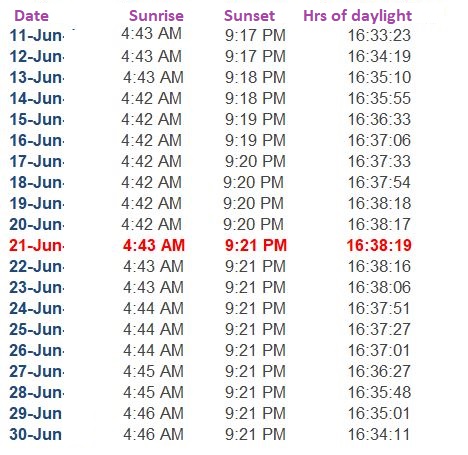
Table of sunrise and sunset times for London (source timeanddate.com 2021).
The Precise definition of the solstice
Although the June solstice is often assumed to occur on June 21 every year, this isn’t quite true. There is a more precise astronomical definition.
The diagram above shows the Earth’s orbit around the Sun. For clarity the sizes of the Earth and Sun have been greatly exaggerated. The Earth’s axis of rotation is tilted at an angle of 23.44 degrees to the plane of its orbit.

.
- During June, the Earth’s North Pole is tilted towards the Sun and the days are longer in the Northern Hemisphere.
- During December, the Earth’s South Pole is tilted towards the Sun and days are longer in the Southern Hemisphere.
- At the equinoxes, neither pole is tilted towards the Sun and the amounts of daylight in the Northern and Southern Hemispheres are equal.
The precise astronomical definition of the June solstice (also called the summer solstice in the northern hemisphere) is the exact point in time when the North Pole is tilted furthest towards the Sun. The times for this event for the years 2025 to 2029 are given in the table below – in UTC (commonly known in the UK as GMT), in Tokyo time (which is 9 hours ahead of UTC) and in Hawaiian time (which is 10 hours behind UTC).
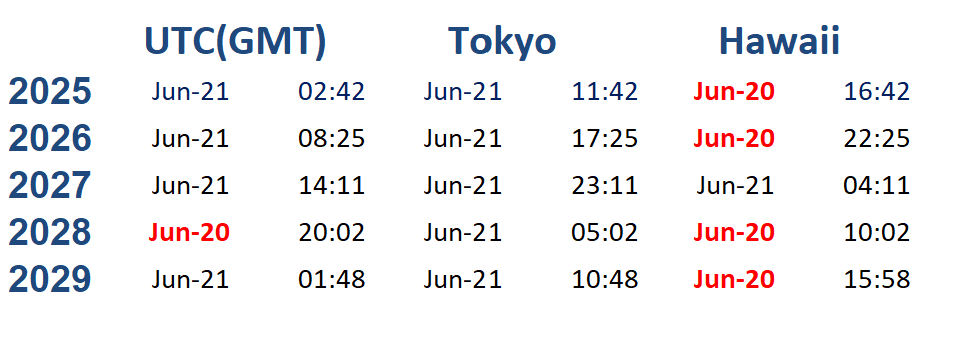
As you can see, the time of the solstice varies from year to year and place to place. During the period 2025 to 2029 it will fall on 20, 21 or 22 June, depending on your longitude (and thus your time zone).
Importance of the solstice to early man
The solstice was of great importance to early man, and many prehistoric sites appear to have been built to celebrate it. One of the most famous of these is Stonehenge, in Wiltshire, England. It is a set of concentric stone circles built between 4000 and 5000 years ago. It was an amazing feat of construction for stone age man. The stone circle is over 30 metres in diameter. The largest stones are more than 9 metres tall, weigh over 25 tonnes and were hauled over 30 km to the site. It is reckoned that the smaller stones were moved from western Wales, a distance of 225 km (Jarus 2023).
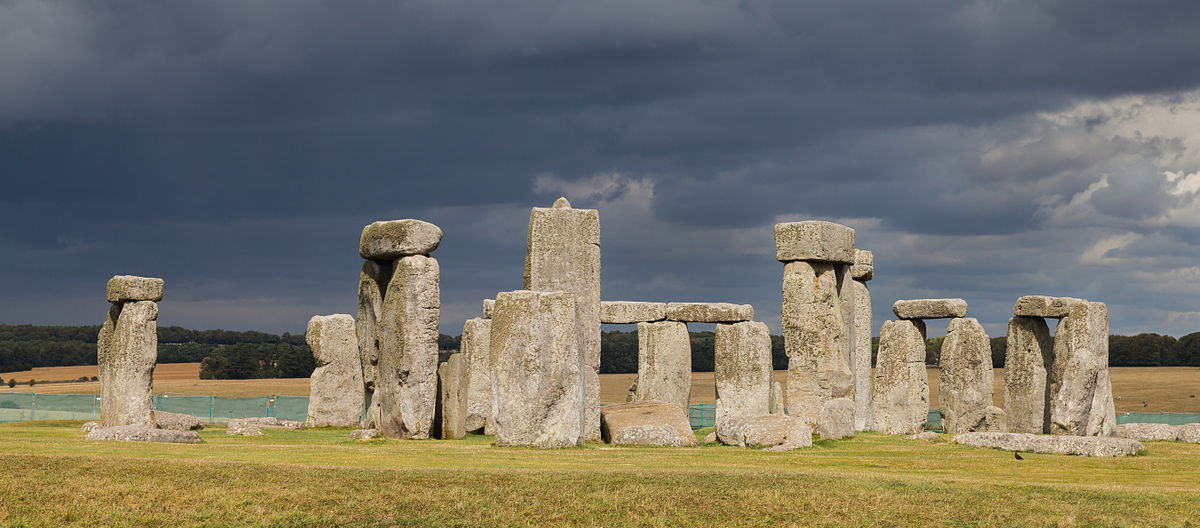
Image from Wikimedia commons
At the centre of Stonehenge is a horseshoe arrangement of five sets of arches called triliths, each containing three stones. The open side of the horseshoe points north east towards a large stone 80 metres away from the main circle, known as the ‘Heel Stone’.
.

Image from Wikimedia commons
The monument is arranged in such a way that, for a few days either side of the June solstice and only at those dates, someone standing in the centre of the horse shoe and facing North East will see the Sun rise over the Heel stone.
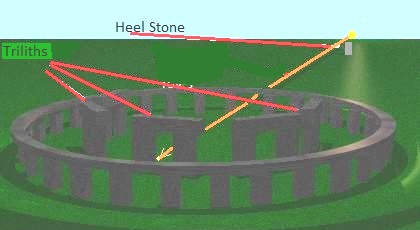
How sunrise at the summer solstice at Stonehenge would have looked after the monument’s construction.
It is amazing that prehistoric man built such a large monument to line up with the June solstice. But early man, without artificial light and central heating, was far more in tune with the natural environment than we are today. The solstice, marking the date after which the days started to get shorter again, would have been an important event for a people living with only natural daylight.
The Solstice today
The solstice is still celebrated at Stonehenge today. Modern groups with ancient origins, such as Druids and Pagans, who revere the natural world more than many modern humans, travel to Stonehenge to watch the Sun rise at the solstice each year.
In the 1970s as a very young child I remember visiting Stonehenge with my parents and was able to walk right up to the stones and touch them. Nowadays, to prevent damage to such an important monument, access is more controlled (and more expensive!) and visits need to be booked in advance. The Stone Circle Experience which allows, visitors to spend 45 minutes inside the stones costs £77 per person (equivalent to $100 at the current exchange rate).
The one exception to this is for the solstice and equinox celebrations where, according to their website, English Heritage who manage the site are still planning to allow free but carefully managed access.
I hope this free access will continue for future generations 🙂

Image credit English Heritage
And finally…
To find out more about the solstice and how it how is has been badly reported even by so called quality news websites, please watch the video below.
Jarus, O (2023) Stonehenge: Facts & Theories About Mysterious Monument, Available at: http://www.livescience.com/22427-stonehenge-facts.html(Accessed: 1 June 2025).
Time and Date (2021 London, ENG, United Kingdom — sunrise, sunset, and daylength, June 2018, Available at: http://www.timeanddate.com/sun/uk/london(Accessed: 2 June 2022).

 Explaining Science
[…] the amount of twilight, after Sun has set but it is not fully dark, is greatest. Even though the June solstice has now passed we can still enjoy the long summer evenings for the next month or […]
LikeLike
[…] the amount of twilight, after Sun has set but it is not fully dark, is greatest. Even though the June solstice has now passed we can still enjoy the long summer evenings for the next month or […]
LikeLike
Today we have a heatwave, a canicule. The next days also. The “dog days”are supposed to have a relationship with Sirius, between july 20 and august 24. Is this canicule too early or nothing to do with Sirius? 🙂
LikeLike
A little too early I think…
I have put together this video about Sirius which also mentions the dog days
LikeLiked by 1 person
Very nice, thank you very much.
LikeLike