
In the International System of Units, the SI system, the standard unit of time is the second. The origin of the word second comes from the Latin secunda pars minuta – the second small part of the division of the hour [1]. The first small part of the division, pars minuta prima, is the minute.
Definition of the Second
The original definition of the Second
There are 86 400 seconds, which is 24 x 60 x 60, in a day, where a “day” means a mean solar day – the natural day determined by the motion of the Sun through the sky. The second used to be defined as 1/86400th of a mean solar day. However, this definition isn’t quite precise enough for accurate scientific work since, as I’ll explain next, the rotation speed of the Earth is slightly irregular which causes the length of the day to vary and also, in the long term, it is slowing down gradually.
The 1960 definition of the Second
In 1960, a new definition for the second was adopted to make it more precise. It was based on the length of the year in 1900:
“The second is the fraction 1/31 556 925.9747 of the tropical year for 1900 January 0 at 12 hours ephemeris time.”
To non-astronomers this phrase “tropical year for 1900 January 0 at 12 hours ephemeris time ” is confusing. It meant the tropical year starting at 12-noon GMT on 31 December 1899.
The modern definition of the second
In the 1960s the use of highly accurate atomic clocks became widespread and in 1967, the second was re-defined in terms of the radiation emitted by the transitions between two energy levels in a caesium atom in an atomic clock. This is still the definition today.
“The SI unit of time is the second defined as follows:
The second is the duration of 9 192 631 770 periods of the radiation corresponding to the transition between the two hyperfine levels of the ground state of the caesium 133 atom” [2].
The length of the 1960 and 1967 seconds are the same, but the 1967 definition has no references to the Earth’s rotation or its orbit around the Sun.
Variation in the length of the Mean Solar Day
The length of an apparent solar day, the period of time between one solar noon, when the Sun is at its maximum elevation, and the next varies significantly throughout the course of the year. It is at its longest, 24 hours 30 seconds, around Christmas Day and is at its shortest, 23 hours 59 minutes 38 seconds, in mid-September. This variation has been known since the time of the Greek astronomer Hipparchus in the second century BCE. Virtually all of it is predictable and has nothing to do with small changes in the Earth’s rotation speed. As explained in my post: How the Length of the Day Changes throughout the year it is caused by the ellipticity of the Earth’s orbit and the tilt of its axis.

The y-axis shows the difference in seconds between the length of an apparent solar day and 24 hours on a given date. So, for example:
- 10 means the apparent solar day is 24 hours 10 seconds long
- 20 means 24 hours 20 seconds
- -10 means 23 hours 59 minutes 50 seconds.
Changes in the rotation speed of the Earth
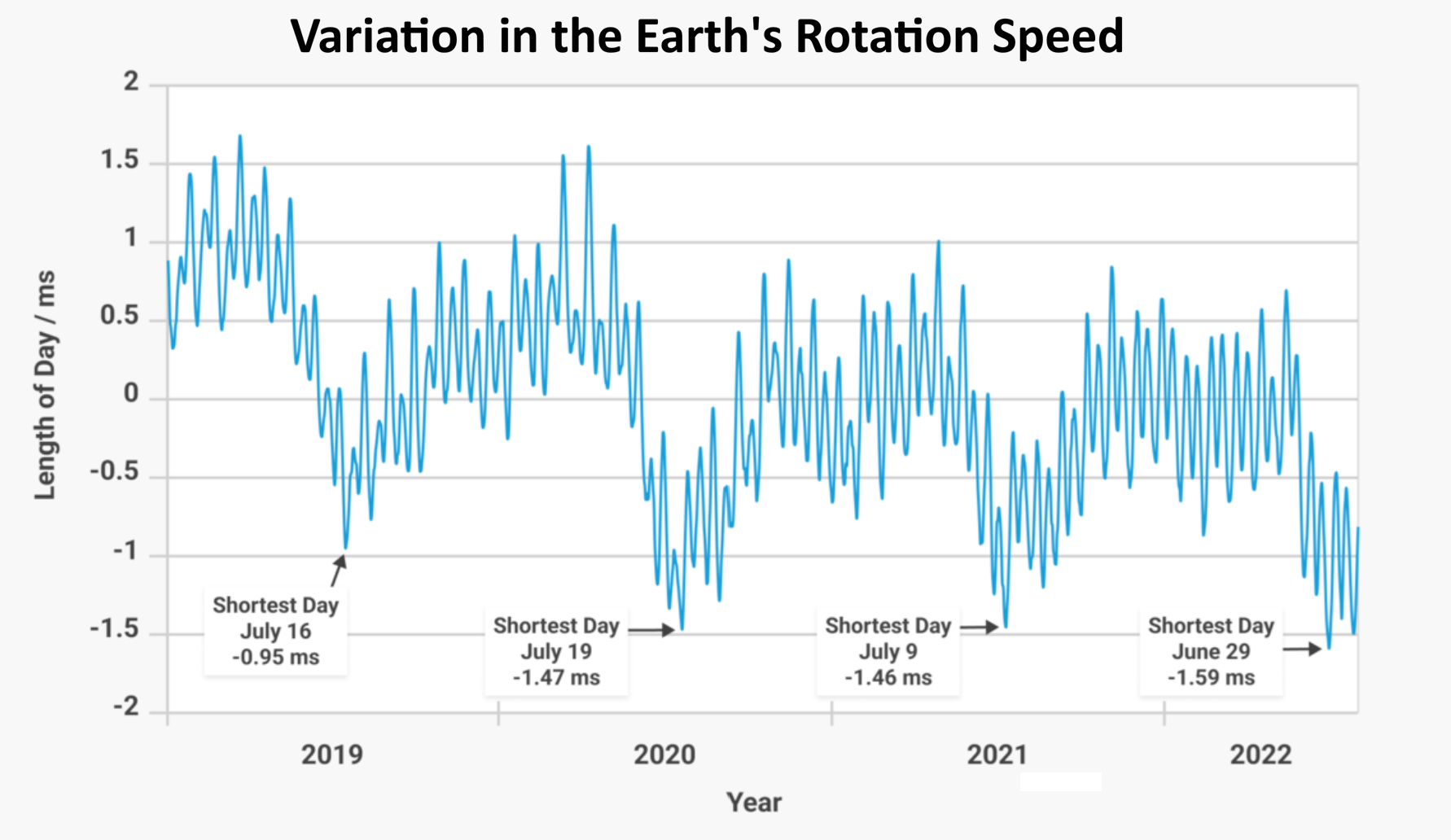
When astronomers and geologists talk about the variation in the length of day these large predictable variations which can be relatively easily calculated are subtracted out, leaving something called the mean solar day. The mean solar day has very small unpredictable variations caused by the change in the Earth’s rotation speed.
The table below was taken from data on the timeanddate.com website.[3] The first column shows the average day length for the days in each year expressed in milliseconds shorter or longer than a standard day of 86400 seconds. The second column the length of the shortest day of the year and the third column the length of the longest day of the year.
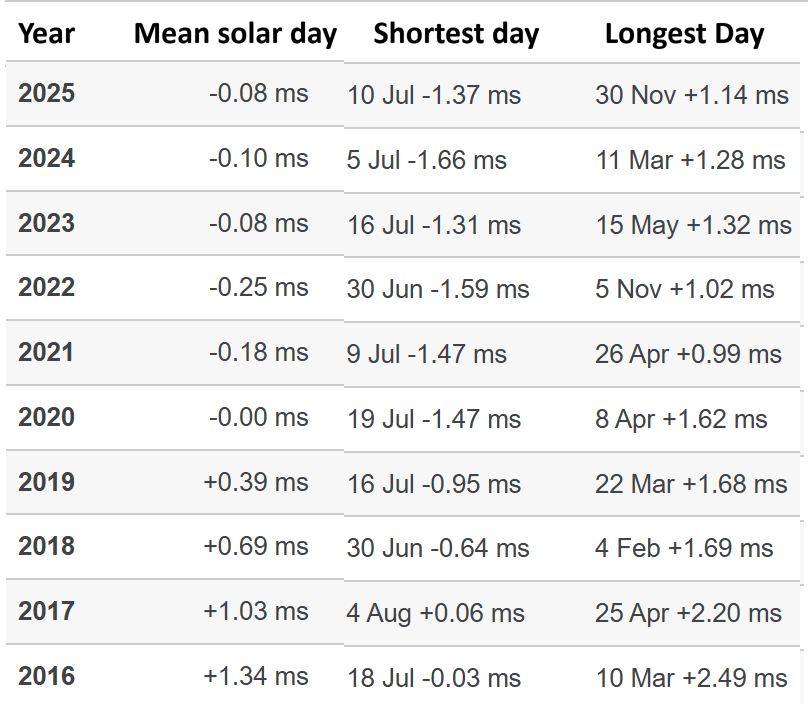
Averaged over the years from 2016 to 2025 the length of a mean solar day was 86 400.00026 seconds i.e. 0.26 milliseconds longer than the standard day. But as you can see there is significant variation. Events such as earthquakes or unusual weather patterns can temporarily speed up or slow down the Earth’s rotation.
The shortest day ever recorded, since the days of accurate atomic clocks, occurred on 5 July 2024 and was 86399.99834 seconds. The longest day in this 10 year period occurred on 10 March 2016 and was 86400.00249 seconds -but this wasn’t the longest day ever recorded. This honour goes to 1 July 1972 which was 86400.00424 seconds long.
The Long Term trend in the Length of Day
In a detailed analysis of astronomical observations stretching back over 2000 years, published in 2016, FR Stephenson and colleagues [4] determined the Earth’s rotation is gradually slowing down at a rate which increases the length of the day by a long-term average of 1.8 milliseconds per century; although there is considerable fluctuation around this average value.
This gradual slowing down is due to tidal friction, caused by the pull of the Moon’s gravity on the Earth’s tidal bulge. The net effect is that some of the energy of the Earth’s rotation is transferred to the Moon, lengthening the day on Earth and boosting the Moon to a higher orbit . This is described in more detail in the days are getting longer.
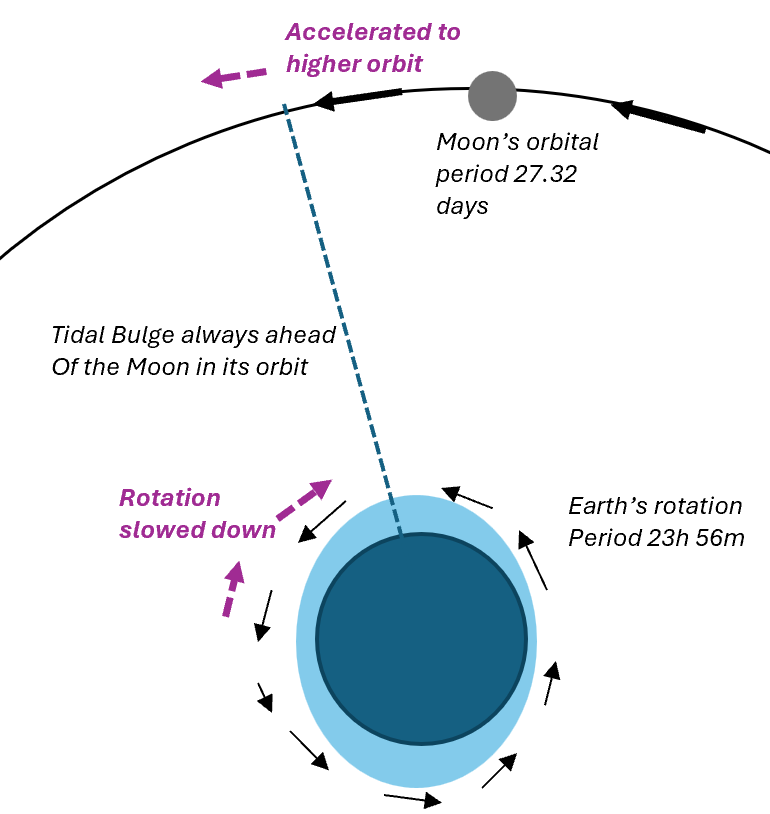
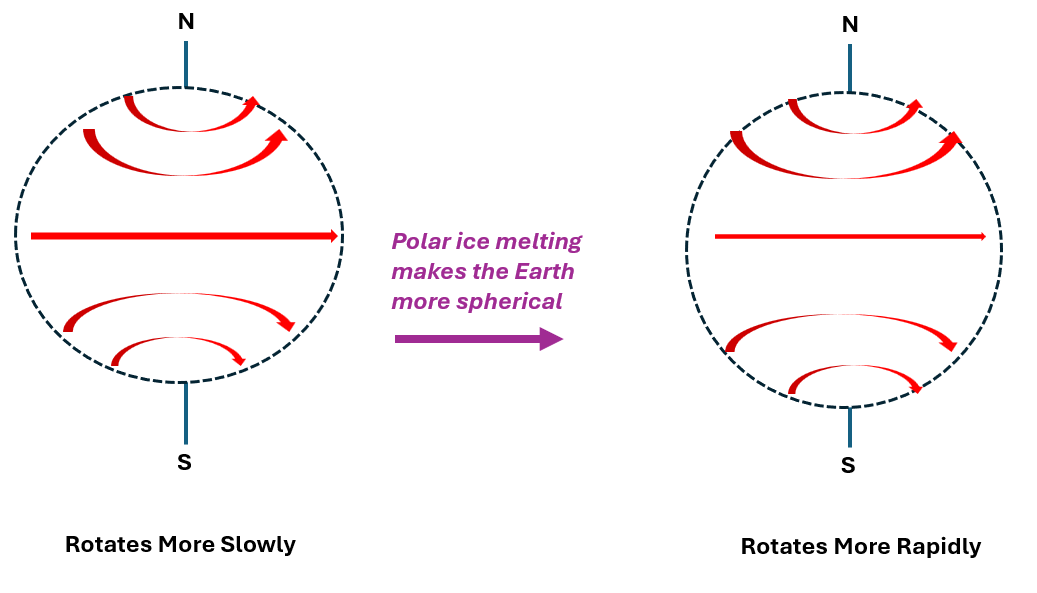
However, FR Stephenson et al [4] calculated that the length of the day should increase at a long term average of 2.3 milliseconds per century if tidal friction were the only cause. However, because they observed a rate of 1.8 milliseconds per century other factors must be at work. One of them is climate change. As glaciers near the poles melt, the weight of this ice is removed, and the land underneath rebounds [5] the Earth becomes less flattened at the poles and as a result its rotation speeds up. If you want to know more about this then see my notes at the end of this post.
The changing length of the tropical year
As mentioned in my previous post on the three types of year
- The Sun is getting slightly lighter at the rate of nearly six million tonnes a second. This solar mass loss weakens the pull of the Sun’s gravity on the Earth and lengthens the year by about 5.61 microseconds a year.
- On top of this steady lengthening, there is a cyclical effect. The tropical year is currently getting shorter by 5 milliseconds per year. It will reach a minimum in about 10000 years’ time and then start getting longer.
But as I’ll talk about now, if we measure the length of the year in days (to be totally precise we should say mean solar days), the gradual increase in the length of the day means that, although the year is getting steadily longer over the long term the number of days in the year is decreasing.
Because of the different factors at work, it is difficult to say with any certainty how much the day will lengthen over the millennia. If we assume that over the long term the day lengthens at an average rate of 2 milliseconds per century, then in 1000 years’ time, a day will be on average 86400.02 seconds long.
If human civilisation still exists in 1000 years time and still uses the second as the fundamental time unit and desires to keep its definition as being almost exactly equal to 1/86400th of a mean solar day, as it currently is, the second would need to be redefined to be slightly longer than its current value.
The longer day means that in 1000 years’ time there would be a slightly smaller number of days (365.242105) in the tropical year compared to the 365.2421897 days today.
The length of the year 10000 years into the future
As the day continues to lengthen, in 10000 years’ time a day will be 86400.2 seconds long. and there will be 365.2413443 days in a year. By this stage there would have to be an adjustment to the calendar so that leap years would be less frequent than they are at present.
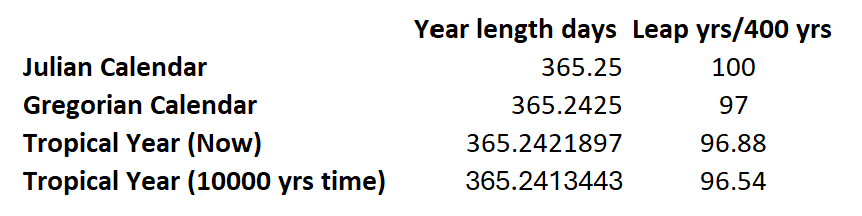
For each calendar the average length of year is given in days. The year length for the tropical year in 10000 years’ time is measured in units of “days in 10000 years’ time” rather than current days. The leap yrs/ 400 yrs column gives the number of leap years in a four hundred year period.
In the Gregorian calendar a year is a leap year if it is divisible by 4, unless it is a century year in which case it must be divisible by 400. This formula gives slightly too many leap years, an additional 0.12, over the 400 year cycle. So a leap year needs to be omitted every 3300 years from the Gregorian calendar to keep it in line with the seasons. In 10000 years’ time, a leap year will need to be omitted every 870 years.
The length of the year in three million years’ time
As the Earth’s rotation continues to slow causing the day to lengthen, in 2866000 years’ time the day will be 86 457.33 seconds long. There will be only 365 days in a year meaning that there will be no need for leap years at all. I wonder if humanity will be around then? :-).
References
[1] etymonline. (2026). etymonline. [online] Available at: https://www.etymonline.com/word/second#etymonline_v_23075 [Accessed 12 Feb. 2026].
[2] BIPM. (2026). Resolution 1 of the 13th CGPM (1967) – SI unit of time (second) [online] Available at: https://www.bipm.org/en/committees/cg/cgpm/13-1967/resolution-1. [Accessed 12 Feb. 2026].
[3] timenanddate.com. (2026). How Long Is a Day on Earth? [online] Available at: https://www.timeanddate.com/time/earth-rotation.html . [Accessed 12 Feb. 2026].
[4] Stephenson, F.R., Morrison, L.V. and Hohenkerk, C.Y. (2016). Measurement of the Earth’s rotation: 720 BC to AD 2015. Proceedings of the Royal Society A: Mathematical, Physical and Engineering Sciences, 472(2196), p.20160404. doi:https://doi.org/10.1098/rspa.2016.0404. [Accessed 12 Feb. 2026].
[5] US,National Ocean Service (2019). What Is Glacial Isostatic adjustment? [online] Noaa.gov. Available at: https://oceanservice.noaa.gov/facts/glacial-adjustment.html. [Accessed 12 Feb. 2026].
Notes
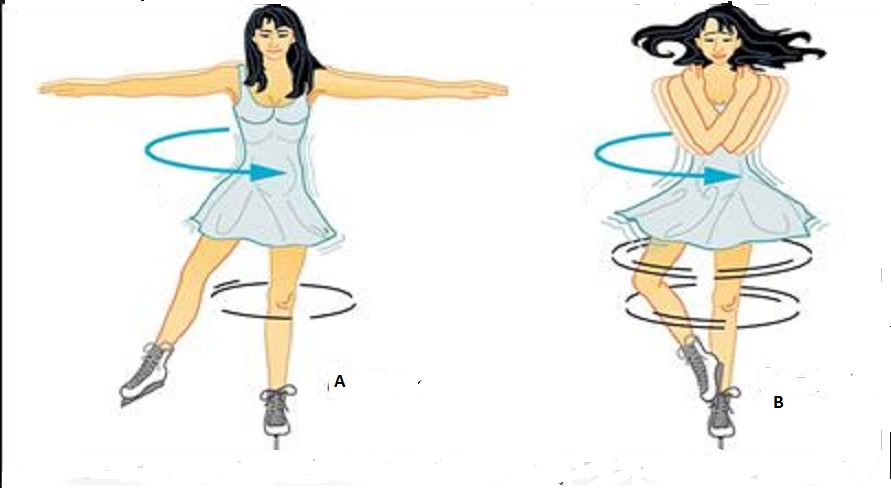
The reason why as the Earth becomes less flattened at the poles and its rotation speeds up is due to a law of physics called the conservation of angular momentum. This causes the rotation of an object to speed up when more of its mass is closer to its rotational axis.
A much more familiar example of this is from the world of ice skating: ice skaters spin more rapidly when they pull in their arms.
If we take the example of the Earth becoming less flattened i.e. more spherical a similar thing happens

 Explaining Science
I doubt it, in answer to your final question! Or at least, not counting fragments of seconds…… I’m blown away by how much brain effort must have into working all this out over the centuries – millenia even, given the ancient Greeks ref. There, you have even got me talking in time-bytes.
LikeLike
Yes it is a fascinating topic, I guess whether or not humanity will be around in millions of years time is something we can only speculate about.
We have got to through through the next few decades first ! 🙂
Steve
LikeLike
How about just the next three years?😜
LikeLiked by 1 person
Yes indeed !! 🙂
LikeLike