The Impact of Earth’s Rotation on Time Measurement

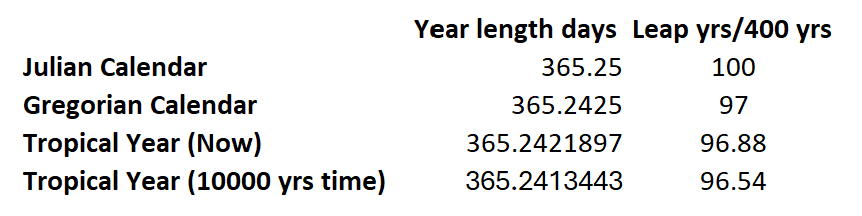
The year length and number of leap years in different calendars

The standard unit of time in the SI system is the second, historically defined as 1/86400th of a mean solar day. The modern definitions since 1967 is based upon a caesium atom transition. The Earth's rotation is gradually slowing down meaning that in thousands of years' time the second may need to be redefined to bring it back in line with the mean solar day.
No more leap seconds

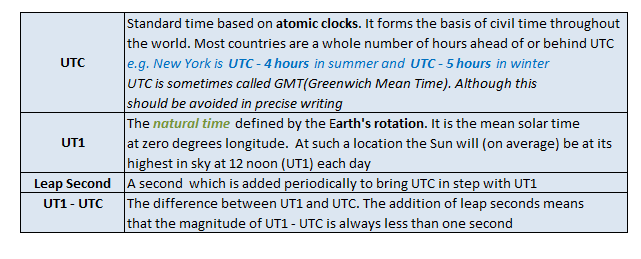
With all the events going on in the world it passed almost unnoticed that a decision was made recently to abolish the leap second. The resolutionĀ  was made on 18 November 2022 during a meeting held in ParisĀ  held by the International Bureau of Weights and Measures. What is a leap second? The length of… Continue reading No more leap seconds

December 31 2016 Leap Second

On New Year's EveĀ an extra second will be addedĀ to the end of the day. This extra second is called a leap second. As I'll explain later, leap seconds need to be added periodically to bring the time we measure with accurate atomic clocks in line with the natural time which results fromĀ the rotation of the… Continue reading December 31 2016 Leap Second

Jun 30 2015 – Leap Second

On June 30 2015 an extra second will be inserted into the very end of the day. This extra second is called a leap second.   Why do we need leap seconds? Although we take the average length ofĀ a day to be 24 hours, the mean solar day, or average "natural" day measured by the… Continue reading Jun 30 2015 – Leap Second

The Days are Getting Longer

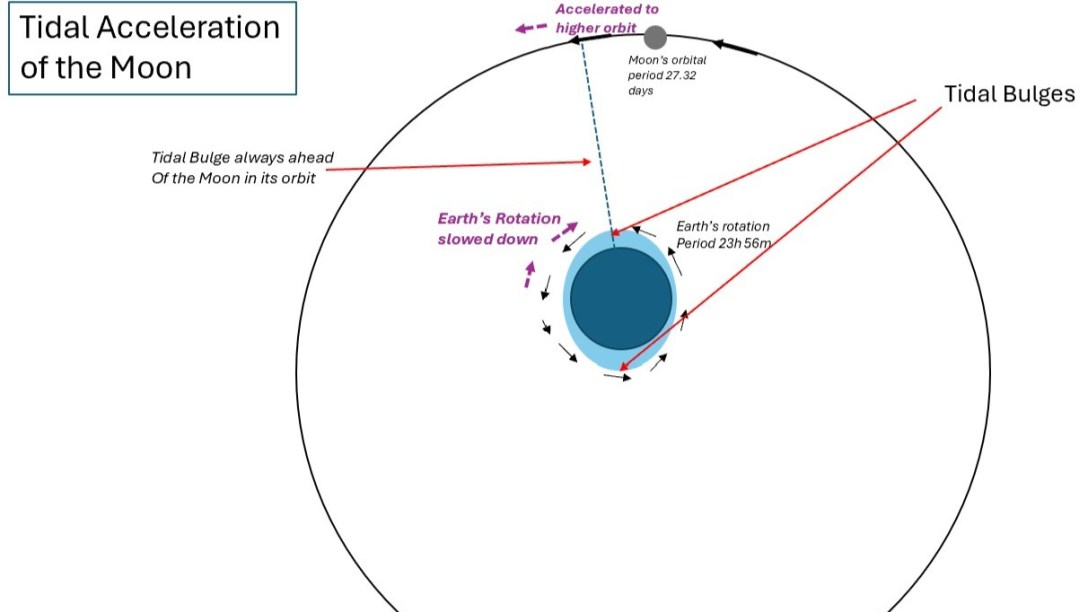
Tidal Friction From the Mon slowing the Earth's rotation

The Moon's gravitational influence creates tides on Earth, with tidal bulges occurring on both sides of the planet. This interaction gradually slows Earth's rotation, lengthening days and causing the Moon to drift away at about 3.8 cm per year. Past proximity may have facilitated the emergence of early life due to stronger tidal forces.