
Revised and Updated November 2026
With all the events going on in the world in 2022 it passed almost unnoticed that a decision was made to abolish the leap second. The resolution was made in November 2022 at a meeting held in Paris held by the International Bureau of Weights and Measures. [1]. This decision was ratified in October 2026 [2].
What was a leap second?

The length of a day for civil timekeeping purposes is precisely 24 hours. However, due to the slowing of the Earth’s rotation, the mean solar day, or average “natural” day measured by the Earth’s rotation, is now slightly longer than this. In the year 1900 the mean solar day was almost exactly 24 hours, but averaged over the last 20 years it is now around 24 hours 0.6 milliseconds. The cumulative effect of using a civil day slightly shorter than the mean solar day means that standard time measured by atomic clocks would slowly drift away from the time standard defined by the Earth rotation (which astronomers call UT1) if no adjustments were made.
To bring the time measured by accurate atomic clocks to within a second of UT1, a leap second was added occasionally. This always occured at the end of the day on either 30 June or 31 December.
So, in summary, we have

To complicate matters further, the speed of the Earth’s rotation is variable and events such as
- large earthquakes
- movements in the Earth’s crust
- melting of glaciers and
- changes in the mantle (the region of the Earth below the crust)
may temporarily speed it up. So, although the trend over decades and centuries is that the days are getting longer, over shorter time-scales the average length of a day may actually decrease.
The table below was taken from data on the timeanddate.com website.[3] The first column shows the average day length for the days in each year expressed in milliseconds shorter or longer than a standard day of 86400 seconds. The second column the length of the shortest day of the year and the third column the length of the longest day of the year.
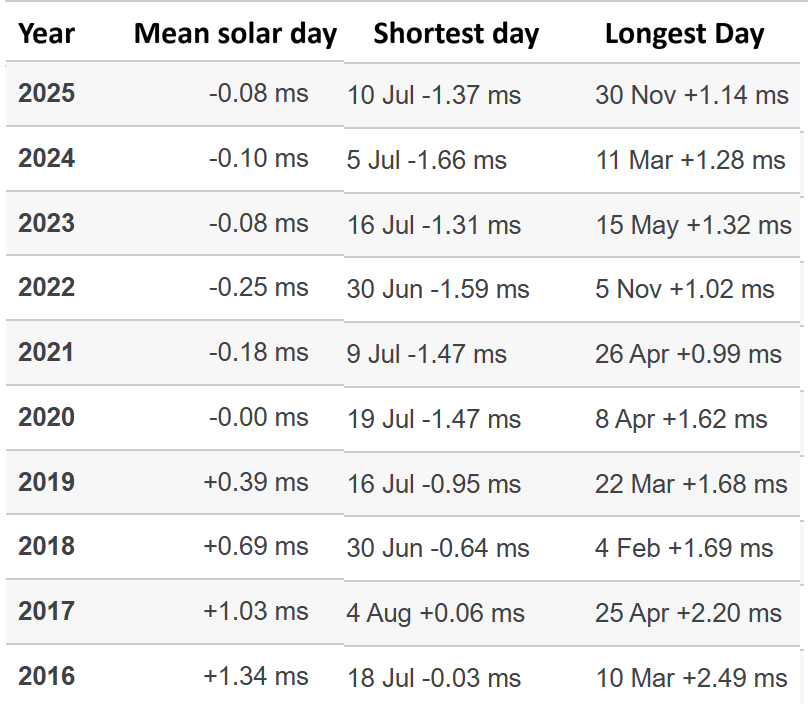
The shortest day ever recorded, since the days of accurate atomic clocks, occurred on 5 July 2024 and was 86399.99834 seconds. The longest day in this 10 year period occurred on 10 March 2016 and was 86400.00249 seconds -but this wasn’t the longest day ever recorded. This honour goes to 1 July 1972 which was 86400.00424 seconds long.
Despite the recent temporary speeding up of the Earth’s rotation, in a detailed analysis of astronomical observations stretching back over 2000 years, published in 2016, FR Stephenson and colleagues [4] determined the Earth’s rotation is gradually slowing down at a rate which increases the length of the day by a long-term average of 1.8 milliseconds per century.
.
The unpredictability of the Leap second
This variation means that, unlike the case of leap years, where there are precise rules for determining whether or not a given year will be a leap year, it was not possible to say years in advance when there would be a leap second. A body called the International Earth Rotation and Reference Systems Service (www.iers.org) decided from accurate measurements of the Earth’s rotation when the next leap second will occur.
Leap seconds were always inserted at midnight (GMT). The final leap second was inserted at 23:59:60 at 31 December 2016, Greenwich Mean Time (GMT) . In the UK which uses GMT in the winter months, it occurred just before midnight. In different parts of the world the leap second was added at different local times. New York is 5 hours behind GMT, so the extra second was added at 18:59:60 on 31 December 2016 local time. Beijing is 8 hours ahead of GMT and the extra second was added at 07:59:60 on 1 January 2017
This announcement of a leap second used to be made around five months in advance. The announcement of the final leap second was on 6 July 2016.

In the past when leap second were applied, a number of data centres and websites around the world experienced system problems and crashed. They could not cope with a minute which contains 61 seconds and interpreted this unforeseen event as a system failure.
The Google approach for the 2016 leap second- smearing time
For the December 2016 leap second Google (and many other organisations)used an interesting solution to the problem. For the 20 hour period from 2 pm on 31 December 2016 to 10 am on 1 January 2017 Google adjusted the normal rules of timekeeping. Instead of normal seconds, they used a “Google Second” which was fractionally longer than the usual second. So rather than of adding an extra second before midnight, which might have caused system errors, they spread the extra second throughout this 20 hour period.

What will happen now the leap second has been abolished?
Following the earlier resolution, in October 2026, the maximum difference between UTC and UT1 has been increased to one hour [2]. So, in future UTC will not be tightly locked to the mean solar time on the zero longitude line.
As the Earth’s rotation slows, over the centuries UTC will drift ahead of UT1 (and thus GMT) until an entire leap hour is needed to bring it back in line. However, no one reading this post will be around to experience the leap hour, it will take thousands of years before this happens 🙂 and I sure that there will be many more changes to how UTC is defined before we get to that point!
And Finally….
If you’d like to find out more about the difference between local and mean solar time, you may be interested in this Explaining Science video.
References
[1] General Conference on Weights and Measures (CGPM) (2022). Resolution 4 of the 27th CGPM (2022) – on the use and future development of UTC. BIPM. [online] Available at: https://www.bipm.org/en/cgpm-2022/resolution-4 [Accessed 4 Nov. 2026].
[2] BIPM. (2026). Resolution 5 (2026) – BIPM. [online] Available at: https://www.bipm.org/en/cgpm-2026/resolution-5 [Accessed 4 Nov. 2026].
[3] timenanddate.com. (2026). How Long Is a Day on Earth? [online] Available at: https://www.timeanddate.com/time/earth-rotation.html . [Accessed 4 Nov. 2026].
[4] Stephenson, F.R., Morrison, L.V. and Hohenkerk, C.Y. (2016). Measurement of the Earth’s rotation: 720 BC to AD 2015. Proceedings of the Royal Society A: Mathematical, Physical and Engineering Sciences, 472(2196), p.20160404. doi:https://doi.org/10.1098/rspa.2016.0404. [Accessed 4 Nov. 2026].
Discover more from Explaining Science
Subscribe to get the latest posts sent to your email.


[…] For more information, read No more leap seconds. […]
LikeLike
I’m a bit confused, but after reading a book called Free Time (a Buddhist take on the matter), I’m no longer sure time is more than a construct anyway….. must go, things to do, people to see, before……!!!
LikeLike
🙂
LikeLike
Interesting information
LikeLike
Thank you
LikeLike
X
LikeLike