Three years ago my first ever post was about Saturn's moon Enceladus. It is interesting that once again this small moon is in the headlines as a possible place on which there could be life. https://www.nasa.gov/press-release/nasa-missions-provide-new-insights-into-ocean-worlds-in-our-solar-system The Science Geek
Tag: Mars
Mars
The Evening Star-Venus.
Anybody who has looked up into the western sky after sunset in the past month will have noticed a brilliant white object - the planet Venus, sometimes called the Evening Star. It is brighter than any other planet and ten times brighter than the brightest star Sirius. The "Evening Star" Venus next to the Moon… Continue reading The Evening Star-Venus.
What Went Wrong with the Schiaparelli Mars landing
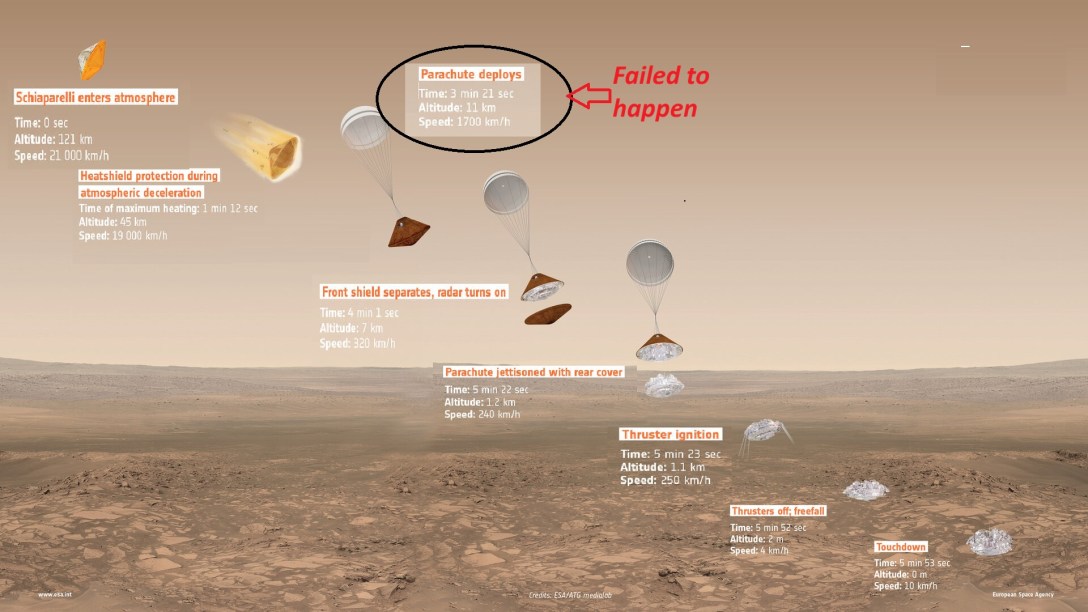
The Schiaparelli probe tragically failed to land on Mars due to its parachute malfunctioning, resulting in a crash at high speed. Despite this setback for the European Space Agency, the ExoMars Trace Gas Orbiter remains successful, set to study methane in the Martian atmosphere, making the overall mission worthwhile.
Schiaparelli’s landing on Mars
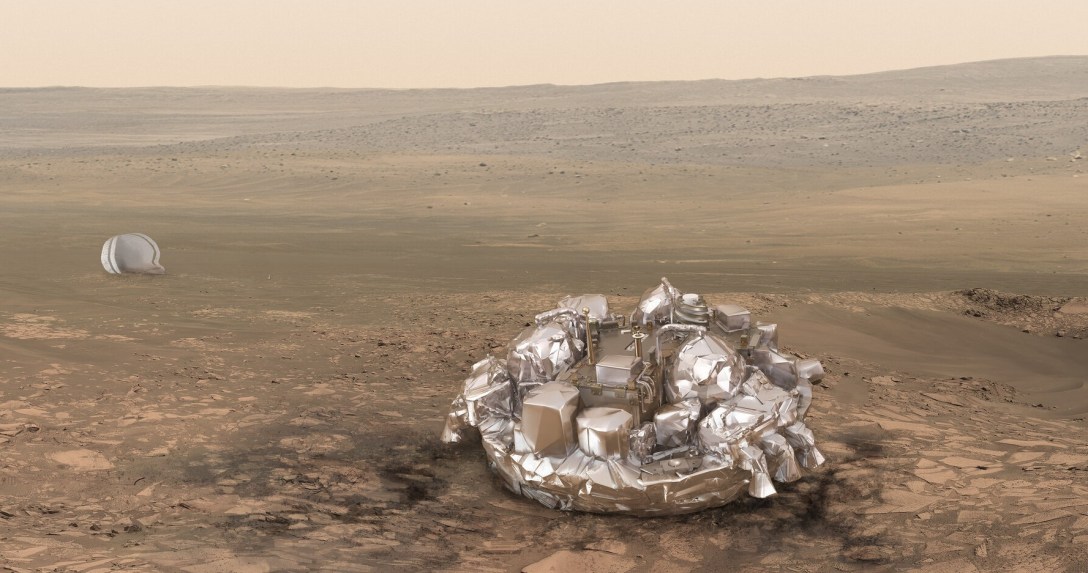
The Schiaparelli Spacecraft tragically failed to land on Mars, crashing at 300 km/h. Launched on March 14, 2016, with the ExoMars Trace Gas Orbiter, it aimed to study Martian surface conditions. It only planned to be operational for a week because it lacked solar panels, relying solely on a non-rechargeable battery.
Giving Venus an artificial magnetic field
As discussed in a previous post, in the far future humanity may decide to terraform Venus so that the planet has a similar temperature and atmosphere to that which currently exists on the Earth. However, the lack of a global magnetic field would cause significant obstacles to humans settling on Venus. Without this protective shield inhabitants would be exposed to the… Continue reading Giving Venus an artificial magnetic field
 Explaining Science