
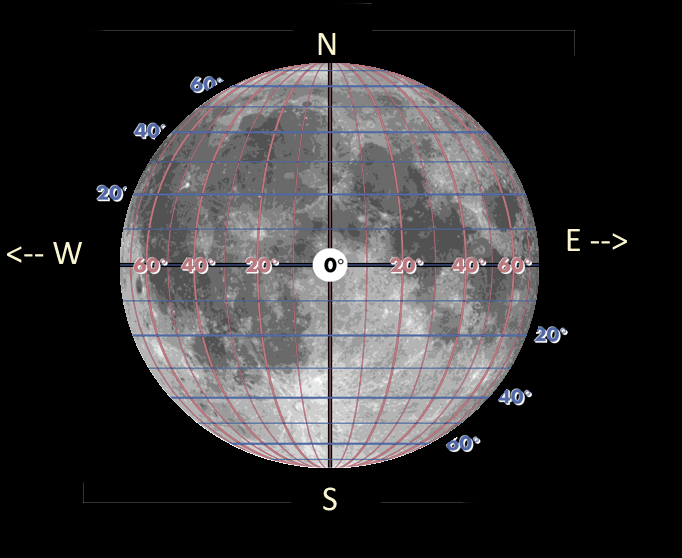
Latitude and Longitude on the Moon and the Planets

Revised 18 December 2025 We're all familiar with specifying a location by its latitude and longitude, but I thought it would be interesting to write a post about latitude and longitude on other bodies in the Solar System. Locations on the surface of the Moon are given a latitude and longitude just like they are… Continue reading Latitude and Longitude on the Moon and the Planets

Gliese 710: The Closest Future Star Encounter

Updated 21 November 2025 In this post I’ll talk about the star Gliese 710. In 1.3 million years’ time it is forecast to pass within 0.166 light years of the Solar System, 25 times closer than Proxima Centauri which is our current nearest star (excluding the Sun of course). The close approach of Gliese 710… Continue reading Gliese 710: The Closest Future Star Encounter

Surveying the Cosmos – Part II

In a previous post  I talked about the Large Synoptic Survey Telescope (LSST), a large telescope being built in Chile which will spend 90% of its time surveying most of the sky a total of  1000 times over a 10 year period (in the remaining 10% it will revisit areas of specific interest).  In this… Continue reading Surveying the Cosmos – Part II

The Future of the Sun

The Sun is the star at the centre of our Solar System and its sunlight provides energy which is essential for life on Earth. The two key natural units of measuring periods of time, the year and the day, are both based upon the Earth's motion with respect to the Sun and in many ancient cultures… Continue reading The Future of the Sun

Dark Matter

Revised and re-written 11 December 2025 This post about dark matter and is part of my series on cosmology, the study of the origin and evolution of the Universe as a whole. As readers of Dark Energy in the Universe will recall, dark matter makes up about 27% per cent of the mass of the Universe. Evidence for… Continue reading Dark Matter