Updated 16 December 2025 On 4 October 1957, the Soviet Union launched the first artificial satellite, Sputnik 1, into orbit around the Earth. This is considered to be the beginning of the space age. Before this date there were no human made satellites in space but on every single day since then there have been artificial… Continue reading 4 October 1957 – the start of the space age
Tag: Space
12-13 August 2017 – the Perseids
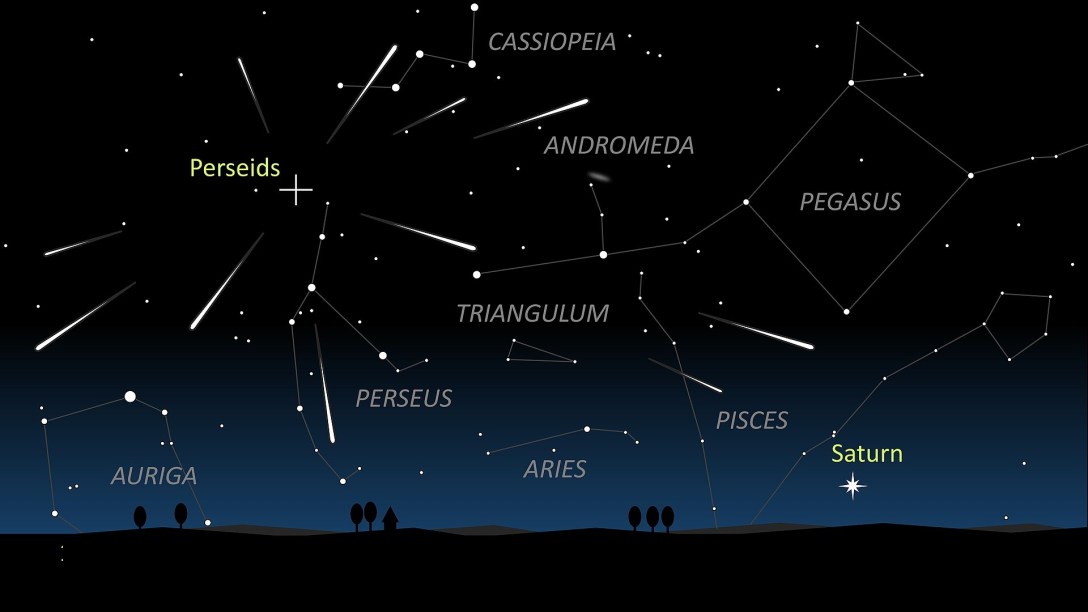
In this post originally published in 2017 I talk about the Perseids meteor shower. Occurring annually from late July to mid-August, it offers an alternative for those who were unable to see the August 2017 eclipse. Best observed just before dawn in dark areas, the meteor shower is caused by the Earth passing through debris from the comet Swift-Tuttle. Clear skies enhance the viewing experiences!
Discoveries made by Voyager 1 and 2 in the Solar System

On August 20, 1977, NASA launched Voyager 2 to explore the Solar System's outer planets, followed by Voyager 1. Both spacecraft made significant discoveries, including active volcanoes on Jupiter's moon Io and Titan's dense atmosphere with potential hydrocarbon lakes. They now send data from interstellar space and contain a golden record intended for any potential alien finders.
Life in our galaxy?
With the recent discovery of three planets orbiting the red dwarf star Trappist-1 which have a similar size, mass and average surface temperature as the Earth, there has been considerable speculation as to whether one or more of these planets supports life. What the surface of Trappist 1f, one of the planets orbiting Trappist 1, might look… Continue reading Life in our galaxy?
The Trappist-1 system.
Revised 12 December 2025 Many of you will be aware of the discovery announced back in February 2017 of seven Earth-sized planets orbiting a small cool star known as Trappist-1. (Gillon et al 2017). In this post I'll talk about this exciting finding and the possibility that some of these planets might support life. The planet around… Continue reading The Trappist-1 system.

