
Revised March 2026
Although the Moon is less massive than the Earth its gravitational field still has significant effects on the Earth. The most noticeable of these are tides – the twice daily rising and falling of sea levels.
The principle cause of tides is that the pull of the Moon’s gravity is stronger on the side of the Earth closest to the Moon and weaker at the side facing away.
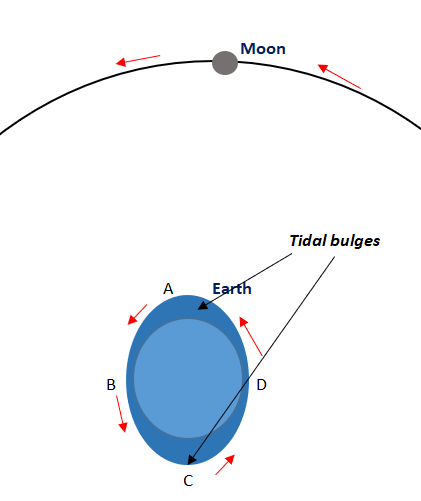
This causes a tidal bulge in the area closest to the Moon, shown as A in the diagram below. Another tidal bulge also occurs in the area of the Earth furthest away from the Moon, where the Moon’s gravity is weaker than its average value – C in the diagram.
Slowing of the Earth’s rotation due to Tidal Friction
The Earth rotates on its axis in around 24 hours, whereas the Moon takes 27.3 days to complete an orbit of the Earth. Because the Earth rotates on its axis faster than the Moon revolves around the Earth, the tidal bulge is always a little bit ahead of the moon.
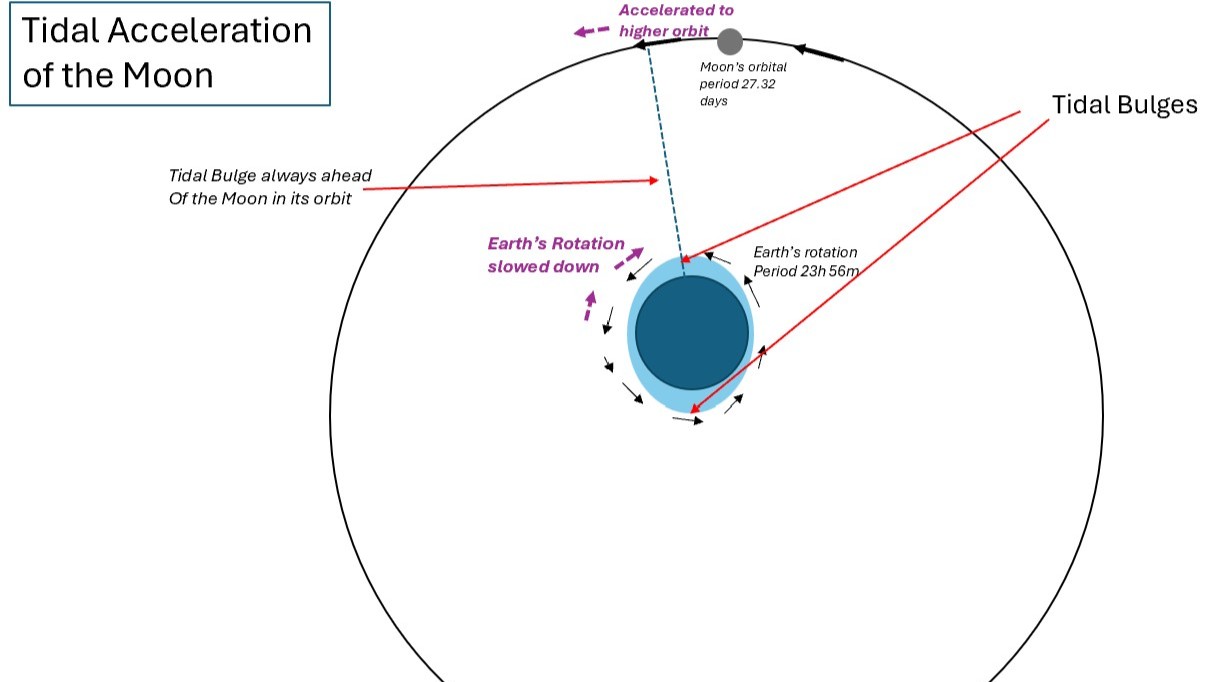
This causes two separate effects: one on the Moon and one on the Earth.
- The pull of the tidal bulge ahead of the Moon causes the Moon to accelerate very slightly. In effect the Moon saps the Earth’s rotational energy, causing it to gradually spiral away from the Earth.
- As the Earth’s rotational energy is sapped, it rotates more slowly. This causes the length of the day to grow gradually longer.
The sapping of the Earth’s rotational energy by the Moon is not 100% efficient. Rather than all of the extracted energy going to accelerate the Moon away from the Earth, some of it is dissipated as heat – warming up the oceans slightly.
How fast is the Moon moving away from the Earth?
Experimental equipment left on the Moon by the Apollo astronauts has confirmed that the average distance from the Earth to the Moon is increasing at the rate of about 3.8 cm a year. So, the Moon is now over 2 metres farther away from the Earth than it was at the time of the Apollo 11 landing in 1969.
The Lengthening of the Day
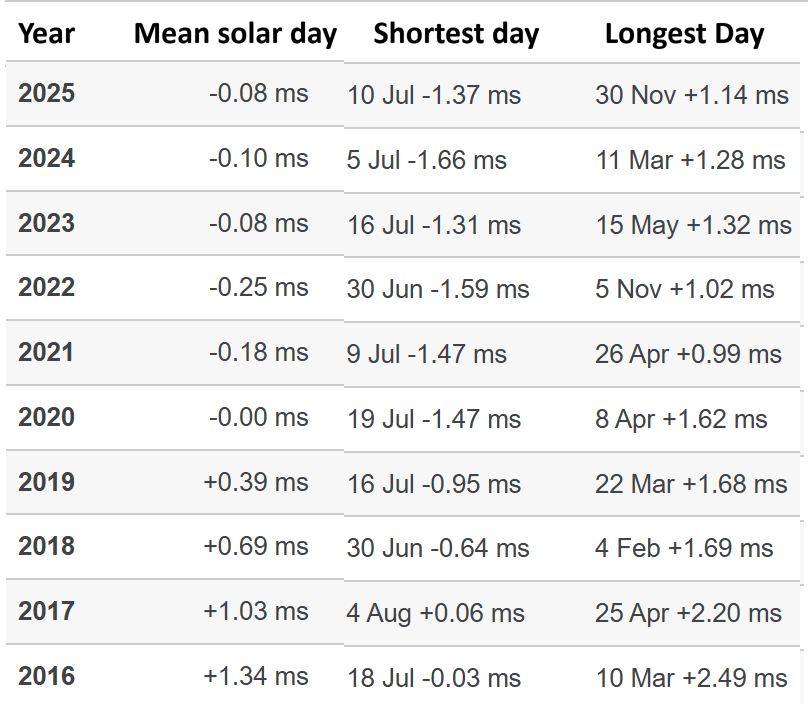
In the year 1900 a mean solar day (the term astronomers use for the day measured by the rising and setting of the Sun) was exactly 24 hours in length. However, analysis of astronomical observations over more than two millenia has shown that the day has been getting longer at a rate of 1.8 milliseconds per century. [1] Although there is considerable variation from year to year.
The table below was taken from data on the timeanddate.com website.[2 ] The first column shows the average day length for the days in each year expressed in milliseconds shorter or longer than a standard day of exactly seconds. The second column the length of the shortest day of the year and the third column the length of the longest day of the year.
Other factors affecting the speed of the Earth’s rotation
Like many things in science, there are multiple causes of a single phenomenon (in this case the change in the Earth’s rotation speed). If tidal friction were the only cause, the day length would increase at a rate of 0.0023 seconds per century. However, the Earth’s rotation is erratic and events such as a large earthquake can temporarily speed it up. Also, since the end of the last ice age the Earth has been changing shape to become less flattened at the poles. This has caused a temporary speeding up of the Earth’s rotation – shortening the day by 0.0006 seconds per century. This is why we observe an average increase of only 0.0018 seconds per century. This is described in more detail in my post The Impact of Earth’s Rotation on Time Measurement
Leap Seconds
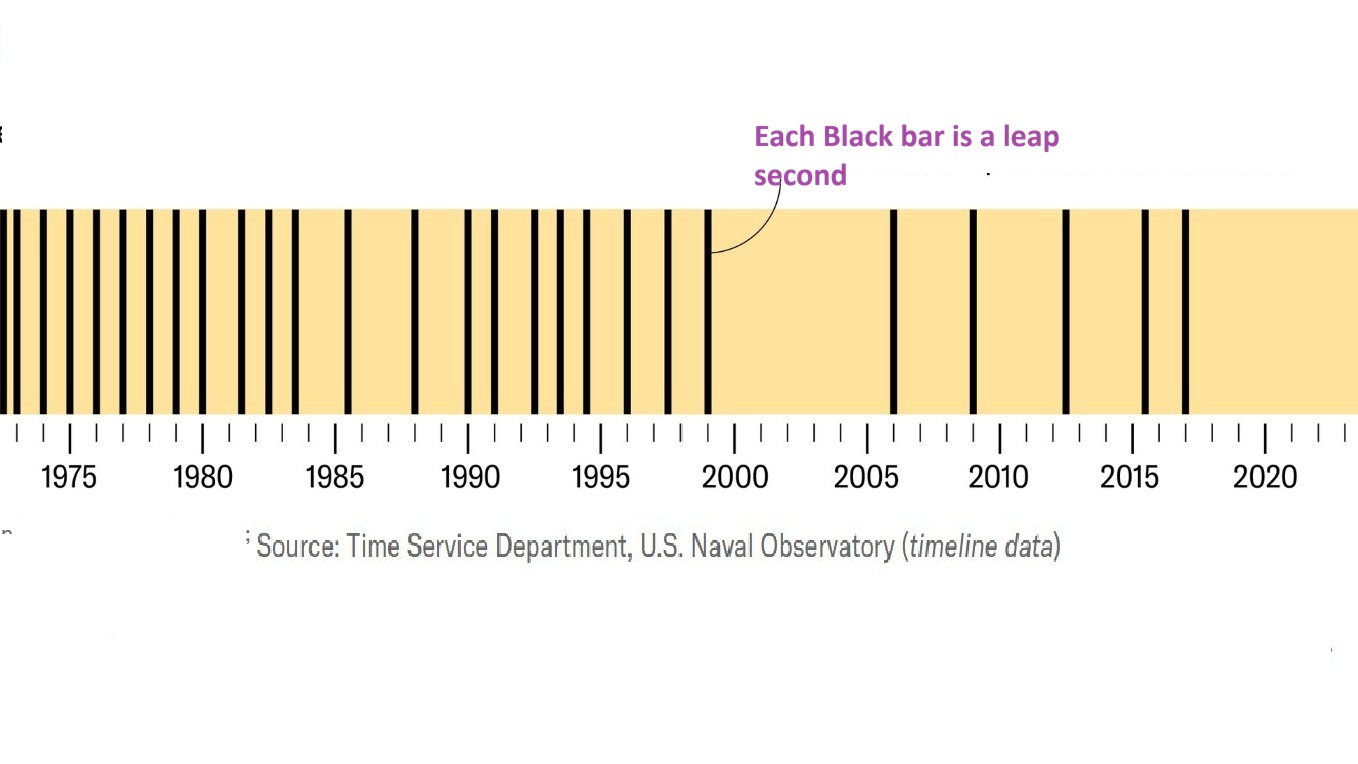
Because the day, defined by the Earth’s rotation, is slightly longer than 24 hours, every so often an extra second, known as a leap second, needs to be added to ensure that the time we use on a day to day basis lines up with the “natural” time defined by the Earth’s rotation to within one second. Leap seconds are always added just before midnight on 30 June or 31 December. They were first introduced on 30 June 1972 and since then there have been 27 leap seconds. Recently the Earth’s rotation has sped up slightly and there have been no leap seconds since 31 December 2016. At the time of writing the most recent leap second was on 31 December 2016.
How Long will a Day be in the Far Future
In the future, as the Earth’s rotation continues to slow down, the days will continue to get longer and longer. As this happens, we will have to add leap seconds more often to ensure that the day that we use aligns with the day defined by the Earth’s rotation. Unless of course we decide the make the hour, minute and second slightly longer than they are today!!
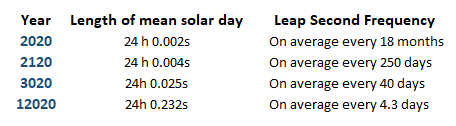
This table assumes the length of a mean solar day increases at 0.0023 seconds per hundred years.
As you can see, assuming that humanity is still around (;-) ), in 10,000 years’ time in the year 12020, we would have to add a leap second every 4.3 days. By then instead of having frequent leap seconds, we might choose to redefine how long a second is. We could have a ‘new second’ which would be slightly longer than the second we currently use, 60 of these new seconds would make a ‘new minute’, and 60 new minutes would make a ‘new hour’. With these new units then a day would be exactly 24 hours long– but not “hours” as we now know them.
The Origins of Life?
Because the Moon has been getting farther away from the Earth, in the distant past the Moon was much closer than it is today. When the Moon was first formed about 4.5 billion years ago it was only 25 000 km away. The Moon’s proximity to Earth meant tidal forces were much stronger and when the first primitive single celled life forms emerged, about four billion years ago, the Moon was already around 138,000 km away from Earth, 36% of its current value. At this time, the Earth rotated faster and a day was around 18 hours in length. It would have taken only eight of these 18-hour days for the Moon to complete one orbit around the Earth.
Four billion years ago the tidal forces would have been 22 times larger than they are today. There would have been a difference of hundreds of metres between the water levels at low and high tides and a large number of tidal pools These would have filled and evaporated on a regular basis to produce higher concentrations of amino acids than found in the seas and oceans, which facilitated their combination into large complex molecules. These complex molecules could well have been the origin of the first single celled lifeforms.
I hope you’ve enjoyed this post,. If you’d like to know more I’ve written an e-book about the Moon, It is available at a nominal cost in the Amazon Kindle store and for those of you who have signed up to Kindle unlimited it is free.

References
[1] Stephenson, F.R., Morrison, L.V. and Hohenkerk, C.Y. (2016). Measurement of the Earth’s rotation: 720 BC to AD 2015. Proceedings of the Royal Society A: Mathematical, Physical and Engineering Sciences, 472(2196), p.20160404. doi:https://doi.org/10.1098/rspa.2016.0404. [Accessed 7 Mar. 2026].
[2] timenanddate.com. (2026). How Long Is a Day on Earth? [online] Available at: https://www.timeanddate.com/time/earth-rotation.html . [Accessed 7 Mar 2026]

 Explaining Science
[…] These results are mentioned in a earlier put up The Days are getting Longer. […]
LikeLike
[…] These effects are discussed in a previous post The Days are getting Longer. […]
LikeLike
[…] These results are mentioned in a earlier put up The Days are getting Longer. […]
LikeLike
[…] These effects are discussed in a previous post The Days are getting Longer. […]
LikeLike
[…] day measured by the Earth’s rotation, is now slightly longer than this. As discussed in a previous post, this is due to the slowing down of the Earth’s rotation (see note 1). In the year 1900 a […]
LikeLike
[…] day measured by the Earth’s rotation is now slightly longer than this. This is actually due to the slowing of the Earth’s rotation. See Note 1. At this present time, in the early 21st century, it is actually around 24 hours […]
LikeLike
[…] those of you who have read my previous post “The Days are Getting Longer” will recall, the Moon is gradually gettting further away from the Earth at a rate of about 4 cm per […]
LikeLike
[…] as readers of my earlier post “The Days are Getting Longer” will know, the Earth’s rotation is gradually slowing down as its energy is transferred to the […]
LikeLike
[…] The Earth’s rotation is slowing down, causing the length of a day to get gradually longer. In the year 1900 a mean solar day was 24 hours long. Now, in the early 21st century, a mean solar day is actually 24 hours 0.002 seconds long. To prevent the day we measure using accurate clocks from drifting away from the “natural day” we need to add an second called a leap second ever few years. For more information on this see my post: The Days are Getting Longer. […]
LikeLike
I can see why there’s a bulge where the water is pulled by the moon’s gravitational pull but why is there a bulge at the other side of the earth?
LikeLike
Thank you for your comment. At first sight it appears strange that we have two high tides per day and the second high tide occurs on the side of the Earth furthest away from the Moon. The reason for the second high tide on the side of the Earth facing away from the Moon is as follows.
The gravitational field created by the Moon exerts a slightly stronger than average force on the side of the Earth facing the Moon, and a slightly weaker force on the opposite side. The Moon thus tends to “stretch” the Earth slightly along the line connecting the two bodies. This causes the two bulges: one in the side nearest the Moon, and one in the side furthest away.
LikeLike