
This year, the northern hemisphere winter solstice will fall on 22 December. On this date there are the fewest hours of daylight and, during the day, the Sun reaches its lowest elevation.
The origin of the word solstice is from two Latin words: sol, which means Sun, and sistere, to stand still. At the time of the winter solstice the Sun stops getting gradually lower in the midday sky on successive days, appears to stand still at the same height for a few days, and then starts to get higher in the sky.
The reverse is true for the summer solstice. At this time, the Sun stops getting higher in the midday sky on successive days, appears to stand still at the same height for a few days, and then starts to get lower in the sky.

The maximum elevation of the Sun, in degrees during December 2023. This data is for Manchester,England latitude 53.5 degrees North.
Because the Sun’s elevation changes very slowly in the days around the solstice, the total hours of daylight change slowly too – as the example of Manchester shows.
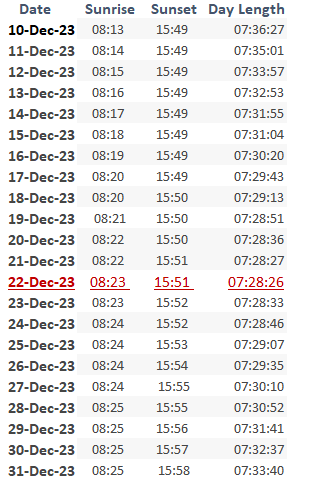
Data from Time and Date (2023).
Although the winter solstice is the day with the least daylight, the date with earliest sunset is 10 days earlier and by the solstice the evenings are already drawing out. The reason for this is discussed in my previous post: The darker mornings
Astronomical definition of the solstice
The diagram below shows the Earth’s orbit around the Sun. For clarity the sizes of the Earth and Sun have been greatly exaggerated in relation to the Earth-Sun distance.
.
- During June, the Earth’s North Pole is tilted towards the Sun and the days are longer in the northern hemisphere.
- During December, the Earth’s South Pole is tilted towards the Sun and days are longer in the southern hemisphere.
- At the equinoxes, neither pole is tilted towards the Sun and the amounts of daylight in the northern and southern hemisphere are equal.
The precise astronomical definition of the December solstice is
the time when the North Pole is tilted furthest away from the Sun.
Many people assume that the solstice always occurs on December 21 but this not the case. It occurs on December 22 roughly once in every four years. Over the next 5 years the times of the solstice are:
- 22 December 2023 03:28
- 21 December 2024 09:20
- 21 December 2025 15:03
- 21 December 2026 20:50
- 22 December 2027 02:43
All these times are in GMT (which is more correctly known as UTC). So if you live in an area many hours ahead or behind GMT then the solstice will sometimes occur on a different date.
Importance of the solstices to early man
Both the winter and summer solstices were of great importance to early man, and many prehistoric sites were built to celebrate them. The most famous of these is Stonehenge in England, which consists of a horseshoe arrangement of stones inside a large stone circle, built between four and five thousand years ago. It is an amazing feat of construction by stone age man; the stone circle is over 30 metres in diameter and its largest stones are more than 9 metres tall and weigh over 25 tonnes.
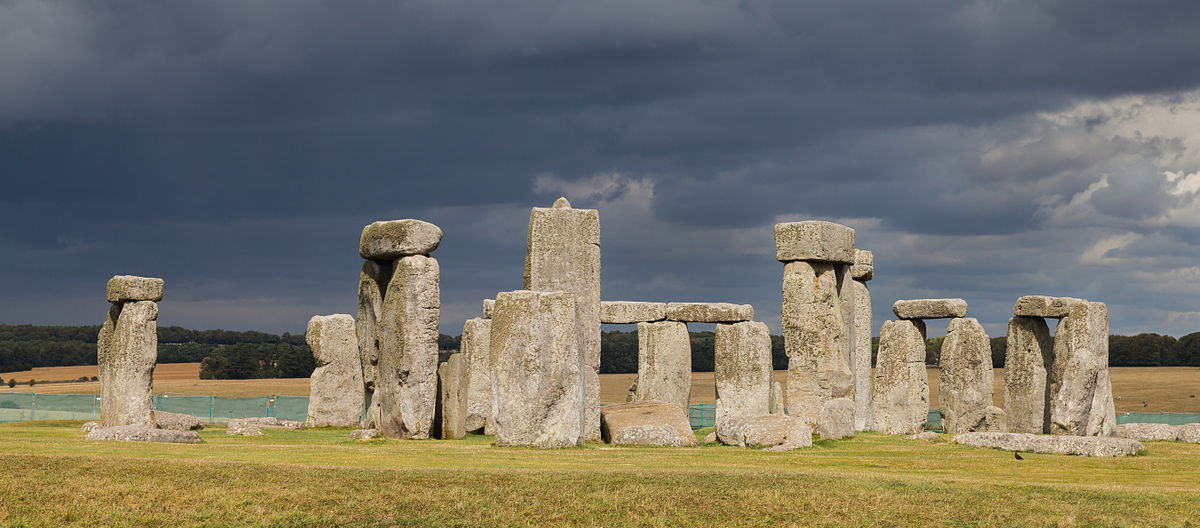
Image from Wikimedia commons
The horseshoe arrangement consists of five arches called triliths, each made up of three stones. The open side of the horseshoe points north east towards a large stone 80 metres away from the main circle. Today this large stone is called ‘The Heel Stone’.
.

Image from Wikimedia commons
For a few days either side of the June solstice, someone standing in the centre of the horseshoe and facing north east will see the Sun rise over the Heel Stone.
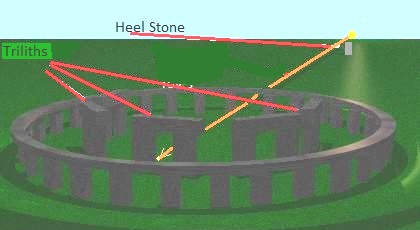
How sunrise at the summer solstice at Stonehenge would have looked after the monument’s construction.
Also, for a few days either side of the December solstice, someone standing at the Heel Stone facing south west will see the Sun set in the middle of the central trilith. Thus, Stonehenge marks both sunrise at the summer solstice and sunset at the winter solstice.

How Stonehenge originally looked from above
It is amazing that prehistoric man built such a large monument to line up with the solstices. However, these would have been major events for a people living outdoors with only natural daylight and whose lives were tied in to the cycle of the seasons. The arrival of the winter solstice signified that although the days would start to get longer there would very likely be a period of colder weather where food would be in short supply for these hunter-gatherers.
Over 38,000 discarded animal bones have been found at Durrington Walls, a large Neolithic settlement 3.2 km away from Stonehenge. These remains have been dated to be around 4,500 years old and represent at least 1,000 animals, of which 90% were pigs and the rest cattle.
Most of the pigs had been killed at about nine months old. Since the piglets were most probably born in the early spring, they were all slaughtered around the time of the solstice. Some of the bones still had meat attached suggesting that they were being eaten at a time of plenty which suggests that people were gathering for feasts at this time of year. (Source https://www.english-heritage.org.uk/visit/places/stonehenge/history-and-stories/history/food-and-feasting-at-stonehenge/ )
Modern groups with ancient origins such as Druids and Pagans, who revere the natural world more than most modern humans, celebrate the winter solstice at Stonehenge. Each year there is a gathering of several thousand who celebrate the first sunrise after the winter solstice, even though Stonehenge is aligned for sunset.
To prevent damage to such an important ancient monument it is not normally possible to get right up to the stones. However, English Heritage, the charity which manages the site, opens it up every year from around 07:45am to 10:00 am in the morning for the solstice celebrations, giving people a rare chance to get up close.

Although Stonehenge is the ancient monument most people associate with the solstices, particularly in the UK, there are many others.
Other Stone Circles
In Aberdeenshire in Northeast Scotland there are a large number of recumbent stone circles. The defining feature of a recumbent stone circle is a large stone placed on its side (the recumbent), flanked by two pillars (the flankers). Recumbent stone circles are normally aligned to form a frame through which to view the rising or setting of the standstill moon. This is a topic which I’ll write about in a future post.
There is an interesting stone circle at Cothiesmuir Hill. This circle is approximately 75 metres in diameter and remains almost complete. The recumbent is 4.2 metres long and weighs 20 tonnes. It would have been a massive effort for prehistoric humans to get this into the correct position 4500 years ago! Viewed from the centre of the circle at Cothiesmuir Hill, the west flanker (the taller of the two) is aligned exactly to the midwinter sunset. So perhaps the stone circle was used to celebrate the winter solstice as well?

The recumbent and flanking stones at Cothiemuir Hill stone circle Image credit Siùsaidh Robastan
Related posts
I hope you have enjoyed this post. Other related posts include
- The date of Christmas
- The date on which Easter falls
- The date of the Equinox and the start of autumn

 Explaining Science
Past, present and future from a realistic perspective:
The transition from ice-age to melt-age is 120 meters ago, still 60 meters to go.
LikeLike
🙂
LikeLike
Oh – and a very merry Christmas to you!
LikeLike
Thank you hope you had a good Xmas too.
LikeLike
Good! We generally have a bonfire on the solstice with mince pies and mulled cider…. I was feeling bad this year that I bowed to pressure from friends to do the fire tomorrow not today, so very relieved to learn the shortest day actually IS tomorrow this year – thanks Steve! And Cothiesmuir not too far from us…. a recumbent stone circle expedition in order I think for early 2024….
LikeLike
A number of us from my local amateur astronomy group normally observe the solstices from a nearby hill but I couldn’t persuade anyone to go this year to watch the sunrise. In the end it was so cloudy on the day of the solstice it didn’t matter no one would have seen anything !!
LikeLike
Sadly Cothiesmuir hill is a good distance from Manchester. Although I plan to go up and see recumbent stone circles in Aberdeenshire one day. The picture was sent to me by a friend of mine who is lucky enough to live in the area
LikeLike