
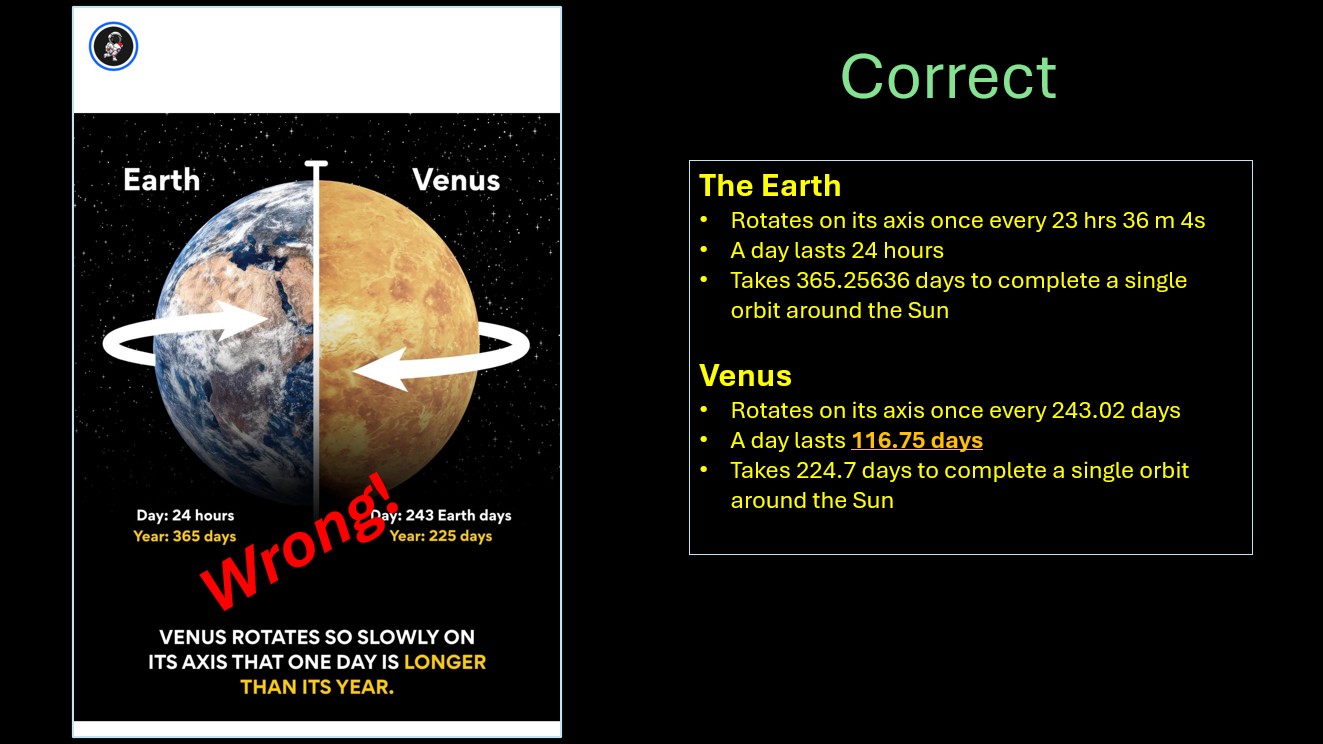
I saw this image on a Facebook page which has over half a million followers. It perpetuates a common misunderstanding, that the period a planet takes to rotates once on its axis is the same as its length of day. This is not the case, and for planets which rotate slowly, such as Venus and Mercury, there can be large differences between the two. This post explains how to calculate the length of a day. But first it is worth defining what we actually mean by the term “a day”.
The Definition of a day
An apparent solar day (or natural day) on a planet, uses the natural time which would be kept by a sundial and is the interval between two successive times when the Sun (or parent star if it isn’t in the Solar System) is at its highest in the sky.
In general, planets move in elliptical orbits and move faster when they are closer to their parent star. They also have their rotation axis tilted. Taken together these two effects cause the length of the natural day to vary. For the Earth it ranges over the course of a year between 24 hours 30 seconds and 23 hours 59 minutes 38 seconds. This is described in more detail in my post on the Variation in the length of the Solar Day .
Averaged out over the course of a year the length of the apparent solar day on Earth is 24 hours. This is known as a mean solar day, or average day and is what we mean by a “day” without any further qualification.
Day Length of Planets Rotating Prograde
The Earth, like most of the planets in the Solar System, rotates in the same direction as it revolves around the Sun. This is called prograde rotation. Looking from “above” the plane of its orbit, it rotates and revolves in an anticlockwise direction. It takes just over 23 hours 56 minutes to rotate once and 365.256363 days to complete a single orbit around the Sun, a period of time astronomers call a sidereal year.
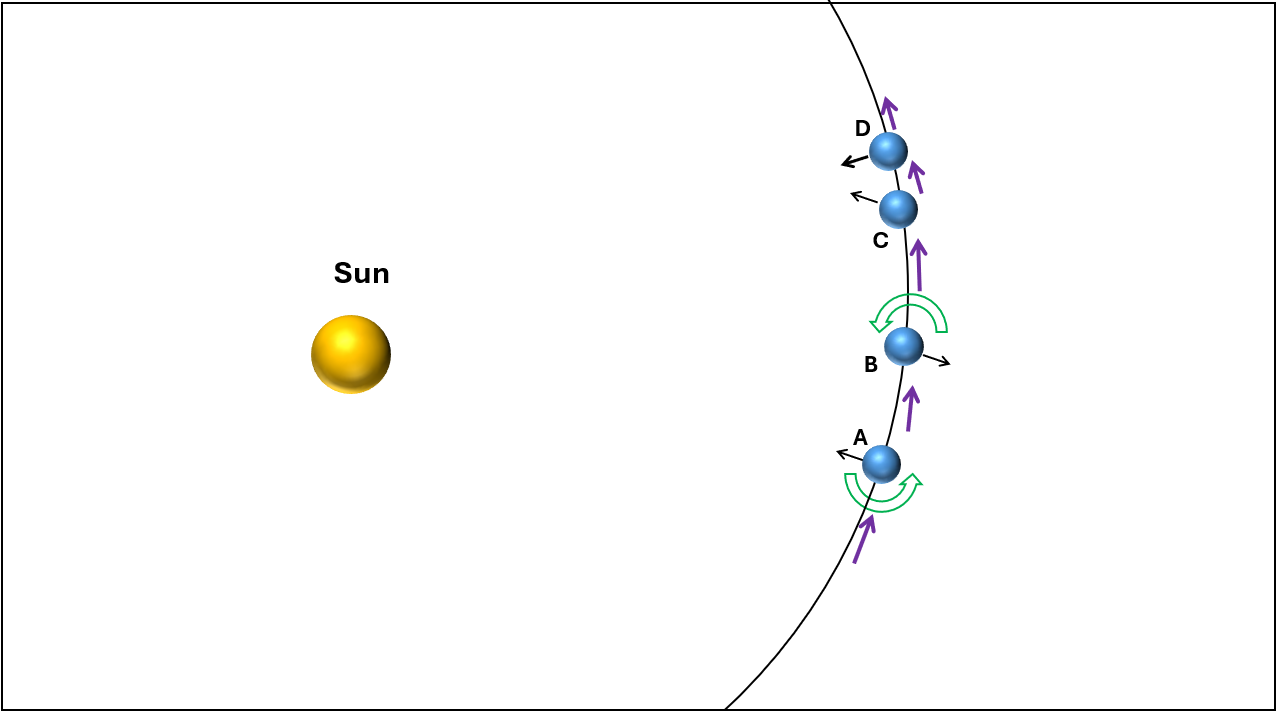
The Earth’s rotation and its orbit around the Sun. The distance it travels in its orbit in 24 hours has been exaggerated for clarity.
Why a day is not the same as the rotation period
If we start at time A when the Sun is at its highest in the sky, then at B, the Earth has made half a rotation. 23 hours 56 minutes later, the Earth has performed one full rotation (C), but the Sun hasn’t quite reached its highest point in the sky.
During this time the Earth has moved around the Sun and needs to rotate slightly more than one turn for the Sun to be at its highest point in the sky again (D). On average It takes an extra 4 minutes to do this. So, a day is 24 hours long.
Formula for the length of day for planets rotating in a prograde direction.
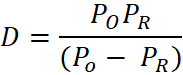
If a planet has orbital period PO and rotation period PR then its average day length D is given by:
Length of day on the Earth, Mars and Mercury
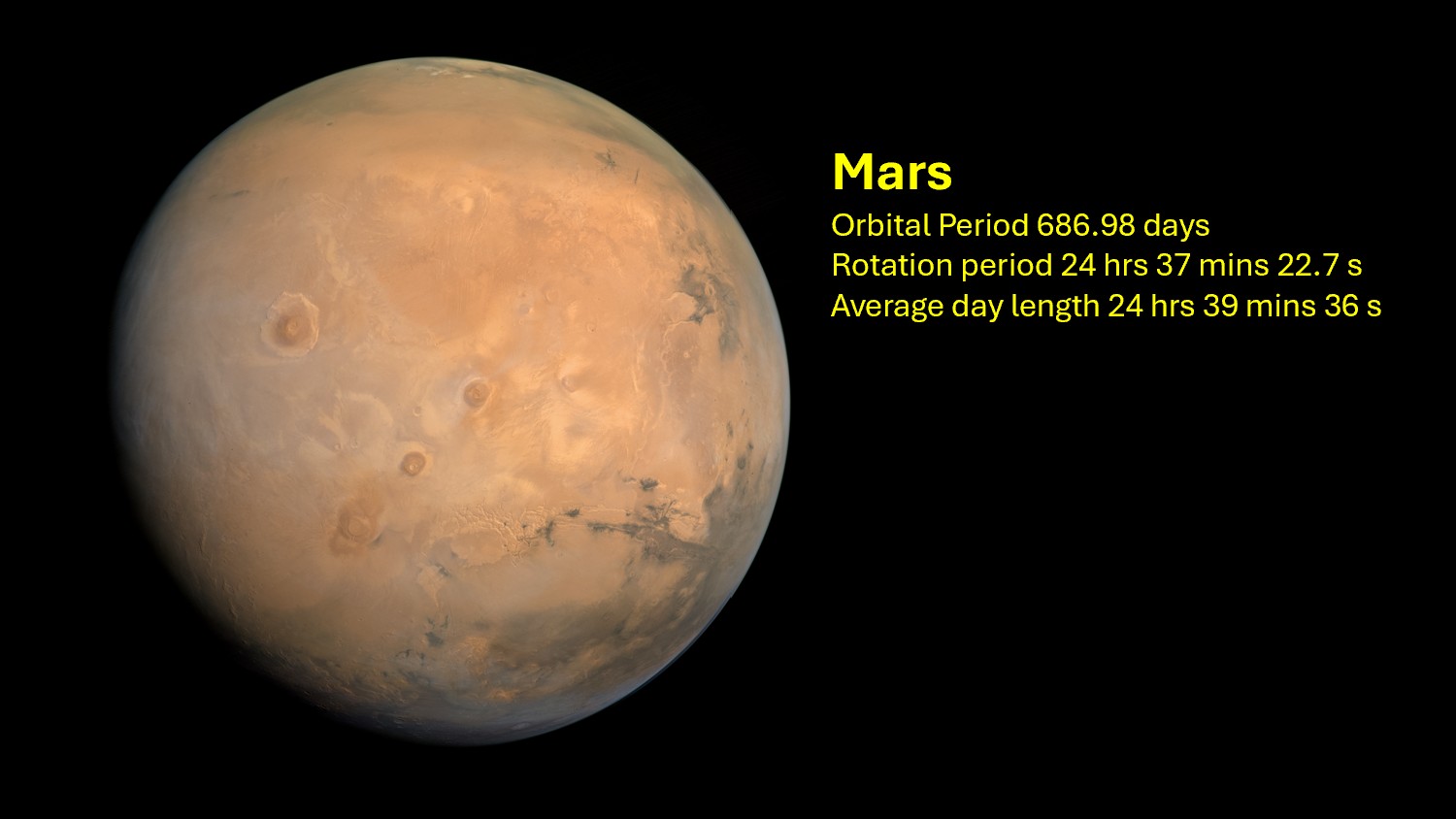
For the Earth PO is 365.256363 days and PR is 0.99726968 days (or 23 hours 56 minutes 4.1 seconds)[1]. If we put these numbers into the formula the average day length is 1 day (24 hours). This is what we would expect! Mars takes 686.98 days to orbit the Sun and 24hours 37minutes 22.7 seconds to perform one rotation [1]. If we put these numbers into the formula, the average Martian day is 1.02749125 (Earth) days (24 hours 39 minutes 36 seconds).
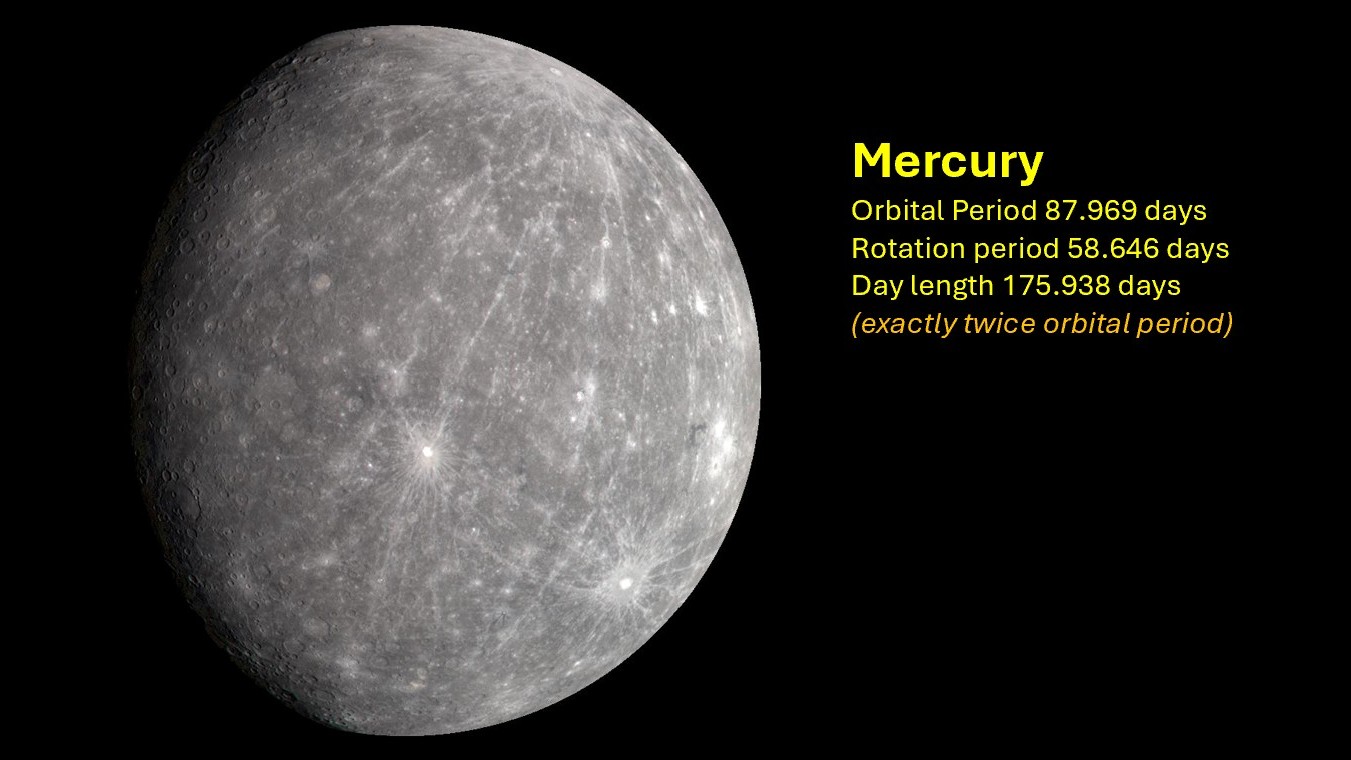
Mars and the Earth have a rotation period which is much shorter than their orbital period. The formula gives a day which is only slightly longer than their rotation period. This is not the case with Mercury. It orbits the Sun once every 87.969 days and it spins very slowly, its rotation period is 58.646 days, exactly two thirds of its orbital period [1]. Astronomers call this a 3:2 spin-orbit resonance, because the planet rotates three times for every two revolutions around the Sun. Its day length is 175.938 earth days, exactly twice the length of its orbital. Mercury is the only planet in the Solar System where its day is longer than its year. (A year is effectively the same as the orbital period)
Tidal locking of a planet’s rotation
An interesting thing about the formula is that if a planet’s rotation period is exactly equal to its orbital period, its day length is infinite. The planet’s rotation would be tidally locked to its orbit in the same way the Moon’s rotation is tidally locked to its orbit around the Earth.
- One side, the dayside, would permanently face the Sun. It would be constant daylight – the Sun would never set.
- The other side, the nightside, would permanently face away from the Sun. It would be constant night – the Sun would never rise.
- If the planet had an elliptical orbit or its axis of rotation was tilted slightly there would be regions close to the dayside/nightside boundary where the Sun would dip below and rise above the horizon.
Mercury is difficult to observe from the Earth as it is close to the Sun and has few surface features. Its rotation period wasn’t accurately measured until the 1960s. The Italian astronomer Giovanni Schiaparelli observed surface features on the planet in the 1880s and claimed (wrongly) to have discovered that its rotation was tidally locked. His results were published in 1890 [2].
…Observations in 1882-3, confirmed in 1886-7, showed that the planet revolved about the Sun at least somewhat as the Moon revolves about the Earth, namely: in turning always the same face, or nearly the same face, to the primary body. The observations themselves were so difficult that it was impossible to prove that Mercury revolved on its axis exactly in the period of one revolution in its orbit (as in the case of the Moon). Professor Schiaparelli takes the sidereal period of Mercury (87.9693 days) at once as its rotation time…
There were firm theoretical reasons for believing that Mercury’s rotation and orbital periods were the same. And until the 1960s most astronomy textbooks and popular astronomy books stated that its rotation was tidally locked -even though there was no accurate observational evidence for this.
The first science fiction novel I read was Arthur C Clarke’ s Islands in the Sky [3]. It was written in 1952 and set in the late twenty-first century in a time where space travel was routine and humans had explored the surfaces of other planets.
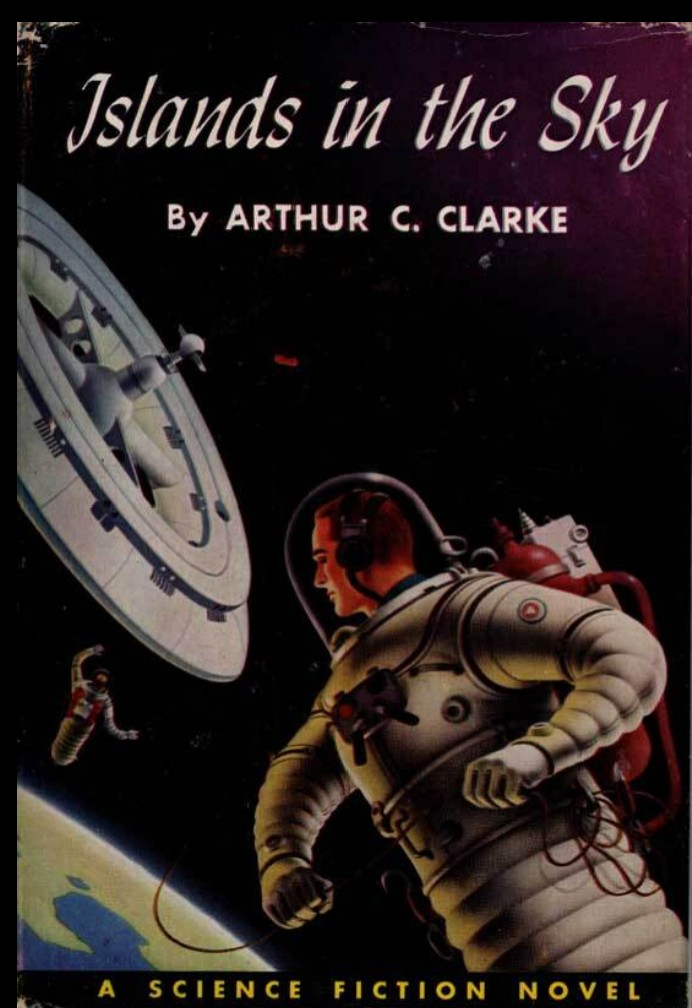
In this book Clarke followed the scientific consensus of the time. He described Mercury as having a permanent day side where the Sun was above the horizon all the time, and was so hot rocks were molten, and a cold dark permanent night side which never received any direct sunlight having a temperature close to absolute zero. In reality, the existence of the cosmic microwave background, the weak afterglow from the Big Bang, means the coolest a planet’s surface could ever be is 2.7 degrees above absolute zero. However, this hadn’t been discovered in 1952.
In the novel, exploration of Mercury was only possible in a region Clarke called the Twilight Belt – the area where the Sun hovers near the horizon. The rest of the planet was too hot or too cold.
Day Length of Planets Rotating Retrograde
Retrograde rotation is when a planet rotates in the opposite direction to its orbit around its parent star. Out of the planets in the Solar System only Venus and Uranus have retrograde rotation. In fact, Uranus is a bit of a special case – as I’ll explain later.
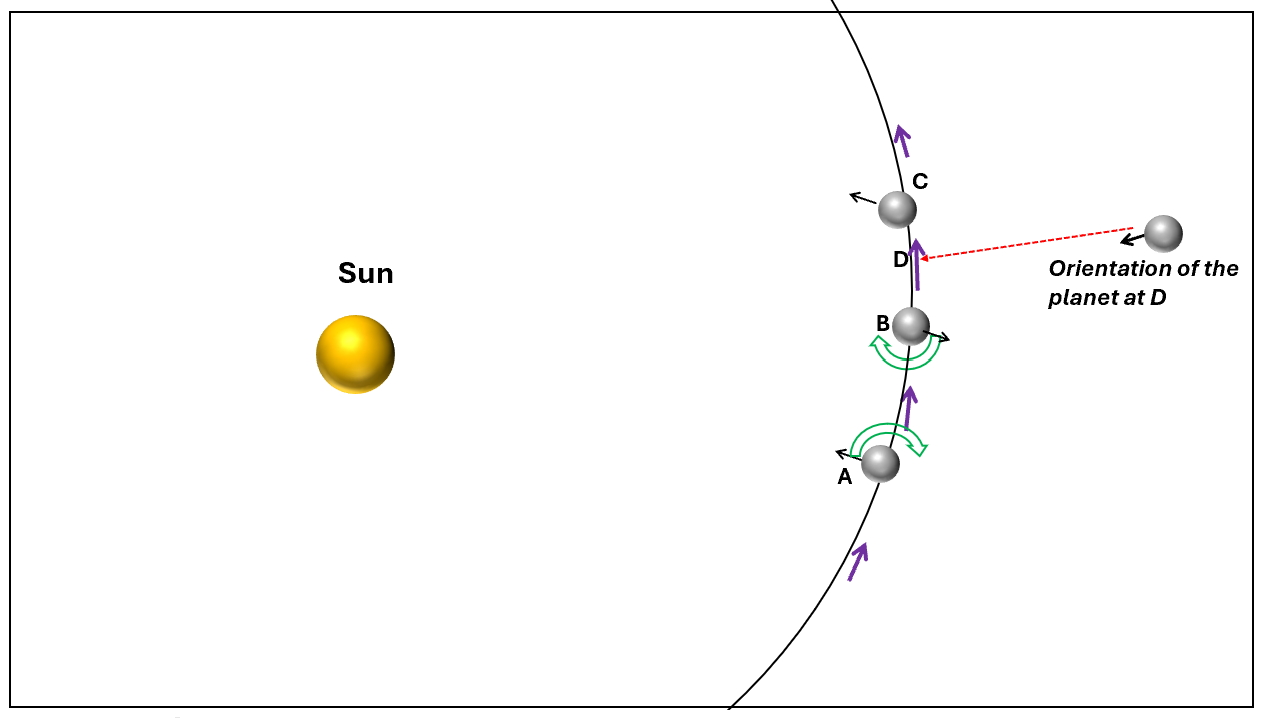
A planet with retrograde rotation in its orbit around its parent star (its sun)
If we start at time A when its sun is at its highest in the sky, then at B the planet has made half a rotation. At C the planet has made a full rotation, but it has already passed the point where its sun was highest in the sky. This occurred a little earlier at D. For a retrograde rotator the length of day is always shorter than the time to make one rotation.
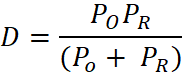
Formula for the length of day for planets rotating in a retrograde direction.
If a planet has orbital period PO and rotation period PR , its average day length D is:
Length of Day on Venus
Venus takes 224.7 days to orbit the Sun and rotates very slowly in a retrograde direction, taking 243.02 days to perform one rotation. [1] From the formula the average Venusian day length is 116.75 days.
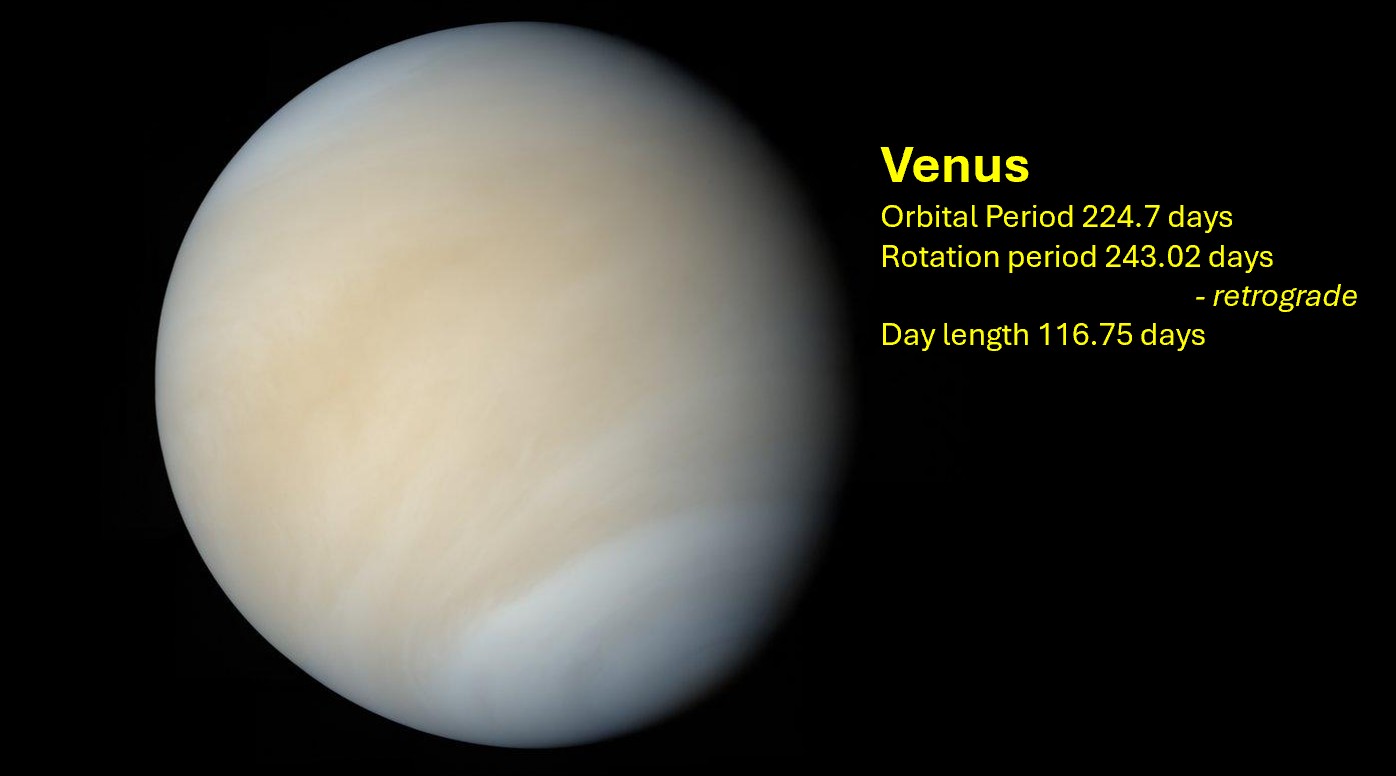
This means there are on average only 1.92 Venusian days in the Venusian year.
Day length on the giant planets
There are two types of giant planets in the outer Solar System can be divided into two types:
- The gas giants – Jupiter and Saturn
- The smaller ice giants – Uranus and Neptune
All of these planets have atmospheres thousands of kilometres thick, and we can only observe the top of the clouds in their upper atmospheres.
Rather than rotate as a solid body, they have differential rotation where the rotation period is different for different latitudes.
They all have much longer orbital periods than the inner terrestrial planets and the factors by which their day lengths are greater than their rotation period are small. For example, Saturn takes 10 hours 14 minutes to rotate (at its equator) but 29.45 years to orbit the Sun [1]. Its day length (at its equator) is only 1.5 seconds longer than its rotation period.
The unusual rotation of Uranus
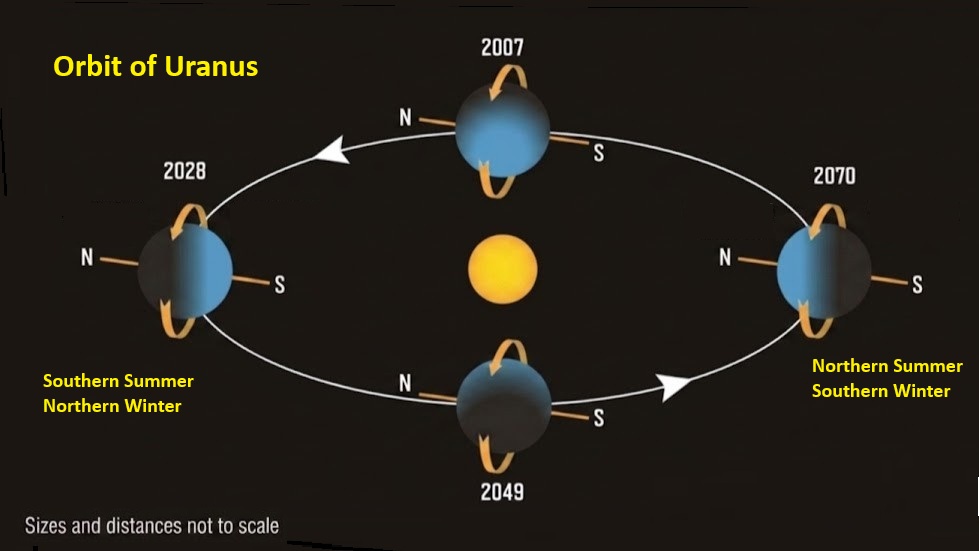
Jupiter, Saturn and Neptune rotate in a prograde direction and Uranus in a retrograde direction. Uranus’s axis of rotation is tilted at 82.2° to the plane of its orbit; it rotates almost side on. [1]
It takes 84.02 years to orbit the Sun, and its extreme axial tilt makes Uranian days very unusual. During the Uranian year one hemisphere is facing towards the Sun for decades, while the other is facing away. On Earth the polar circles, the latitudes above which the Sun doesn’t set for at least one day in the year, occur at latitudes 66.56o north and 66.56o south. On Uranus, they occur at latitudes 7.8o north and 7.8o south. At a latitude of 45o north or south of the equator,the Sun would be above the horizon for 27 years in the Uranian summer. In the Uranian winter it wouldn’t rise for 27 years.
And Finally….
It is not only people without knowledge of astronomy who misunderstand the difference between rotation period and day length. This confusion of the two appears in many books and on websites ( e.g. https://www.thoughtco.com/day-length-other-planets-416568) . In her popular science book The Secret life of the Universe, the astrobiologist Nathalie Cabrol (director at the Carl Sagan Center at the SETI institute) states:
“….. a Venusian day which equals 243 Earth days, lasts longer than a Venusian year and one would say happy birthday on Venus more often than good morning….”.
This is not true!
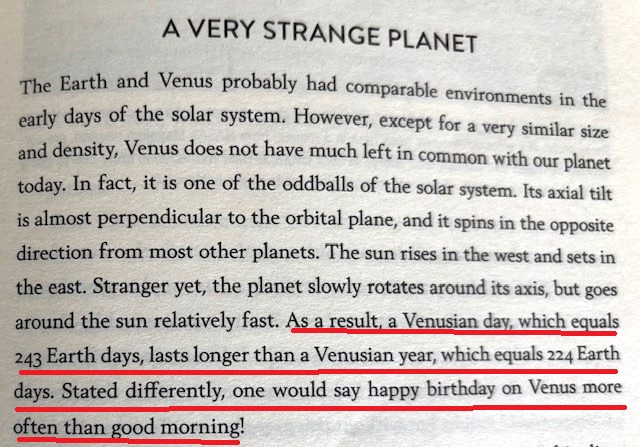
Text taken from page 55 of The Secret life of the Universe [4]
References
[1] The parameters for the planets have been taken from the NASA planetary factsheets. These are a valuable resource – having lots of information in one place. However, for some reason I cannot understand, NASA decided in 2025 to remove them from their website. Fortunately, the factsheets can be retrieved from the web archive:
NASA (2025). Planetary Fact Sheets. [online] Available at: https://web.archive.org/web/20250818154100/https://nssdc.gsfc.nasa.gov/planetary/planetfact.html (Accessed 22 Apr. 2026).
[2] Holden, E.S. (1890). Announcement of the discovery of the rotation period of Mercury [by Professor Schiaparelli]. Publications of the Astronomical Society of the Pacific, 2(7), pp.79–79. Available at doi:https://doi.org/10.1086/120099. (Accessed 22 Apr 2026)
[3] Clarke, A.C. (1952). Islands in the Sky. Sidgewick & Jackson.
[4] Cabrol, N.A. (2024). The Secret Life of the Universe. Simon and Schuster.

 Explaining Science
https://github.com/pachecocordovamoiseseduardo-byte/github-mcp-server
LikeLike