Over the past few years, the number of social media accounts and pages about astronomical topics has greatly increased. Sadly, many creators spend little effort on their creations and much content is AI-generated. Many peddle inaccurate and misleading information -probably because their authors have very little astronomical knowledge. Although there are some good astronomy articles on social media, at least 90% of the astronomy posts in my Facebook feed are inaccurate, often they are sensationalist clickbait.
In this post I’ll focus on Facebook, the platform I use most, but I’m sure the same is true for other social media platforms.
Conflict between Engagement and Accuracy
Facebook is the world’s most popular social media platform. About 2.2 billion people log onto it each day [1] – roughly 25% of the Earth’s population. Facebook makes money by selling advertising which is targeted at users.
Whether or not a post appears in my feed depends on the Facebook algorithm. Although the exact detail of how this works is confidential to Meta (Facebook’s parent company), the algorithm takes into account: my interests, other content I have viewed, how long I have viewed similar content (e.g. have I viewed an entire video, or read the text associated with an image). Facebook wants to keep users on their platform. The longer a user is on Facebook the more likely they are to view ads and make money for the company. The algorithm prioritizes content that generates signals that people are engaging with it rather than just viewing – namely: likes, shares and comments.
Facebook posts with clickbait type headings such as “Secret Alien base discovered on the far side of the Moon”, accompanied by stunning images and text suggesting a government coverup generate strong immediate reactions.
Posts like this will be widely shared by conspiracy theorists. Not only that, but some more rational people will comment to say something along the lines of: “This is fake”. However, the Facebook algorithm sees lots of comments even if they are negative as “High Engagement” and will push the post to more users. Fundamentally Facebook doesn’t care much if a post shows correct information. The important thing is to keep people on the platform for as long as possible and engaging with content.
The Issue of Low Effort Content on Social Media
It is easy for anyone to generate visually stunning images of galaxies, planets, spacecraft or indeed any other astronomical object and some supporting text to go with it. All they need to do is to get AI to generate an image and search the web to produce the text, or even get AI to write it.
No astronomical knowledge whatsoever is needed. In 15 minutes, anyone can produce an astronomy Facebook post with stunning image(s). Many Facebook accounts pump out numerous of these low effort posts each day and have hundreds of thousands of followers.
Examples of Inaccurate Astronomy Stories on Social Media
Here are some examples of inaccurate stories which have recently appeared in my Facebook feed.
Fake Images claimed to be from near the Lunar Surface
There was an explosion in the number of images like these during the recent Artemis 2 mission.
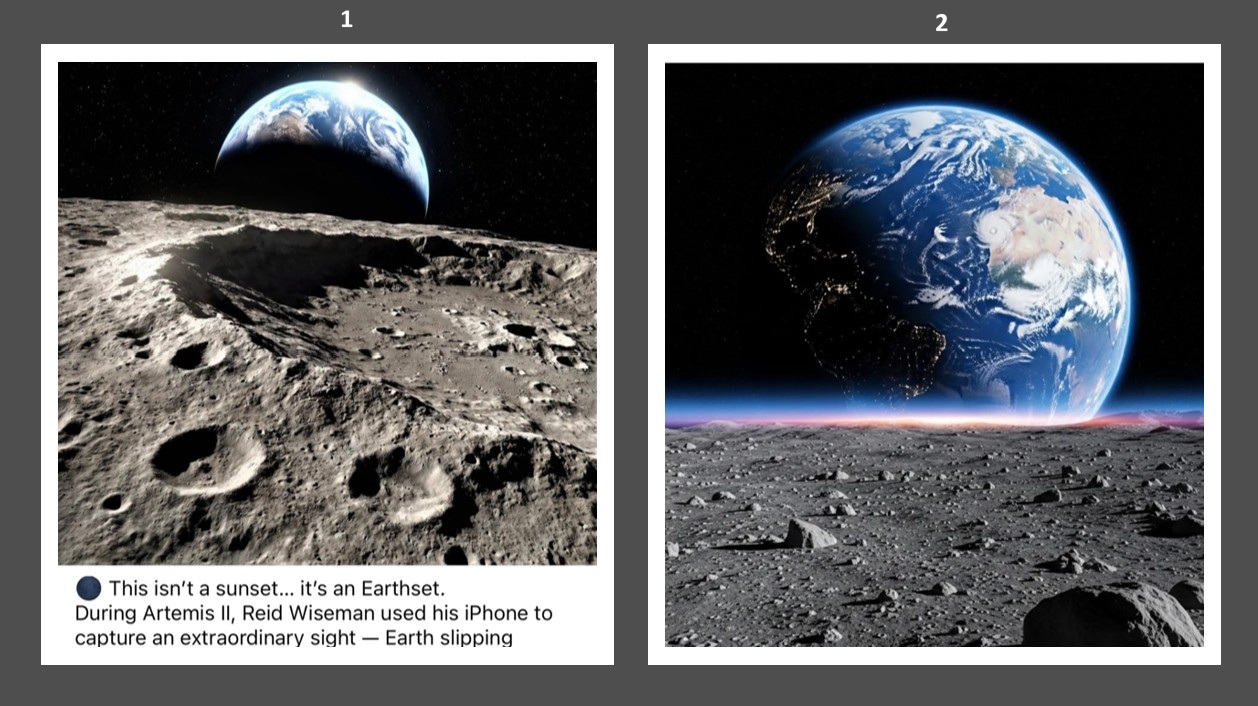
Image 1 claims to show an Earthset taken by an Artemis astronaut with his iPhone. This is utter nonsense.
- If the Sun were almost behind the Earth as in the photo, the part of the Earth visible from the Moon would be barely illuminated. It would not appear as a large crescent.
- For the crater shadows to appear as they are, the Sun should be high in the sky and well to the left – outside the field of view of the image.
- For the Earth to appear as a large crescent, the Sun would have to be well above the Earth in the Lunar sky – outside the field of view of the image. In which case it would not be consistent with the size and direction of the crater shadows.
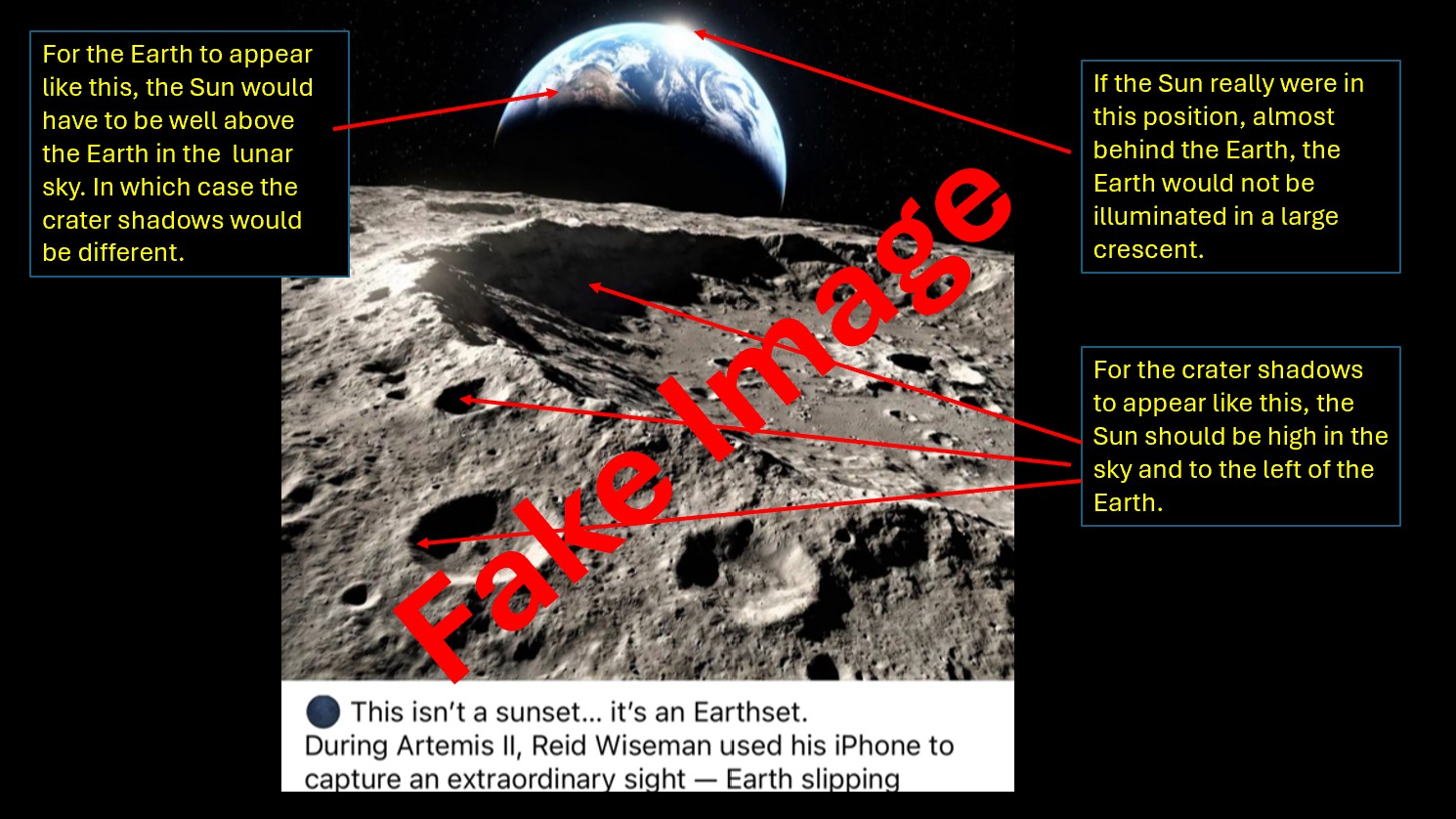
Image 2 shows what appears to be fog above the lunar surface. Clearly who ever created this nonsense didn’t realise the Moon has no atmosphere.
Mixing up the near and far sides of the Moon and a clickbait story.
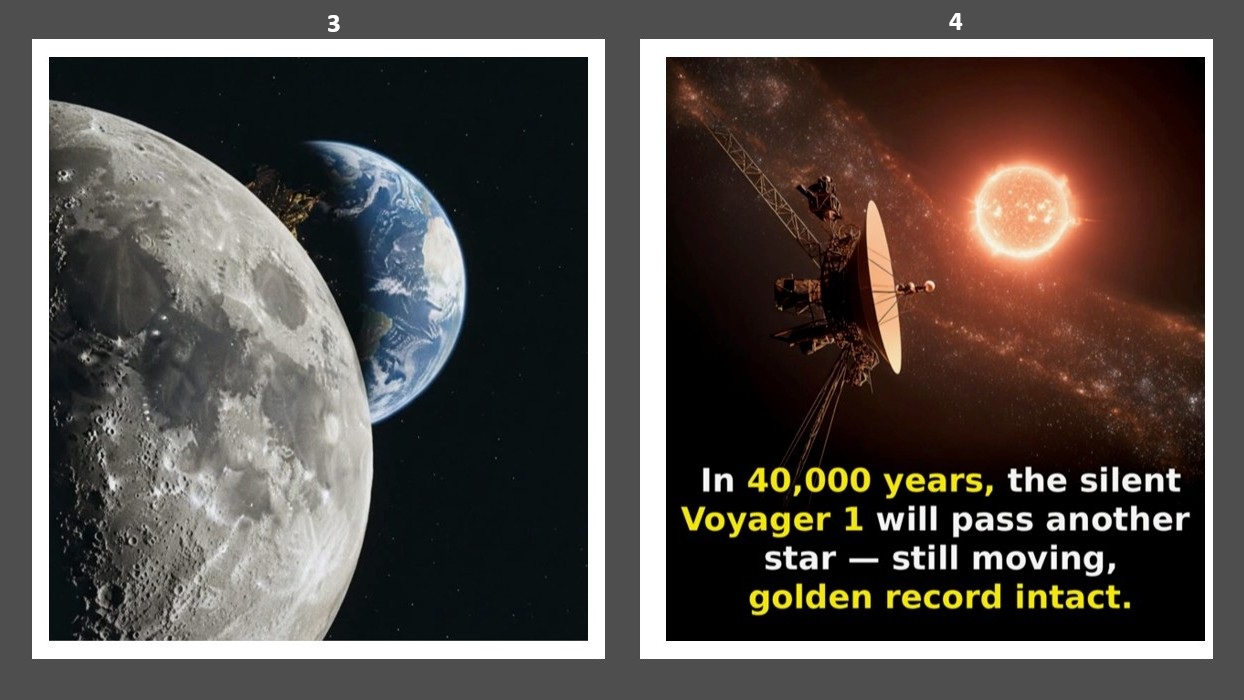
A recent Facebook post claimed Image 3 had been taken by Artemis 2 astronauts on their recent mission. This is clearly nonsense. The Moon’s rotation is tidally locked to its orbital period. It takes 27.31 days to perform one revolution around the Earth and also to rotate once on its axis. This means, one side of the Moon (the nearside) always faces the Earth. The other side (the farside) always faces away.
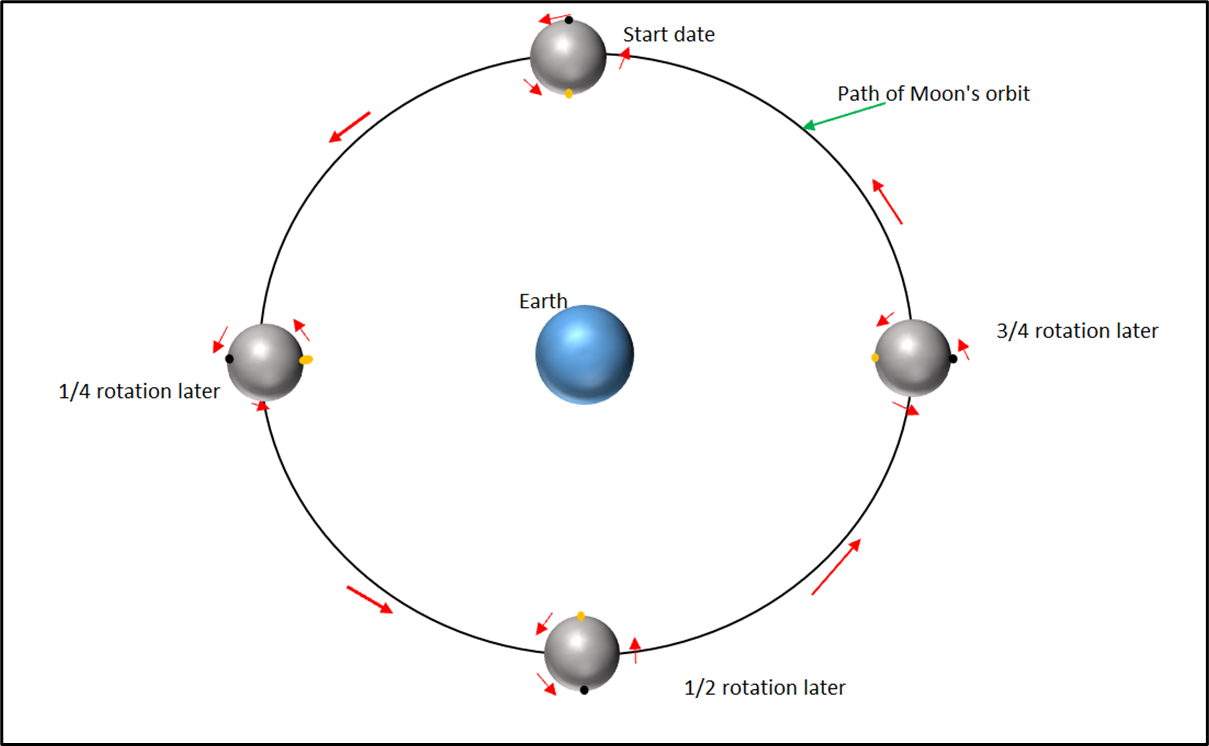
In the diagram the yellow dot shows a location at the centre of the nearside and the black dot a location at the centre of the farside.
To have taken image 3 the Artemis astronauts would have to have been behind the far side of the Moon. So, the portion of the Moon visible should be from the farside. Yet the image shows part of the nearside.
Image 4 is classic clickbait. It is highly misleading, giving the impression that Voyager 1 will make a close approach to another star like the Sun. In fact, the distances between stars is very large in the outer regions of our galaxy . In 45000 years’ time, Voyager 1 will be around 1.6 light years from a faint red star Gliese 445. This is 100 000 times the distance from the Earth to the Sun. By no means is it a close approach!
In addition, Gliese 445 is definitely not a Sun-like star. Its surface is so cool it radiates mostly in the infrared. Even though it is relatively close, 17 light years from us, it is 100 times too faint to be seen with the naked eye. At Voyager 1’s closest approach Gliese 445 would only be a faint point of light.
The sole purpose of this image (which is very likely to have been AI generated) is to hook users in to read the full article.
Clickbait is becoming more and more common. Often posts which are (inaccurate) AI summaries of old articles, have images suggesting “sensational new discoveries” to hook readers in.
Low effort articles with Incorrect Information
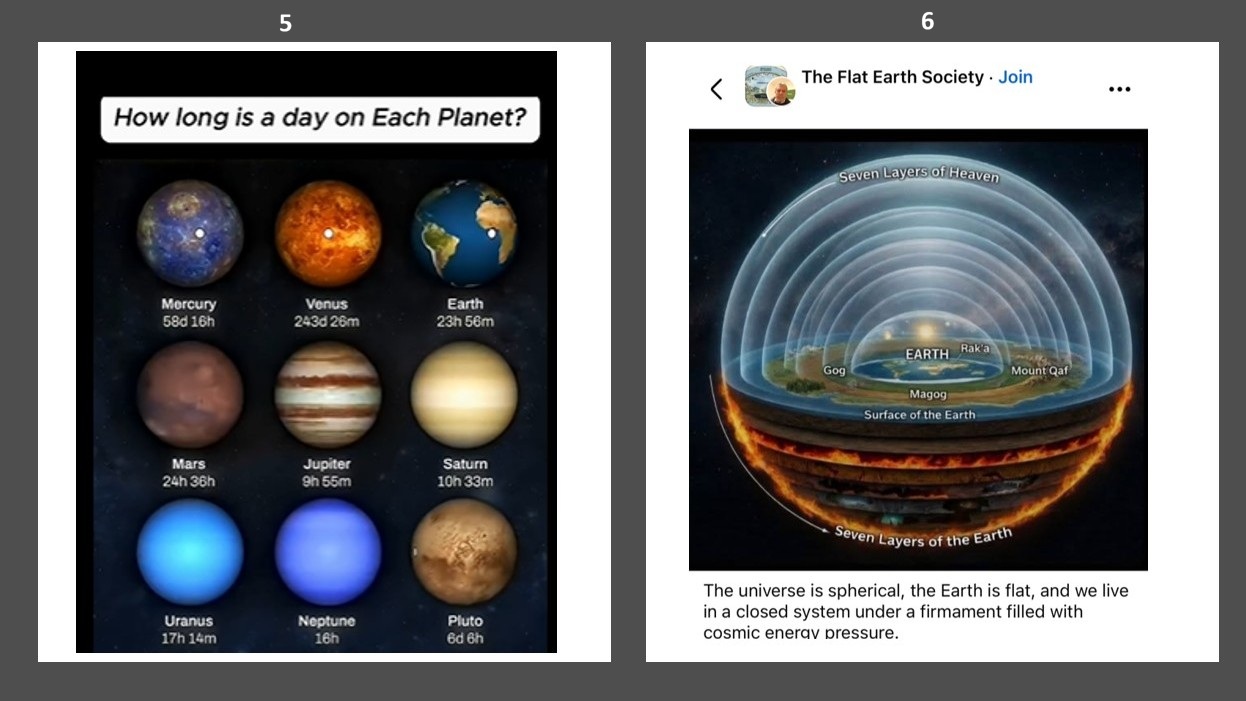
Image 5 is a low effort post and contains information which has probably been generated by AI. The graphics are great, but all the data is wrong! The numbers given are the rotation periods of the planets and not their daylengths. As described in my recent post The Difference Between Rotation Period and Day Length there can be large differences between the two for planets which rotate slowly, such as Venus and Mercury.
I’ve put together the correct day lengths in the tables below.
Length of day for the Terrestrial (inner rocky) planets
| Planet | Value in Image 5 | Actual Length of Day |
| Mercury | 58 days 16 hrs | 175.938 days |
| Venus | 243 days 26 min | 116.75 days |
| Earth | 23 hrs 56 min | 24 hrs |
| Mars | 24 hrs 36 min | 24 hrs 39 min |
Length of day for the outer giant planets
All the giant planets have atmospheres thousands of kilometres thick, and we can only observe the top of the clouds in their upper atmospheres. Rather than rotate as a solid body, they have differential rotation where the rotation period of the upper cloud layer is different at different latitudes. The underlying values in the table below refer to the rotation periods in the planets’ deep interior which are determined from the planets’ magnetic field
Because these planets rotate relatively quickly and take a long time to complete an orbit, their day lengths are almost the same as their rotation periods. For example, Saturn has a day length which is only 1.5 seconds longer than its rotation period.
| Planet | Value in Image 5 | Actual Value of Rotation Period |
| Jupiter | 9 hrs 55 min | Upper Cloud layer varies from 9 hrs 50 min near equator to 9 hrs 56 mins at high latitudes. [2] – underlying value 9 hrs 56 min [3] |
| Saturn | 10 hrs 33 min | Upper cloud layer varies with latitude – underlying value 10 hrs 39 min [3] |
| Uranus | 17 hrs 14 min | Upper cloud layer varies with latitude – underlying value 17 hrs 14 min [3] |
| Neptune | 16 hrs 0 min | Upper cloud layer varies with latitude – underlying value 16 hrs 7 min [3] |
Image 6 shows a model of the Flat Earth cosmology. I won’t say any more about this sort of nonsense, other than posts like this attracts a great deal of viewers and comments and thus boosts usage of the Facebook platform.
To sum up..
Social media platforms like Facebook are not a reliable source for astronomical information because the spread of content is often driven by engagement rather than accuracy. Posts often oversimplify complex topics, spread incorrect information, or amplify misconceptions. Unlike peer reviewed journals or articles written by people knowledgeable in the subject (such as this blog 😊) , content isn’t checked for accuracy, and social media algorithms tend to promote sensational and visually striking claims, which will hook users in, rather than correct explanations.
The moral of the story – don’t expect social media to be accurate 😉
References
[1] Lee, R.A. (2026). Facebook Statistics 2026: Users, Revenue, and Engagement Trends Explained. [online] SQ Magazine. Available at: https://sqmagazine.co.uk/facebook-statistics/. (Accessed 12 May 2026).
[2] Raymond Hide, C.B.E. (2001). Zenographic longitude systems and Jupiter’s differential rotation. Notes and Records of the Royal Society of London, 55(1), pp.69–79. doi:https://doi.org/10.1098/rsnr.2001.0126. (Accessed 12 May 2026).
[3] NASA (2025). Planetary Fact Sheets. [online] Available at: https://web.archive.org/web/20250818154100/https://nssdc.gsfc.nasa.gov/planetary/planetfact.html (Accessed 12 May 2026).
Discover more from Explaining Science
Subscribe to get the latest posts sent to your email.


Hey guys 🥲💔
Please support my website and check it out to learn new things every day 📚✨
I post interesting content about science, technology, knowledge, and many useful topics 🌍💡
My website views have dropped to almost zero since the end of 2025 😔📉
I’ve worked really hard on this site, so even one visit or share means a lot to me 🥺🙏❤️
🔗 https://httpsknowverse.wordpress.com/
LikeLiked by 2 people