A Cyclical Universe

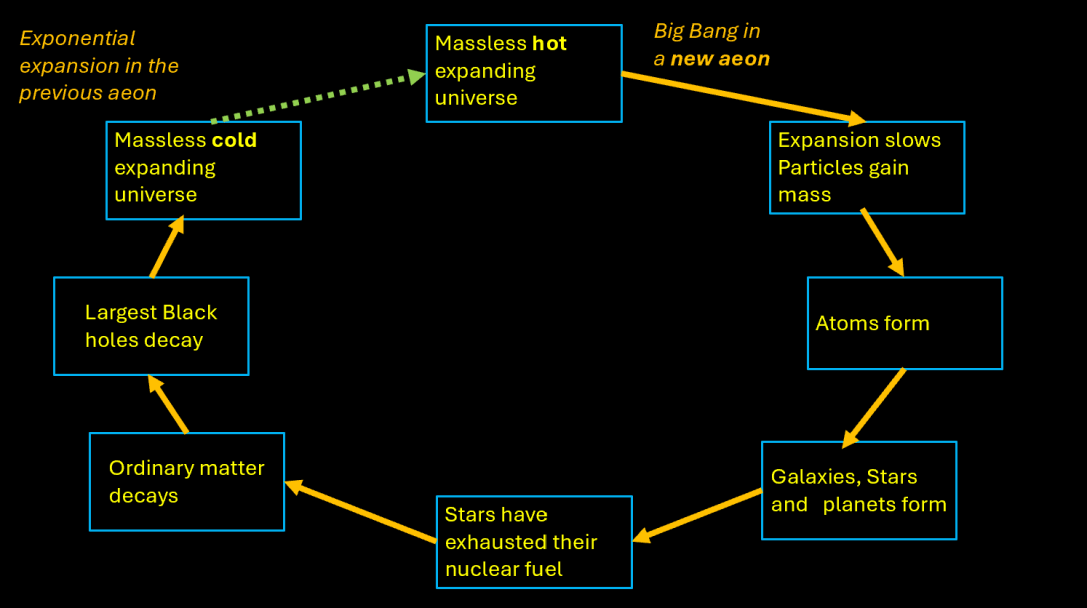
Updated 17 December 2025 In The End of the Universe I remarked on the surprising similarity between conditions in the very early Universe, just after the Big Bang, and the far future of the Universe. In this post I’ll give an overview of Roger Penrose’s model of the Universe  in which it passes endlessly through… Continue reading A Cyclical Universe

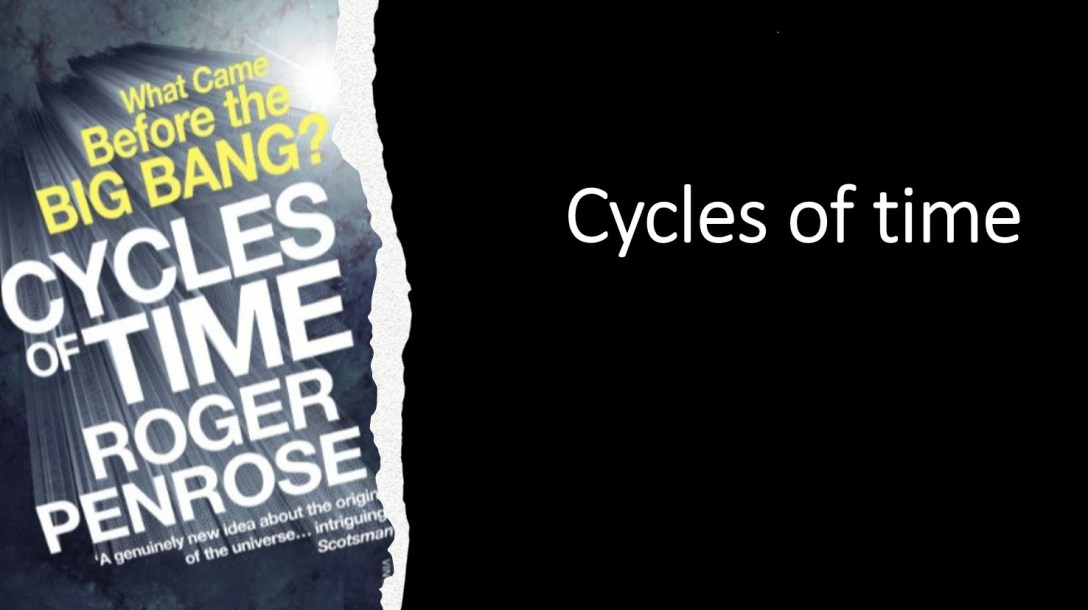
Roger Penrose – Cycles of Time

Updated 18 December 2025 In another post I talk in more detail about conformal cyclical cosmology (CCC). Roger Penrose's model of the Universe where it passes endlessly through a possibly infinite number of cycles (or aeons) each of which starts with a big bang and ends with a rapidly expanding empty universe.  This fascinating idea… Continue reading Roger Penrose – Cycles of Time

Distances in Cosmology

This post has now been superseded by a more detailed post Measuring Distances in Cosmology ---------------------------------------------------------------------------------------------- I recently read an article on the popular astronomy website site Universe Today. It stated that ‘…the CMB [cosmic microwave background radiation]  is visible at a distance of 13.8 billion light years in all directions from Earth, leading scientists… Continue reading Distances in Cosmology

Jim Peebles winner of the Noble Prize 2019

I was interested to hear that Jim Peebles, at the age of 84,  has won a half share of the 2019 Noble Prize for physics for theoretical discoveries in physical cosmology. Jim Peebles (1935-) Image from Wikimedia commons In the early 1960s Peebles and his colleague Robert Dicke had predicted the existence of the microwave… Continue reading Jim Peebles winner of the Noble Prize 2019

The anthropic principle.

In his 1988 book 'A Brief History of Time' the British theoretical physicist Stephen Hawkins (1942-2018) stated: 'The laws of science, as we know them at present, contain many fundamental numbers, like the size of the electric charge of the electron and the ratio of the masses of the proton and the electron. ... The… Continue reading The anthropic principle.