These are some of my cosmology posts
-
Breaking news!
News is just reaching us of the most amazing astronomical discovery which I am ever likely to experience in my lifetime, one which I never thought I would see. As regular followers of this blog will know, the SETI (Search for Extraterrestrial Intelligence) Institute has been searching for evidence of life in the universe by looking for some…
-
Easter – 27 March 2016
This year, for the majority of Christians, 27 March will be Easter Sunday, one of the most of the most important dates in the Christian calendar. Although Easter is a is a festival celebrating the resurrection of Jesus Christ from the dead, it is also widely marked by non-Christians in the UK, particularly as there are two very welcome public…
-
The first day of spring
Now that we are in the month of March, for most of us in the northern hemisphere the worst of the winter is over, and it is only a couple of weeks until 21 March, the first day of spring. 21 March is an important date for other reasons, too. For one thing, it is used as the basis for the…
-
The Discovery of Gravitational waves
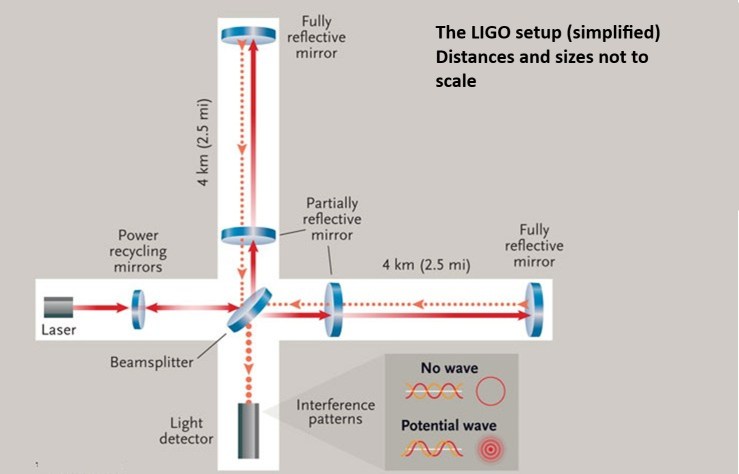
Originally posted 2016. Revised March 2026. Gravitational waves were predicted by Albert Einstein back in 1916, and were finally detected one hundred years later in Febuary 2016 after decades of unsuccessful searching. In an announcement on 11 February at a Washington DC press conference David Reitze, the executive director of the LIGO Laboratory, said:[1] “Ladies and gentlemen,…
-
Terraforming Venus
Updated December 2025 In a previous post I have discussed living on Venus in floating colonies. I’ll now discuss terraforming. This the process of changing the global environment of a planet in such a way as to make it suitable for human habitation. Because it is so far beyond our current technological capabilities, most articles about…
-
Living on Venus
In this post I’ll look into the distant future and talk about humans living and building settlements on the planet Venus. Because it is well beyond what we can achieve with our current technology, it is a topic that been more in the realm of science fiction rather than factual scientific writing. However, even though there are many difficult obstacles in…
-
Transit of Venus
On 6 June 2012, a transit of Venus occurred. This rare astronomical event, when Venus passes directly in front of the Sun, and appears as a large black dot on its surface slowly moving from one side to the other in about 3 hours, has only happened eight times since the invention of the telescope (ref 1). This post…
-
Happy new year 2016
Happy new year to all my readers and followers. I hope you have had a good festive break. My and wife and I went on a cruise to the Canary Islands, Lisbon and Madeira over Christmas to get away from the cold and damp North West of England. During our holiday I was hoping to…
-
The evenings are drawing out already
Revised 14 December 2025 As I complete this post, it’s completely dark outside and it’s only 5 o’clock in the afternoon. Today is 14 December, and most people I come across think that it will continue to get dark earlier and earlier in the afternoons until 21 December (the date of the winter solstice in 2025), the…
-
Akatsuki – a second chance – Updated (7 Dec 2015)
This an update to my original post from 4 December. In a press release today the Japanese space agency JAXA confirmed that the smaller rocket motors had fired as planned and the Akatsuki is now in orbit round Venus. The announcement (http://global.jaxa.jp/press/2015/12/20151207_akatsuki.html) went on to say: “The orbiter is now in good health. We are…

