Revised March 2026
The Steady State theory is an elegant alternative to the Big Bang theory of the origin of the Universe . It was very popular among astronomers in the 1950s, but is now obsolete.
What is the Steady State Theory?
The Big Bang theory states that the Universe originated from an incredibly hot and dense state 13.7 billion years ago and has been expanding and cooling ever since. It is now generally accepted by most cosmologists. However, this hasn’t always been the case and for a while the Steady State theory was very popular. This was developed in 1948 by Fred Hoyle (1915-2001), Herman Bondi (1919-2005) and Thomas Gold (1920-2004) as an alternative to the Big Bang to explain the origin and expansion of the Universe. At the heart of the Steady State theory is the Perfect Cosmological Principle. This states that the Universe is infinite in extent, infinitely old and, taken as a whole, it is the same in all directions and at all times in the past and at all times in the future. In other words, the Universe doesn’t evolve or change over time.
If we take a small region of the Universe, such as the neighbourhood of the Sun, then clearly it does change over time as individual stars burn up their fuel and die, eventually becoming objects such as black dwarfs, neutrons stars and black holes. The Steady State state theory proposes that new stars are continually created all the time at the rate needed to replace the stars which have used up their fuel and have stopped shining. So, if we take a large enough region of space, and by large we mean tens of millions of light years across, the average amount of light emitted in this region doesn’t change.

The Sun will last for about 5-6 billion years before it runs out of fuel. Image from NASA
The Steady State Theory and an Expanding Universe
The Universe is composed of galaxies, each of which contains many billions of stars. Our Milky Way is a large galaxy and is believed to contain over 400 billion stars.

What the Milky Way would look like from a great distance. Image credit NASA
As discussed in my article on the Expansion on the Universe, it has been known since 1929 that the Universe is expanding, which means that when we look at distant galaxies they appear to be moving away from us. The further away a galaxy is from us, the faster it appears to be moving away. This relationship, which is known as Hubble’s law, is shown in simplified form in the diagram below.

The horizontal x-axis gives the distance from Earth, in units of Megaparsecs (where 1 Mpc = 3.26 million light years) The vertical y-axis gives the speed in kilometres per second that the galaxy is moving away from us
Hubble proved that the galaxies are all moving away from each other, which implied that the average distance between galaxies in increasing and so the Universe must be changing over time.
The Steady State theory gets round this by assuming that new matter is continuously created out of nothing at the incredibly small rate of 1 atom of hydrogen per 6 cubic kilometers of space per year (see notes). This new matter eventually forms new stars and new galaxies and, if we take a large enough region of the Universe, its density, which is the amount of matter in a given volume of space, doesn’t change over time. If we take two individual galaxies then their relative distance will get further and further apart due to to the expansion of the Universe. However, because new galaxies are being formed all the time, the average distance between galaxies doesn’t change. This is shown in a simplified form in the diagram below.
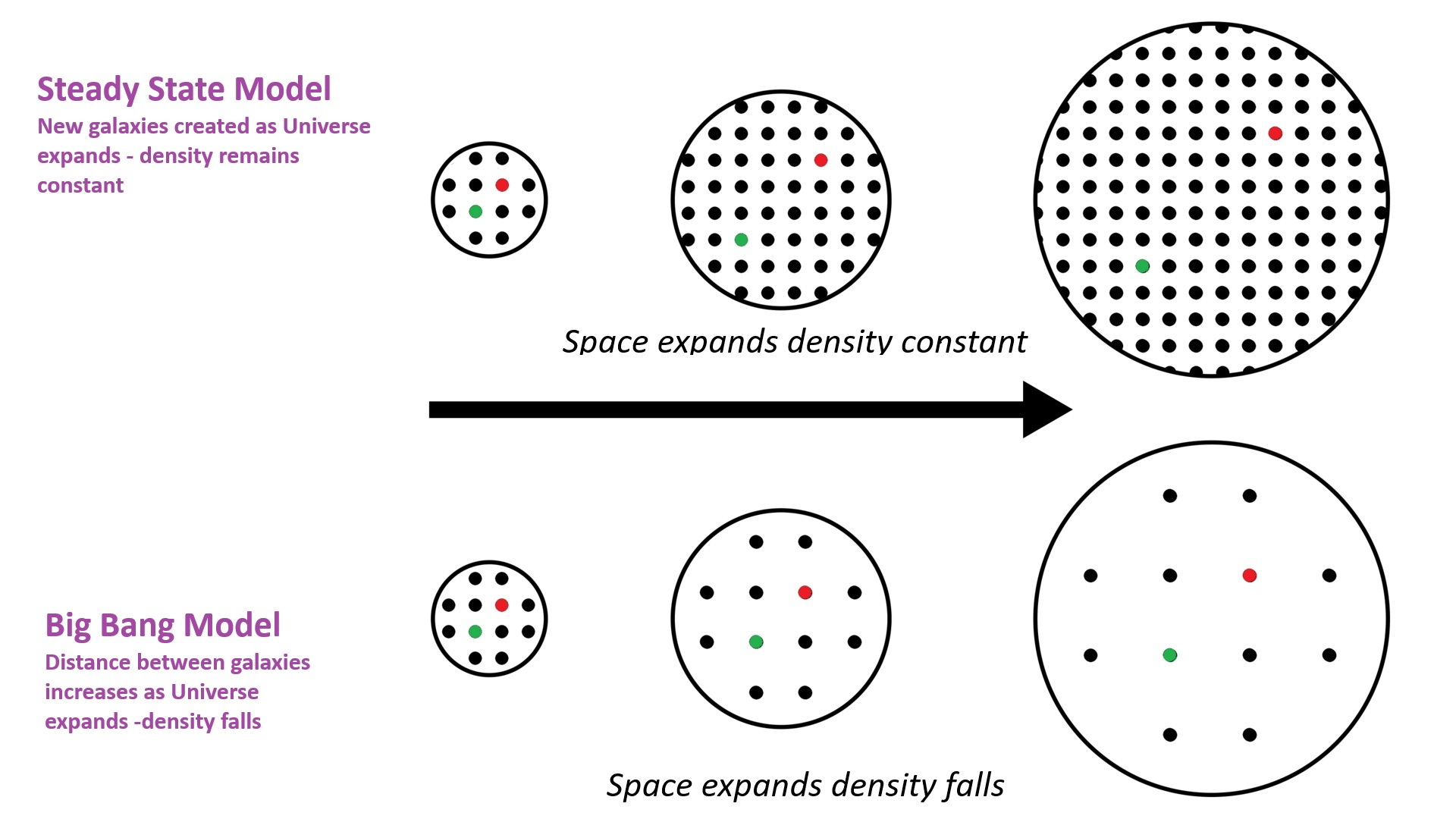
In the diagram I have taken a small region of space and marked two galaxies with a red and a green dot to allow them to be identified. All the other galaxies are marked with a blck dot. The lower part of the diagram illusrates the Big Bang theory where the distances between the galaxies increases as the Universe expands. In the Steady State theory, shown in the upper part of the diagram, the distance between the red and the green galaxies increases but extra galaxies are created and the average distance between galaxies doesn’t change. Indeed if the Steady State theory were true then an observer would measure the same values of:
- the average density of the Universe,
- average distance between galaxies,
- average brightness of galaxies
- how the speed that galaxies are moving away varies with their distance
in all regions of the Universe at any time in the past or in the future.
One of the elegant features of the Steady State theory is that because the Universe is infinitely old the question of its origin doesn’t arise. It has always existed. Unlike the Big Bang theory, the Steady State theory has no point far back in time when a ‘creation event’ occurred causing the Universe to come into being. To Fred Hoyle, who was a committed atheist, this was a particularly attractive feature of the theory.
Decline of the Steady State theory
The Steady State theory was very popular in the 1950s. However, evidence against the theory began to emerge during the early 1960s. Firstly, observations taken with radio telescopes showed that there were more radio sources a long distance away from us than would be predicted by the theory. By a long distance, I mean billions of light years. Because of the times it takes light to reach us then, when we look at objects billions of light years from us, we are looking back billions of years in time. So what these observations were saying is that there were more cosmic radio sources billions of years ago than there are now. This would suggest that the Universe is changing over time which contradicts the Steady State theory
Another piece of evidence to discredit the theory emerged in 1963, when a new class of astronomical objects called quasars was discovered. These are incredibly bright objects which can be up to 1,000 times the brightness of the Milky Way, but are very small when compared to size of a galaxy. Quasars are only found at great distances from us, meaning that the light from them was emitted billions of light years ago. The fact that quasars are only found in the early Universe provides strong evidence that the Universe has changed over time.
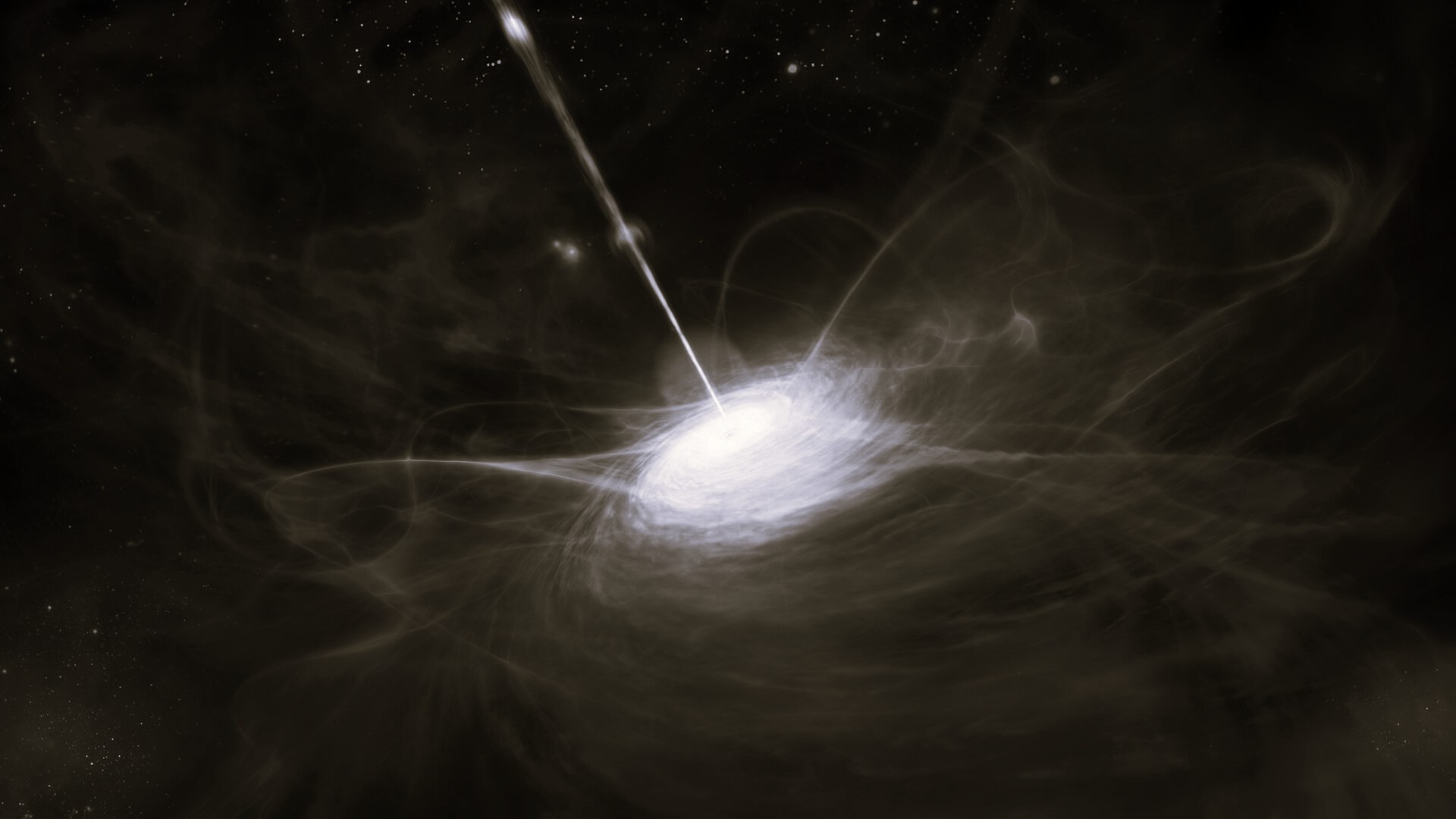
This artist’s impression shows how ULAS J1120+0641, a very distant quasar powered by a black hole with a mass two billion times that of the Sun, may have looked. This quasar is the most distant yet found and is seen as it was just 770 million years after the Big Bang. This object is by far the brightest object yet discovered in the early Universe.
A quasar. Image from ESO
However the real the nail in the coffin of the Steady State theory was the discovery in 1965 of the cosmic microwave background radiation. This is a weak background radiation which fills the whole of space and is the same in all directions. In the Big Bang theory this radiation is a relic or snapshot from the time the Universe was young and hot and was predicted before it was discovered. However, in the Steady State theory it is almost impossible to explain the origin of this radiation.
Is the Steady State theory a good theory?
For the reasons given, by the early 1970s the Steady State theory was no longer accepted by the vast majority of cosmologists. The Big Bang theory is now generally believed to explain the origin of the Universe. However, despite this it can still be argued that the Steady State theory is a good theory.
In the words of the cosmologist Stephen Hawking (1942-2018) :
‘the Steady State theory was what Karl Popper would call a good scientific theory: it made definite predictions, which could be tested by observation, and possibly falsified. Unfortunately for the theory, they were falsified’ [1].
Image from NASA
Further reading and related posts
I hope you have enjoyed this post. For further reading, here are some posts on related topics.
Roger Penrose’s cyclical model of the Universe in which it passes endlessly through a possibly infinite number of cycles each of which starts with a Big Bang and ends with a rapidly expanding empty universe.
An outline of the far future of the Universe in the current Big Bang cosmology
There is also a video explaining the concepts discussed in this post in more detail
This video gives an overview of the generally accepted Big Big Bang theory.
Notes
1 To continuously create matter and to drive the expansion of the Universe. Fred Hoyle introduced into the Steady State model something he called the C-field, where C stands for creation.
References
[1] Stephen Hawking. (2018). The Beginning of TIme. [online] Available at: http://www.hawking.org.uk/the-beginning-of-time.html. (Accessed 9 March 2026)

 Explaining Science
[…] The discovery of cosmic background radiation led most cosmologists to abandon the steady-state model in favor of the Big Bang. While the theory still exists in modified fringe forms, its decline highlighted a core principle of science: no matter how philosophically appealing an idea is, it must yield to observational evidence.[7] […]
LikeLike
[…] The discovery of cosmic background radiation led most cosmologists to abandon the steady-state model in favor of the Big Bang. While the theory still exists in modified fringe forms, its decline highlighted a core principle of science: no matter how philosophically appealing an idea is, it must yield to observational evidence.[7] […]
LikeLike
[…] The discovery of cosmic background radiation led most cosmologists to abandon the steady-state model in favor of the Big Bang. While the theory still exists in modified fringe forms, its decline highlighted a core principle of science: no matter how philosophically appealing an idea is, it must yield to observational evidence.[7] […]
LikeLike
please tell my science teacher not to give us a project on scientific theories on how the universe was created. please. I am on my knees. I am crying. thank you so much. 😦
LikeLike
[…] and many other things. Additionally, we will discuss alternative theories. The ones like the Steady State Theory, Inflation Theory, Quantum Loop Gravity, and Multiverse Theory, and analyze their critiques and […]
LikeLike