
March 2026 – Update of an orginal post first published in 2016
On 14 March 2016 the ExoMars Trace Gas Orbiter (TGO) spacecraft was launched from Baikonur in Kazakhstan on a seven month journey to Mars. When it arrived at the red planet, its key scientific objective was to study how the distribution of the gas methane varies with location and over time.
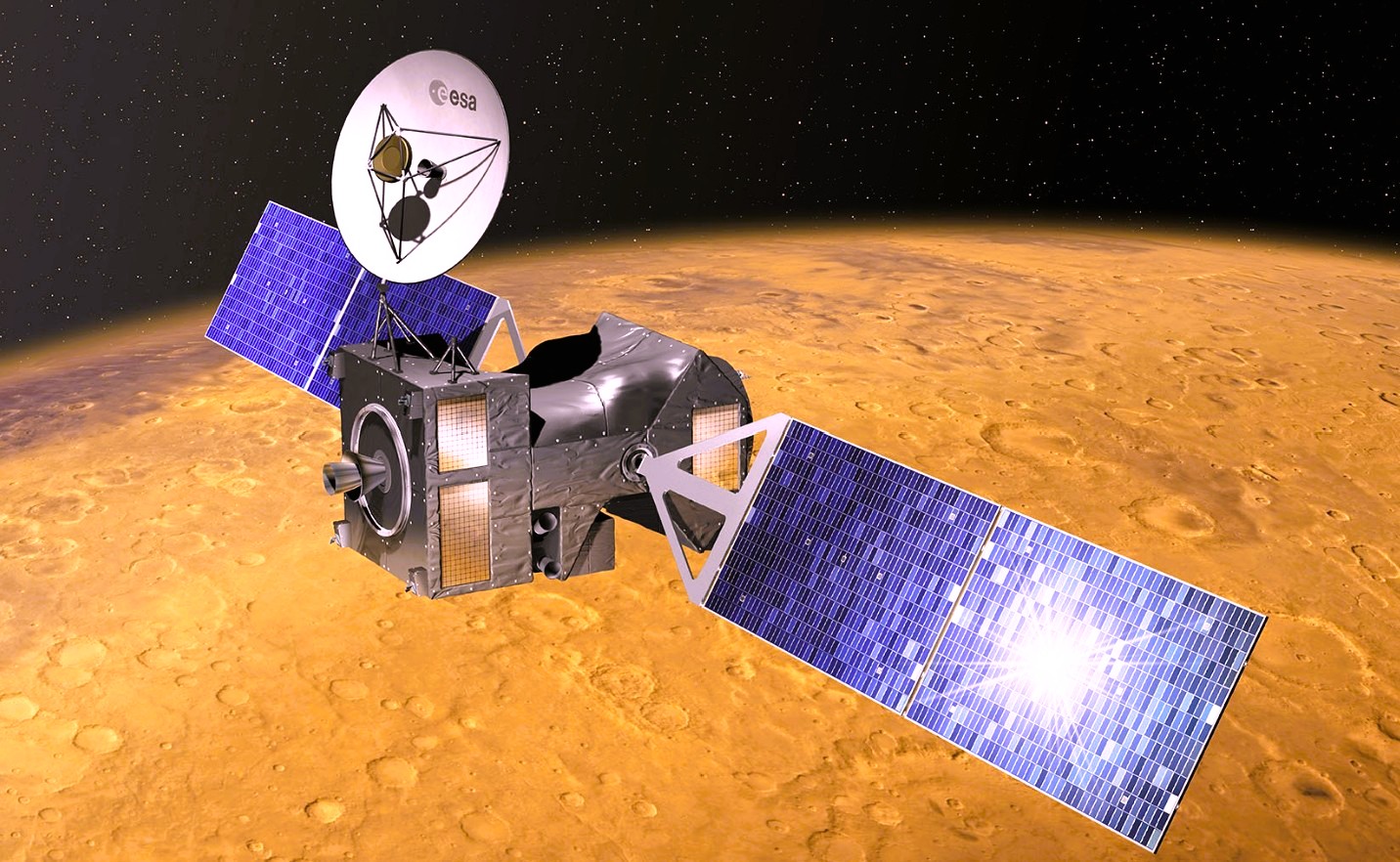
The significance of methane on Mars
Compared to the Earth, Mars has a very thin atmosphere. Its surface pressure is only 0.6% of that of the Earth. The atmosphere mainly consists of carbon dioxide. However, some earlier studies indicated that its atomsphere could contain small traces of methane (around 10 parts per billion) [1].
This is was puzzle because Mars doesn’t have an ozone layer to shield its surface from ultraviolet (UV) radiation and the UV from the Sun should break up any methane within 600 years. Therefore if methane does exist in the Martian atmosphere there must be some process occurring which is constantly replenishing it.
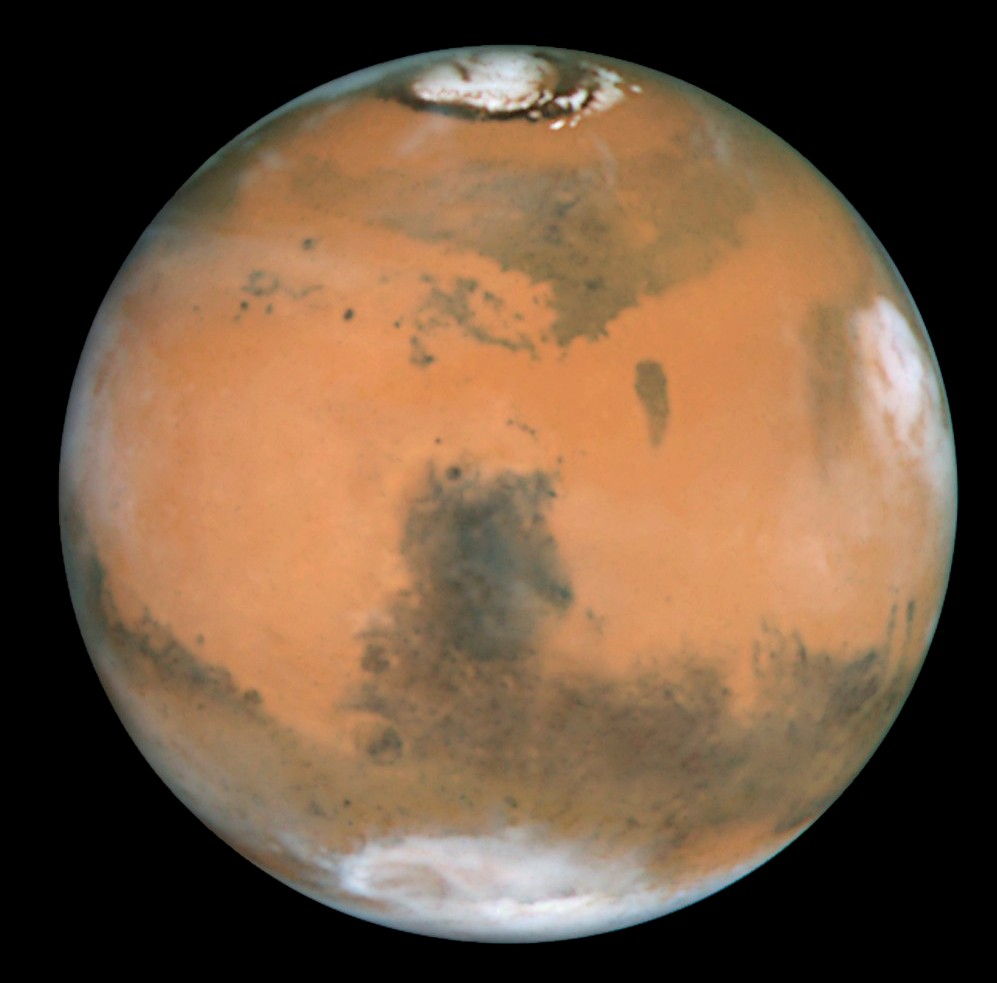
Mars- Image from NASA
How Martian methane could be generated
If these earlier studies were correct methane does exist in the Martian atmosphere there could be variable possibilities for its origin.
- It could be released from volcanoes
- It could be made in a chemical process occurring within rocks called serpentinisation. This is not as exciting as it sounds (no snakes, I’m afraid 😉 ) – it is simply a slow chemical reaction between olivine (a mineral found on Mars) carbon dioxide and water which can produce methane.
- There could be a large reservoir of methane locked away in the ice below the Martian surface and as the temperature varies some of the ice may melt, thus releasing the methane into the atmosphere.
- A fascinating possibility is that the methane is created by microorganisms below the planet’s surface. On Earth more than 90% of methane in the atmosphere is produced by living organisms [2] There are over 50 species of microorganisms known as methanogens that live off organic matter and produce methane as a waste product. These microorganisms are found not only in wetlands (producing what is known as marsh gas) and in the soil but also in the guts of many animals such as cows and humans. At the risk of sounding somewhat vulgar, the methane gas escapes from both cattle and ourselves in the form of flatulence.

Methanogens
What the TGO is measuring
At the time of writing this post the TGO is still orbiting Mars ten years after launch. It is also measuring the concentration of other gases such as sulfur dioxide (which on Earth is normally associated with volcanic activity) and organic compounds such as ethane, methanol and formaldehyde (which on Earth are produced by living organisms).
The spacecraft also carried a probe Schiaparelli to land on the Martian surface but sadly Schiaparelli disintegrated when it crashed into the ground at 300 km/h.
Is there methane on Mars
The spacecraft started Science Operations in April 2018 and one year later April 2019, the science team reported the surpising results that TGO had detected no methane whatsoever. This contricted the earlier finding that methane existed in the Martian atmophere at levels of around 10 parts per billion.. In 2024 it was announced that there was no detectable methane on Mars with an global upper limit on the methane concentration of 50 parts per trillion. [3] As is often the case in science I can only assume those earlier measurements were in error.
Related Posts
I hope you have enjoyed this post. Some other related posts which may be of interest are:
- The NASA Juno mission to Jupiter
- The proposed Schiaparelli landing on Mars
- What went wrong with ESA’s failed Schiaparelli Mars landing
- The Martian Methane Mystery
References
[1] ESA (2004) Mars Express Confirms Methane in the Martian Atmosphere, Available at:http://www.esa.int/Our_Activities/Space_Science/Mars_Express/Mars_Express_confirms_methane_in_the_Martian_atmosphere(Accessed: 20 March 2025).
[2] ESA (2014) The enigma of methane on Mars, Available at:http://exploration.esa.int/mars/46038-methane-on-mars/ (Accessed: 20 March 2025).
[3] Montmessin, O., Korablev, O., Trokhimovskiy, A., Olsen, K., Lefèvre, F., Baggio, L., Fedorova, A., Irbah, A., Lacombe, G., Patrakeev, A. and Duxbury, N. (2024) . THREE MARTIAN YEARS OF SEARCHING FOR METHANE ON MARS. [online] Available at: https://www.hou.usra.edu/meetings/tenthmars2024/pdf/3145.pdf [Accessed 5 Feb. 2026].

 Explaining Science
Wow just 6 months to get to Mars? Did they use the alignment of the planets? Probably so. Is this our regular speed of getting to Mars these days given the convenient coxation of the planets?
LikeLike
Location not coxation (sorry, spellcheck’s fault)
LikeLike
Great post! I have written something close to your topic futuremanweb.wordpress.com
LikeLike
Thank you
The Science Geek
LikeLike
[…] Check out this post by The Science Geek. If you like it, check out his posts on Earth’s magnetic field and life on Mars. […]
LikeLike
[…] via Short post of the month – April 2016: Life on Mars? — The Science Geek […]
LikeLike
As a space fan, I must say, your blog is pretty impressive!
LikeLike
Thank you
LikeLike
It might be a little small to fit on.
LikeLike
Hands up everyone who wants to be on that lander. 😀
LikeLike