
Revised March 2026
Sadly the Schiaparelli Spacecraft failed to land successfully on Mars. It hit the ground at 300 km/h and would have been destroyed on impact. The original version of the post below was published on 13 October 2016, six days before the failed landing.
On 14 March 2016 the European Space Agency used facilities at Baikonur in Kazakhstan to launch their long awaited mission to Mars, the not so snappily named ExoMars Trace Gas Orbiter (TGO) and, bolted onto it, a small probe called Schiaparelli. The TGO will orbit Mars for at least six years looking for trace gases in the Martian atmosphere. On Wednesday, 19 October, Schiaparelli will attempt to land on the surface of of the planet, after its seven month journey.
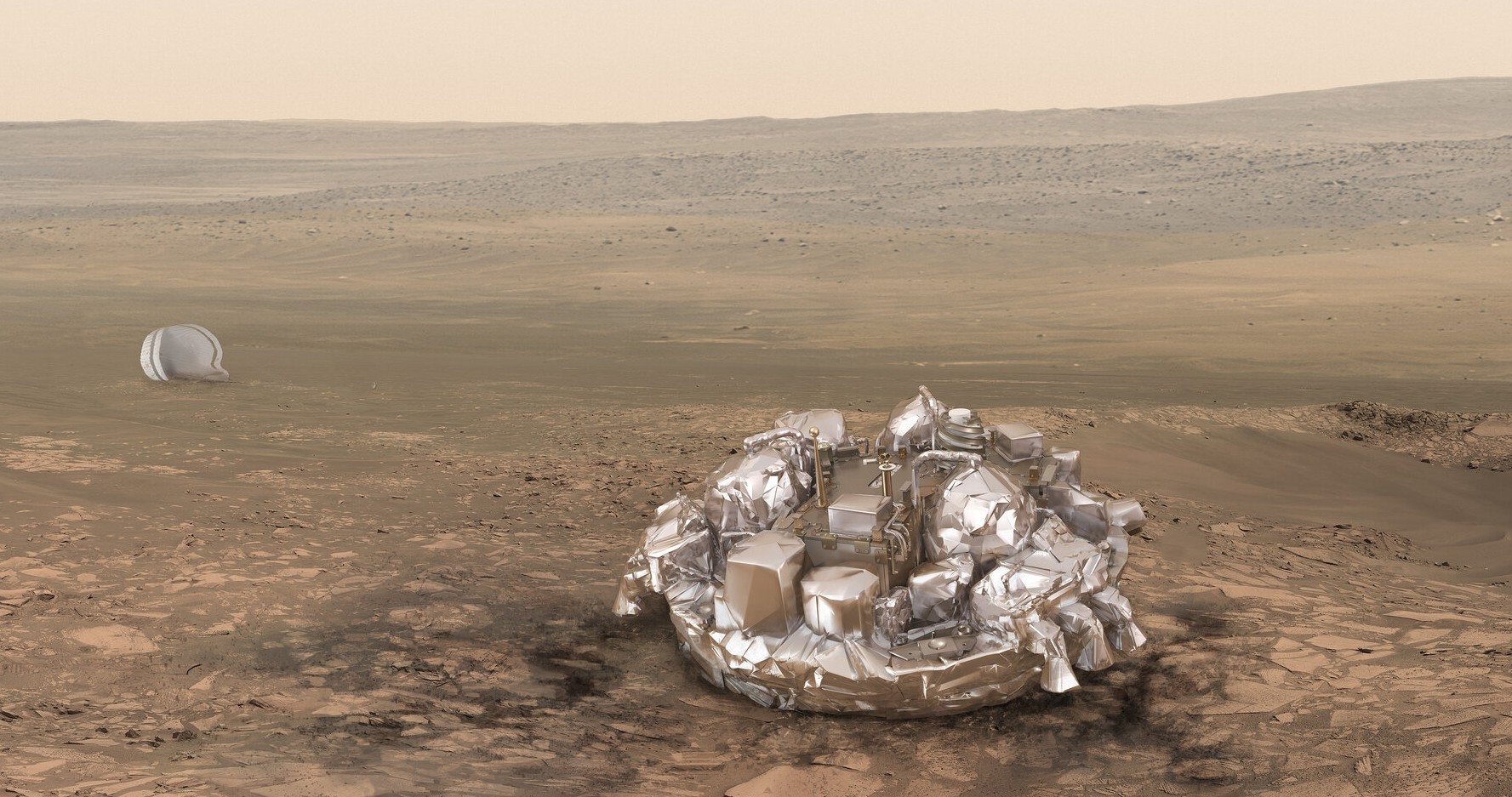
What Schiaparelli might look like on Mars’s surface – Image from ESA
Assuming all goes well, the spacecraft will land on a flat area called Meridiani Planum, just to the south of the Martian equator. Currently (i.e. October 2016) this region on Mars is in its dust storm season. Dust storms occur often on Mars and can be very large, covering an area the size of the US, and may last for many weeks. During a dust storm the dust can be so thick that it is not possible to see the Martian surface from Earth or even a spacecraft orbiting the planet. It also blocks much of the sunlight from reaching the planet’s surface. This was an important part of the storyline in “The Martian” where the hero’s car batteries were unable to move due to the lack of solar power, nearly stranding him.
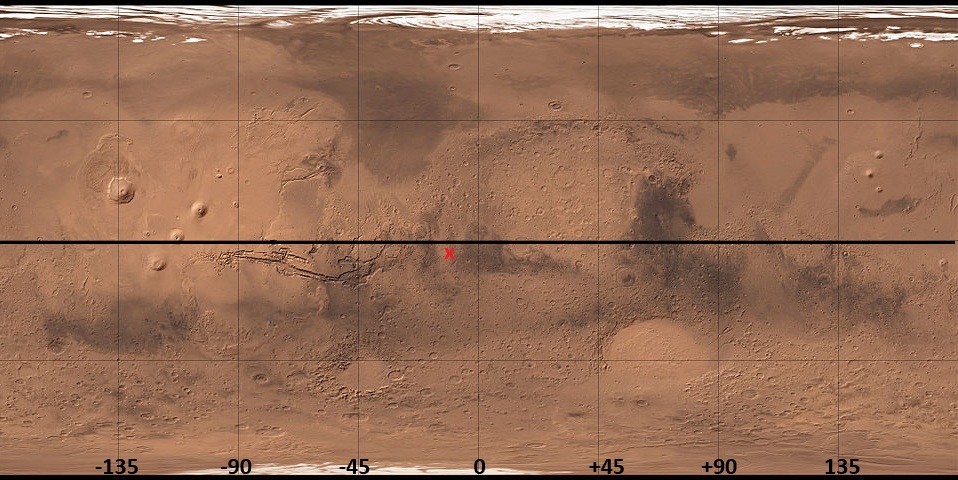
Landing site of Schiaparelli shown with the red cross
Schiaparelli carries a collection of instruments called DREAMS (Dust characterisation, Risk assessment, andEnvironment Analyser on the Martian Surface), to study the Martian environment.
The DREAMS instruments will be able to measure the local wind speed and direction, humidity, pressure, atmospheric temperature, the transparency (or how the amount of light which which gets through the atmosphere varies) and atmospheric electric fields which may be caused by dust.
Unlike nearly all modern spacecraft, Schiaparelli has no solar panels and is powered by a non- rechargeable battery. This battery will only last for about a week, after which the spacecraft will run out of power and stop functioning. The decision to go for non chargeable battery was made because Schiaparelli is a relatively simple lander, with a small set of instruments and will have completed its mission within the week in which it will be operational. The main part of the mission, is the TGO. This is described in my post:
The ExoMARS TGO tracking methane on Mars
And finally…
I hope you have enjoyed this post. Some other related posts which may be of interest are:

 Explaining Science
[…] to begin searching for the surest sign of life — the gas it leaves behind (Matthew Rozsa, Salon) Schiaparelli on Mars (The Science Geek) Exploration of Mars (ESA Official […]
LikeLike
Very interesting blog
LikeLike
I’m so excited about the possibility of life on Mars. It’s kind of funny the probe was named after Schiaparelli, who indirectly started the “Martian canals” phenomenon. It was obviously wrong, but it contributed so much to science fiction.
LikeLiked by 1 person
Yes if the TGO were to discover evidence that the methane which exists in Mars’s atmosphere is very likely to be biological in origin then the implications would be massive.
LikeLiked by 1 person
Incredibly massive. How do you think this would affect future Mars missions? Do you think we’d have to stop sending probes to Mars, so as not to risk contaminating the life on the planet? Or would we just have to change the process to avoid contamination?
LikeLiked by 1 person
In reply to your later comment. At the moment,
all spacecraft which land on Mars should be treated to prevent the accident contamination of Mars by Earth microbes. The attached link gives a little more more information:
http://mars.nasa.gov/mer/technology/is_planetary_protection.html.
I am not what will happen when we send spacecraft to land on Mars, presumably these standards will be relaxed
The Science Geek
LikeLiked by 1 person
Wonderful. Fingers crossed!
LikeLiked by 1 person
Fascinating stuff–thanks for the layman-decipherable explanation. BTW, if the battery dies in a week, how does the data get sent back to Earth?
LikeLiked by 1 person
The spacecraft will communicate with the TGO which will snd the data back to Earth
LikeLiked by 1 person
Thanks
LikeLike
All digits crossed. 🙂
LikeLike
Though not a scientist by education, by inclination I am captivated by the mysteries and possibilities that continually unfold. Thanks so much for expanding my world. It is fascinating to read in language I can grasp about the continuous endeavors to discover. Methane. Who knew the excitement behind finding the source. I am waiting to hear the results – someday.
LikeLiked by 1 person
Thanks. It will fascinating when we discover what the source of all the methane is.
LikeLike
Reblogged this on Dr. Mohsen Behnam.
LikeLiked by 1 person
I hope it succeeds.
LikeLiked by 1 person
Yes fingers crossed for a successful landing on Wednesday
LikeLike