Originally published August 2018 – updated May 2026
2018 marked the 20th anniversary of the International Space Station (ISS).
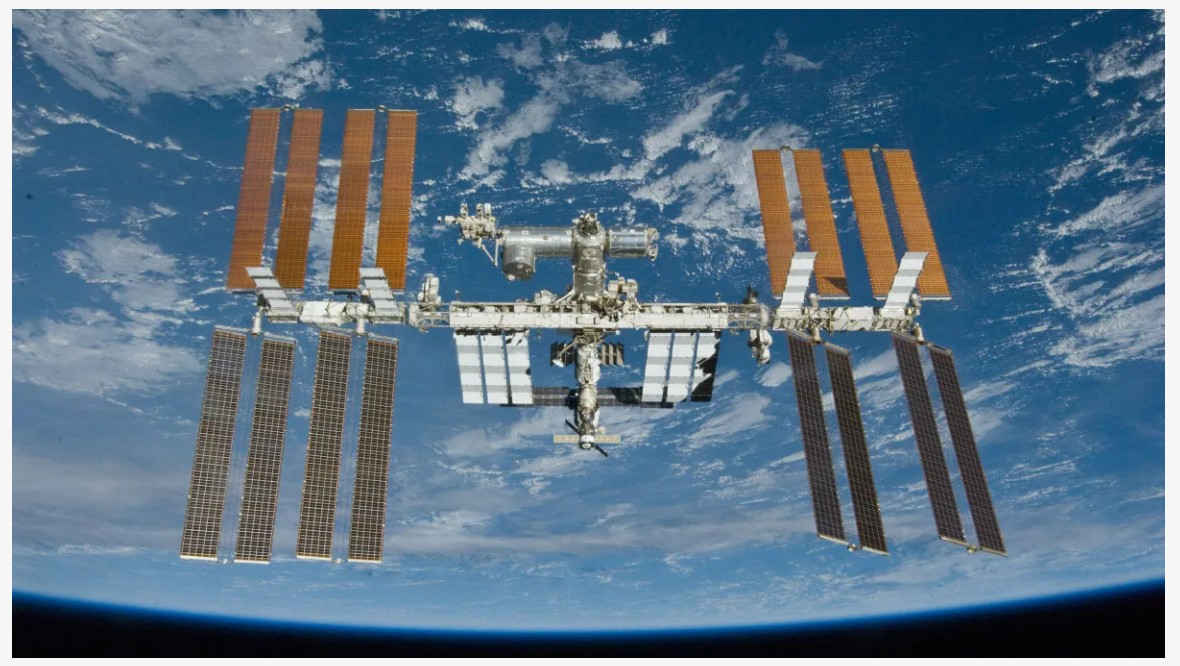
Image from NASA.
Building the ISS was a long process. The first module, called Zarya, was launched by a Russian rocket back in November 1998. Zarya was not an inhabitable module and its function was to provide electrical power, storage and propulsion to the ISS during the initial stages of assembly. Interesting t;yhe word ‘Zarya’ is Russian for sunrise and Zarya, being the first step in building the ISS, was to signify a new dawn in international cooperation and in particular cooperation between the US and Russia.

Zarya – Image create NASA Note: the solar panels shown are no longer used and have been retracted.
The ISS has a modular design, and in the twenty years since Zarya numerous modules have been added, gradually growing it into the structure we see today. A key milestone was achieved on 2 November 2000 when a Russian Soyuz spacecraft bought the first crew to the ISS. The ISS has been manned ever since that date, providing a permanent human presence in space. In August 2018, when the first draft of this post was written, the crew of the ISS consisted of: three Americans, two Russians and one German. Long term crew are given an expedition number and this crew was known as Expedition 56.

Mission patch for Expedition 56 – Image from NASA
The role of the Space Shuttle in Building the ISS

Image from NASA
The Space Shuttle, which flew between 1981 and 2011, was key to building the ISS. The Shuttle was unique in that it had the capacity to take large modules in its cargo bay and crews of up to six astronauts on assembly missions. Many of these missions involved extended spacewalks.
Indeed, without the Space Shuttle it would not have been possible to build the ISS. Although looking at things in a different way, after 1998, construction of the ISS became the almost the entire focus of the shuttle programme. This is illustrated by the statistic that of the 43 space Shuttle Missions flown after the launch of Zarya, 38 (89%) of them went to the ISS to deliver a new module and components to the station, bring fresh supplies or to bring fresh crew to the ISS and return the old crew to Earth. Without the need to build and service the ISS the Space Shuttle may well have have retired much sooner.
The Orbit of the International Space Station
The ISS is shown in the image at the top of this post. By 2018 its construction was essentially complete. The ISS is a very flat structure. It is 73 metres long and a maximum of 109 meters wide, but its maximum depth is only a few metres. It has a mass of 420 tons. Its most noticeable feature are the eight separate sets of solar panels, which look like giant wings and in total generate up to 90 kilowatts of electric power [1]
The ISS orbit is almost perfectly circular, just over 400 km above the Earth’s surface. At this altitude, although it is classified as being in space, which begins at an altitude of 100 km, (see Where does Space Begin), there are sufficient traces of the Earth’s atmosphere to cause the ISS to lose energy as it moves against the air resistance caused by this very thin gas. This causes the ISS to very gradually spiral down to Earth as it loses a small amount of energy on each orbit. The distance a satellite drops in altitude is known as its orbital decay and for the ISS is 2 km per month, about 70 metres per day. If nothing were done the ISS would gradually return to Earth within a few years and as it hit the thicker atmosphere it would disintegrate. To prevent this happening the ISS has a set of thrusters, which are fired periodically to boost it into a higher orbit. Visiting spacecraft also fire their rocket motors to the same effect.
Because it is both large and travels in a low orbit, the ISS can be easily seen from Earth. It is visible to the naked eye as a slow-moving, bright white dot. Its brightness is due to sunlight reflecting off its solar panels. The best time to see it is either after sunset or before sunrise, when the station remains sunlit, but the sky is dark. This is shown in the diagram below.

The ISS takes about 90 minutes to complete an orbit. As it moves around its orbit:
- the ISS is visible at night between sunset, point A, and when it disappears behind the Earth’s shadow, point B;
- between points B and C the ISS is in the Earth’s shadow it receives no direct sunlight and cannot be seen;
- between point C, when it emerges from the Earth’s shadow, and point D, sunrise, the ISS is visible;
- between points D and A, the ISS cannot be easily seen against the brightness of the daytime sky.
Because of its size, the ISS is the brightest artificial object in the sky and has a similar brightness when overhead to the planet Venus.
Research performed at the ISS
A good deal of research is carried out at the ISS. This is described in more detail on the NASA website [2] Much of this research is based upon the fact that that the strength of gravity is very close to zero in the ISS. This is known as micro-gravity and the only place it is possible to create a micro-gravity environment, for longer than a few minutes, is in space. Some examples of this research are given below.
- Fluids can be almost completely combined in micro-gravity, so physicists can study combinations of fluids that do not mix well on Earth.
- In micro-gravity environment combustion occurs differently. Flames have a spherical shape. In the diagram below, the candle on the left is in normal gravity, whereas the candle on the right is in micro-gravity.
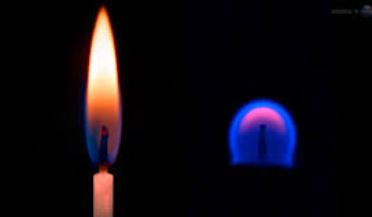
Image from NASA
- Research has been carried out as to how plants develop in micro-gravity. Interestingly, results have shown that plants use light rather than gravity to determine which direction is ‘up’.
But perhaps the most interesting area of research are the effects on the human body of spending long periods on time in near weightlessness. This area is important, because in the next few decades when astronauts travel to Mars they will have to spend at least six months in zero gravity when travelling to the red planet and a further six months on the return journey. Some of the effects which have been found are.
- Without any weight to work against, muscles gradually will get smaller and lose their strength. This includes the heart muscle.
- Fluid shifts around the body causing fluid pressure in the brain to increase.
- One of the most serious problems is that, without gravity, a strong skeleton is not needed to support the body. Studies have shown that astronauts lose 1-2 % of their bone mass for each month of weightlessness; the calcium from their bones is excreted in their urine. So much calcium may be lost that it can cause kidney stones.
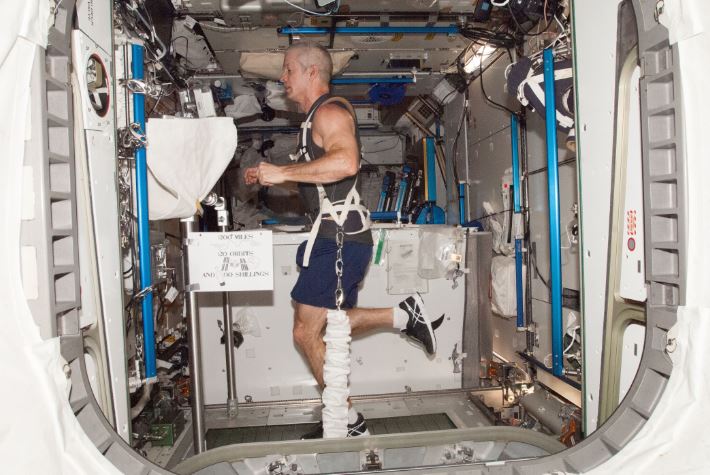
Research on the ISS has shown that to retain their muscle mass, and ensure their heart stays in good condition, astronauts need to spend many hours a day exercising. Because there is no weight for their muscles to work against, astronauts often spend a large fraction of the day running on a treadmill, using elastic harnesses to provide resistance.
However, nothing has been discovered which can prevent the loss of bone density. The rate of bone loss continues at 1-2% per month and does not level off after long durations in space. After more than two years in low gravity, astronauts’ bones would be so weak they would easily fracture and would be unable to support their weight then they returned to Earth. This may be a limiting factor for how long humans can spend in zero gravity environments, especially since it takes a significant time for the bone density to return to normal.
A further limiting factor is that on long duration spaceflights astronauts will be exposed to high doses of radiation. This can cause genetic damage making the astronauts more prone to cancer in later life.
Astronauts become Temporarily Taller in Microgravity
Spending time in a microgravity environment causes the spine to elongate. On Earth, gravity keeps the vertebrae in place by constantly pushing them together. But without gravity, the vertebrae will naturally expand slightly, causing a person to become taller.
Typically, astronauts in space can grow up to three percent of their original height. For example, in 2016 when Scott Kelly came to Earth after spending nearly a year in space he was 2 inches (5 cm) taller. However, this gain in height is only temporary. When under the effects of gravity again astronauts return to their original height.
Getting to and from the ISS
There are two spacecraft which take astronauts to and from the ISS. The Russian Soyuz spacecraft and the SpaceX Dragon.
In fact from the end of the Shuttle programme in 2011 to first flight of the crewed SpaceX Dragon spacecraft in 2020 the only way astronauts could get to and from the ISS was by Soyuz. A point worth remembering as since 2022 relations between the US and Russia have been rather strained. Soyuz was first flown in 1967 and its design has changed little since then. Like the Apollo spacecraft which took astronauts to the Moon, it is a single use spacecraft. NASA used to pay $70 million in 2013 dollars (over $100 million in 2026 dollar) for each astronaut who flew in the Soyuz [3]
After the Shuttle’s retirement, rather than build a new craft to fly crew to and from the ISS, NASA administered a US-government funded programme called Commercial Crew Development (CCDev). This provided a money for private American companies to design, develop and build spacecraft to take astronauts to the ISS. After a lengthy evaluation process NASA announced in September 2014 that Boeing and SpaceX had both received contracts to provide crewed launch services to the ISS.
When the final decision was made, NASA hoped (somewhat optimistically! ) that SpaceX and Boeing would be able to launch crewed missions to the ISS by 2017. Unsurprisingly, there were numerous delays in the development of both spacecraft and the launch dates slipped.
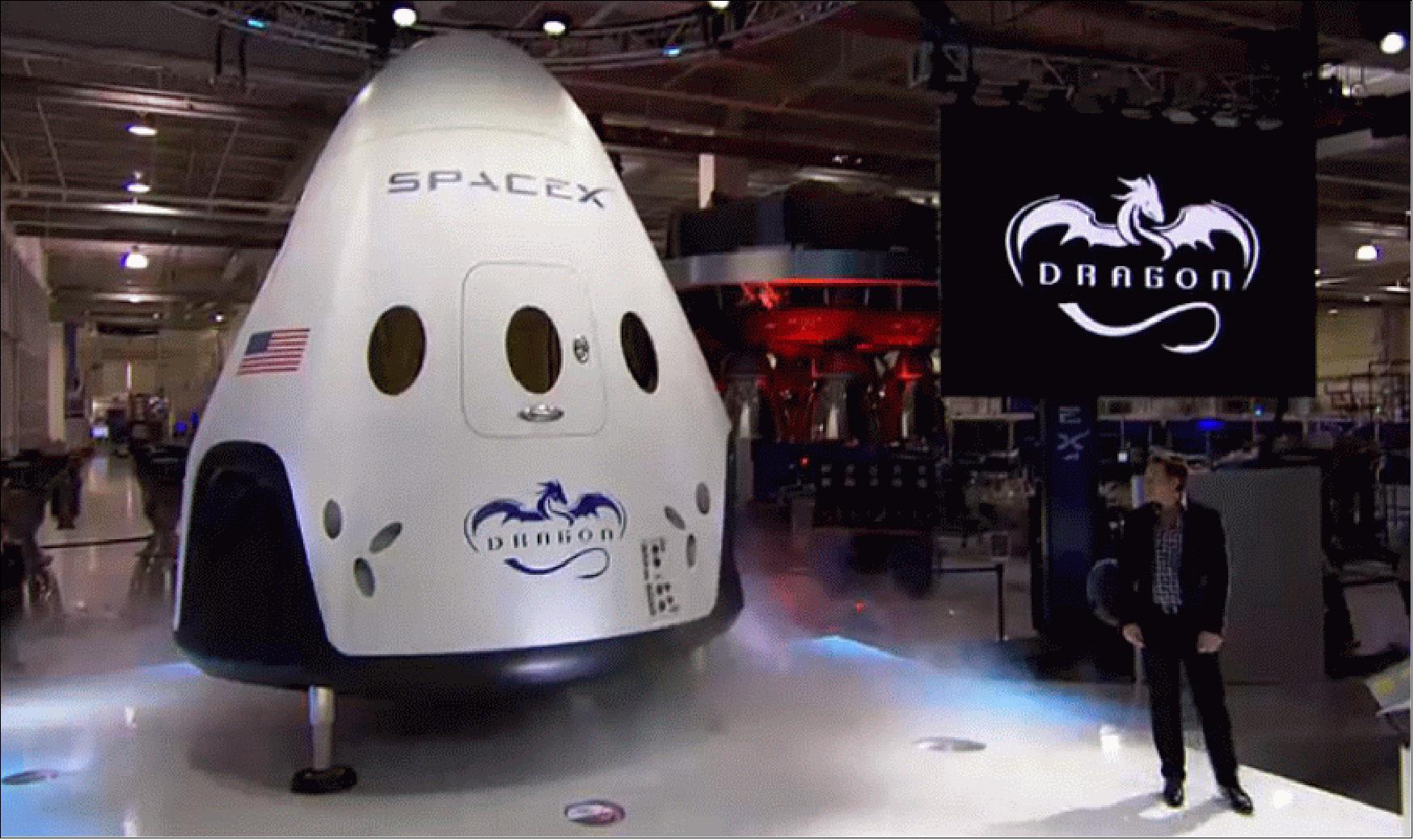
The first spaceflight to the ISS by a SpaceX crewed Dragon spacecraft was in May 2020. Since then 17 further crewed spaceflight to the ISS have taken place. In addition SpaceX has been able to provide orbital spaceflights to wealthy space tourists. The SpaceX Dragon has shown itself to be safe and reliable. The space capsule is designed to be reusable and should last about 15 flights.
After a Dragon capsule returns to Earth it splashes down in the Atlantic Ocean or the Gulf of Mexico. SpaceX extracts it from the ocean using a recovery ship, transports it to a refurbishment facility in Florida, and executes a turnaround process. This includes:
- Deep cleaning to remove salt deposits.
- Extensive structural inspections.
- Replacing the external thermal protection tiles where necessary.
- Replacing any valves or components that show signs of damage.
Things have not gone as well for Boeing. Despite billion being spent on research and development, However at the time of writing (late May 2026) their spacecraft the Starliner has not yet taken astronauts to and from the ISS. A Starliner test mission took two astronauts to the ISS but they had to return on a SpaceX Dragon.
References
[1] NASA (2023). International Space Station Facts and Figures – NASA. [online] Nasa. Available at: https://www.nasa.gov/international-space-station/space-station-facts-and-figures/. (Accessed 27 May 2026)
[2] NASA. (2026). Space Station Research and Technology – NASA. [online] Available at: https://www.nasa.gov/international-space-station/space-station-research-and-technology/. (Accessed 27 May 2026)
[3] Wall, M. (2013). NASA to Pay $70 Million a Seat to Fly Astronauts on Russian Spacecraft. [online] Space.com. Available at: https://www.space.com/20897-nasa-russia-astronaut-launches-2017.html. (Accessed 27 May 2026)
Discover more from Explaining Science
Subscribe to get the latest posts sent to your email.


[…] discussed in my previous post, in the November after the agreement was signed the first module of the ISS, Zarya, was launched. […]
LikeLike
[…] mentioned in my previous post, within the November after the settlement was signed the primary module of the ISS, Zarya, was […]
LikeLike
[…] mentioned in my previous post, within the November after the settlement was signed the primary module of the ISS, Zarya, was […]
LikeLike
[…] mentioned in my previous post, within the November after the settlement was signed the primary module of the ISS, Zarya, was […]
LikeLike
[…] discussed in my previous post, in the November after the agreement was signed the first module of the ISS, Zarya, was launched. […]
LikeLike
[…] Note 10 September 2018. The information in the section ‘Getting to and from the ISS’ has been superseded by information in the updated version of this post. […]
LikeLike
[…] Source link […]
LikeLike
Reblogged this on Peuples Observateurs Avant Garde Togolaise et Africaine.
LikeLiked by 1 person