
Updated May 2026
For a nine year period the retirement of the Space Shuttle in 2011 until the first flight of the SpaceX Dragon spacecraft in 2020 the only way astronauts could get to and from the International Space Station (ISS) was on the Russian Soyuz spacecraft. After the Soyuz spacecraft (Soyuz MS-10) on a mission to take a ffresh crew of three to the ISS failed to get into orbit on 11 October 2018, it looked like all Soyuz flights to the ISS might be on hold for a period of time – until the reason for the failure had been identified and steps put in place to prevent it happening again.
If there had been a delay to the Soyuz crew rotation flights, then when the crew on the spacestation left, there was the possibility the ISS would need to have been temporarily abandoned.
Luckily this didn’t happen. The Russian Space Agency quickly identified the cause of the Soyuz MS-10 failure as a fauly sensor. NASA were happy with the Russian investigation and the next Soyuz (Soyuz MS-11) flew to the ISS, with the replacement crew on 3 December 2018.

Soyuz MS spacecraft docked to the ISS – image from NASA
Eight months before the Soyuz failure, the future of the ISS had been brought into question when in February 2018, during the first Donald Trump administation, the White House indicated that NASA would cease to receive government funding for the ISS by 2025. In the event this actually didn’t happen but it is interesting to look back at this post I wrote back in 2018 on the future of the space station.
The Future of the International Space Station
Although the ISS is labelled as an international project, in reality most of the costs of building and operating it have been born by the American taxpayer. Each year it remains in orbit, NASA allocates roughly half of its total human space flight budget to ISS operations – an expenditure that limits its ability to fully fund development of crewed spacecraft to visit the Moon and other destinations beyond low Earth orbit. One option which was being considered in 2018 was to privatise the International Space Station, make it self-sustaining business without government support, freeing up resouces to spent on other human spaceflight projects
Was privatising the ISS realistic Option
In reality it is difficult to see how private companies would pick up America’s contribution towards running the space station, which is currently running at about $4 billion per annum.
Although in recent years NASA has taken steps to commercialise the ISS, a 2018 NASA audit report [1] was highly sceptical about NASA being able to run the ISS without government support
‘NASA’s current plan to privatize the ISS remains a controversial and highly debatable proposition, …. it is questionable whether a sufficient business case exists under which private companies can create a self-sustaining and profit-making business independent of significant Government funding.
In particular, it is unlikely that a private entity or entities would assume the Station’s annual operating costs, …. Such a business case requires robust demand for commercial market activities such as space tourism, satellite servicing, manufacturing of goods, and research and development, all of which have yet to materialize. Candidly, the scant commercial interest shown in the Station over its nearly 20 years of operation gives us pause for thought about the Agency’s current plan.’
According to this report America pays 77% of the ISS operating costs. It is unlikely that other nations would want to significantly increase their contribution if the US Pulled out. The European Space Agency (ESA) is working with the Chinese Space Agency to fly European astronauts on the new Chinese Space Station, which is planned for operation in 2023, so is unlikely to want to pay more towards the ISS.
Options for the Future of the International Space Station
Assuming that private companies do not take over the running of the ISS over the next 5-10 years, I can see four options.
Option 1: Continue with US government funding beyond 2024.
One thing to bear in mind with this option is that the ISS has already exceeded its original lifetime. At the start of the ISS programme in 1998, it was expected to be decommissioned in 2015. In 2011, as construction was nearly complete, this was extended to 2020. In 2014, it was further extended to 2024.
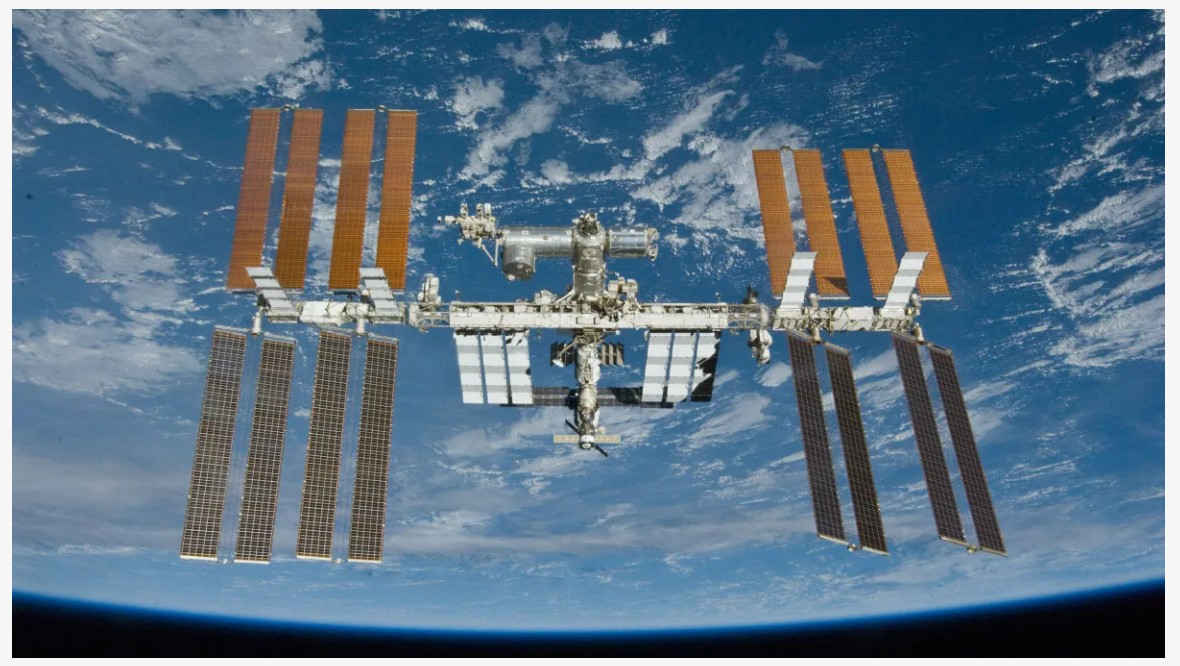
The ISS – Image from NASA
Some of the components in the ISS are almost 30 years old and nearing the end of their operational lifetimes. Although this does not mean that there will be a major failure in the ISS, it is inevitable that as the ISS gets older there will be increased risks to the crew due to ageing hardware and equipment. If this option is chosen, it means that NASA would have less money to develop spacecraft to go beyond low Earth Orbit.
[Update]. Since the publication of the original version of this post, this option has been chosen as an interim measure. In 2021 NASA announced the extension of the lifetime of the ISS to 2030, NASA administrator Bill Nelson said:
“The International Space Station is a beacon of peaceful international scientific collaboration and for more than 20 years has returned enormous scientific, educational, and technological developments to benefit humanity. I’m pleased that the Biden-Harris Administration has committed to continuing station operations through 2030,” [2]
However at the time of writing it is unlikely that the ISS wil be extended much beyond 2030.
Option 2 Controlled re-entry of the International Space Station
At the end of the lifetime of the ISS, a specially built spacecraft (the deorbit vehicle) would dock with it. The deorbit vehicle’s thrusters would fire to lower the ISS’s orbit, from its current altitude of 400 km to around 100 km. At this altitude there is sufficient atmosphere for air resistance to rapidly slow the ISS down. The ISS would break up into many pieces each moving so fast that friction would generate enough heat for most of them to burn up in the atmosphere. However, a few larger parts might survive to hit the Earth’s surface.
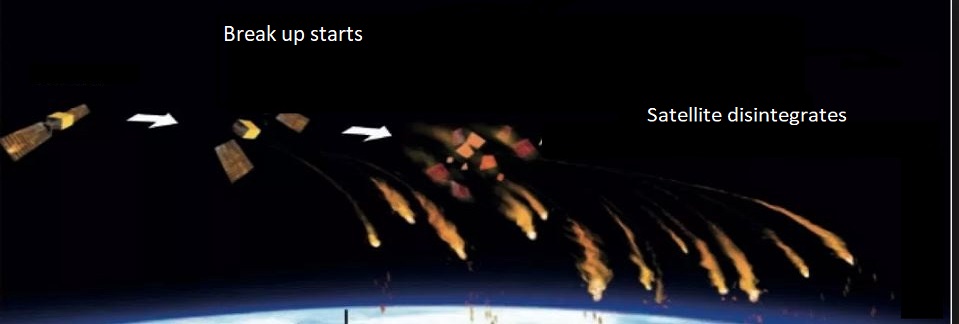
A controlled re-entry would ensure that the ISS’s final disintegration would take place over an unpopulated area. The Russian space station MIR, which had a mass of 132 tonnes, was destroyed in a controlled re-entry over the South Pacific in 2001.
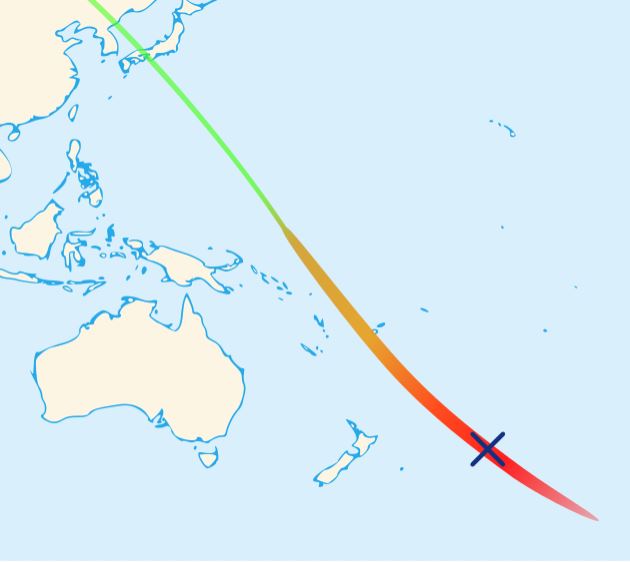
Path following by MIR during its re-entry – image from Wikimedia commons
[Update] In 2024 the decision was taken that at the end of the ISS lifetime the ISS will be deorbited by the US deorbit vehicle. This is being developed by SpaceX in a contract worth up to $843 billion [3]. This will not happen before 2031.
Option 3 When the ISS reaches the end of its lifetime it is abandoned and left to its fate.
At the ISS’s altitude (400 km), there are sufficient traces of the Earth’s atmosphere to cause it to lose energy as it moves against air resistance. This causes the ISS to very gradually spiral down to Earth. The distance a satellite drops in altitude is known as its orbital decay and for the ISS is 2 km per month. This is the reason why the ISS needs to be periodically pushed upwards by firing its boosters or those from attached spacecraft.
If the decision were taken to abandon the ISS and stop boosting it upwards, it would return to Earth within a few years and as it hit the thicker atmosphere it would disintegrate. However, there would be little or no control over where the disintegration happened. There would a small risk that debris could land over a populated area and cause damage to people or property. This is what happened to the American space station Skylab which was abandoned in 1974 and re-entered the Earth’s atmosphere in July 1979.
Skylab weighed 77 tonnes (compared to the 420 tonnes for the ISS) and is to date the largest ever satellite to return to Earth in an uncontrolled re-entry. The inclination of Skylab’s orbit was 50 degrees to the Earth’s equator, which meant that anyone between latitudes 50 degrees North and 50 degrees South was in danger from being hit by debris, although the actual risk of anyone coming to harm was exceedingly low. On July 11 1979 it re-entered and disintegrated over a sparely populated region of Australia.
No one was hit by debris, but some large pieces of Skylab hit the Earth’s surface including part of an oxygen tank (shown below) which was found 15 miles southwest of the town of Rawlina, Western Australia.
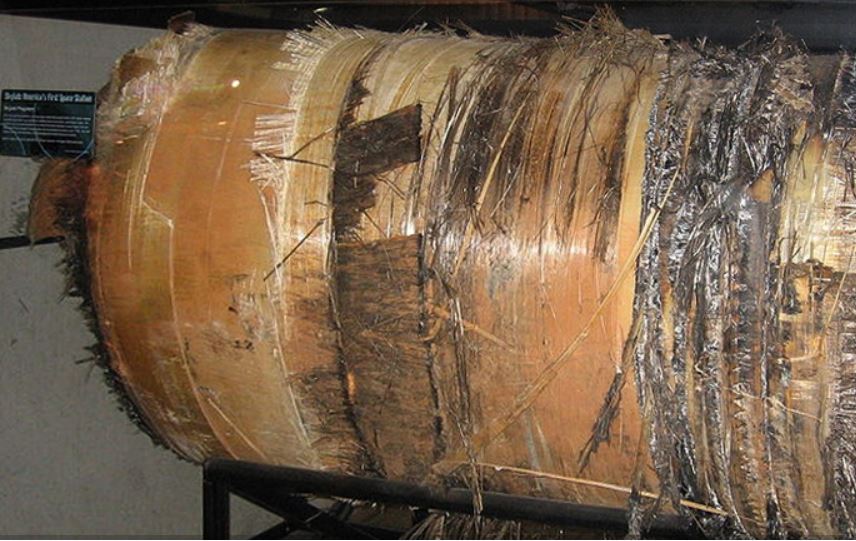
President Jimmy Carter issued the following message of apology, when it was clear that Skylab hadn’t fully broken up in the Earth’s atmosphere.
‘ I was concerned to learn that fragments of Skylab may have landed in Australia. I am relieved to hear your Government’s preliminary assessment that no injuries have resulted. Nevertheless, I have instructed the Department of State to be in touch with your Government immediately and to offer any assistance that you may need.’
Although this option was the cheapest, given the size of the ISS and risk of large pieces hitting a populated area, it was not a viable option.
Option 4 boost the ISS into a higher orbit.
At the end of its lifetime, a booster is attached to the ISS to place it into a higher orbit where the atmospheric drag is very low. If the ISS could be boosted to an altitude of 900 km if would remain in space for about 1000 years [4]. This option gives the interesting possibility that future generations of astronauts would be able to visit the ISS. Eventually, it might become a historical site where extremely wealthy space tourists would travel to.
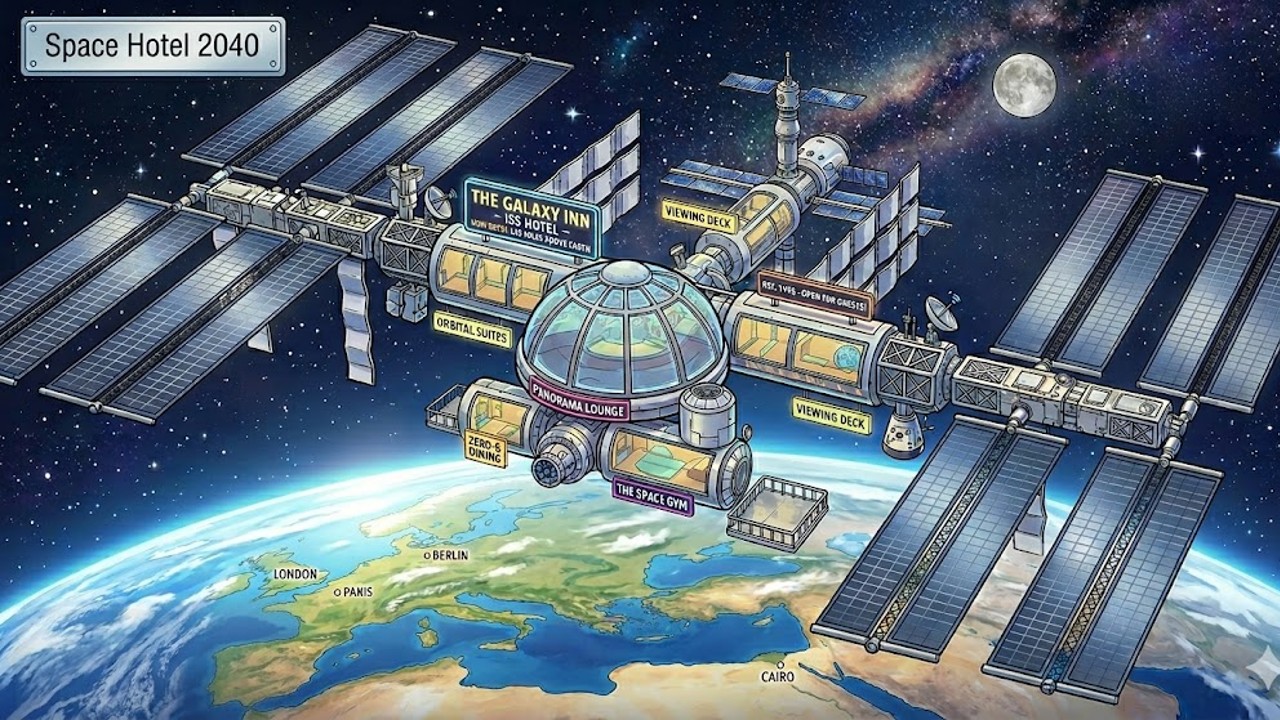
For various reasons NASA has decided not to persue this option, the main ones being:
- The risk of collison with collision with space debris in a higher orbit which would in more space debris.
- The costs of doing this.
- The ongoing maintenance and management of the ISS in its higher orbit
International Cooperation in Space
The ISS provides a platform in which humans can spend a long period of time in near zero gravity. This research is important because, in the next few decades, when astronauts eventually travel to Mars they will have to spend at least six months in zero gravity when travelling to the red planet and a further six months on the return journey. An extension of the ISS’s lifetime to 2028 or beyond would enable NASA to continue in-orbit research to prepare for future long duration space missions.
For political reason, largelty driven from America China has been frozen out of the ISS. Since 2021, China also has it own modular space space station Tiangong and although so far it has only been crewed by Chinese astronauts, China is looking to partner with other nation. In the next few years it is likely that Tiangong may be visited by astronauts from other countries. In 2025 China and Pakistan made an agreement to send a Pakistani astronaut to the ISS [5] , athough there is not yet any firm date for when this will happen.
References
[1] NASA Office of Inspector General EXAMINING THE FUTURE OF THE INTERNATIONAL SPACE STATION Statement of Paul K. Martin Inspector General National Aeronautics and Space Administration. (2018). Available at: https://oig.nasa.gov/wp-content/uploads/2024/02/CT-18-001.pdf. (Accessed 31 May 2026)
[2] NASA. (2021). Biden-Harris Administration Extends Space Station Operations Through 2030 – NASA. [online] Available at: https://www.nasa.gov/blogs/spacestation/2021/12/31/biden-harris-administration-extends-space-station-operations-through-2030/. (Accessed 1 June 2026)
[3] NASA, (2024). NASA Selects International Space Station US Deorbit Vehicle – NASA. [online] Available at: https://www.nasa.gov/news-release/nasa-selects-international-space-station-us-deorbit-vehicle/. (Accessed 1 June 2026).
[4] Australian Space Academy (2020). Orbital Lifetimes. [online] Spaceacademy.net.au. Available at: https://www.spaceacademy.net.au/watch/debris/orblife.htm. (Accessed 1 June 2026)
‘[5] He, F. and Saifi, S. (2025). Pakistani astronaut will become first foreign national to enter Chinese space station. [online] CNN. Available at: https://edition.cnn.com/2025/04/24/science/china-space-station-pakistani-astronaut-intl-hnk. (Accessed 1 June 2026)
Discover more from Explaining Science
Subscribe to get the latest posts sent to your email.


2024 huh? $4 billion a year is roughly $ 30 a year per tax payer. Is the US govt so cheap that they cant keep that going for the benefit of humanity? Not to mention just plain bragging rights that the ISS is basically ours? I think they should keep it running with no plans to stop it running. We need more space science. How are we going to test new space techs that will take us off this planet if we dont have a place to do it it. So lame.
LikeLike
You make a very interesting point, I am not sure that everyone in the current US government would agree ! 😉
I am also aware that since I wrote this post back in November 2018, I probably need to write a revised version in the next year or as things develop
LikeLike
[…] space post-2024. Articles like The Options for the Future of the International Space Station and The future of Internation Space Station pointed out towards decommissioning the station as the best alternative. They discuss how private […]
LikeLike
I would think the only two options would be to control the re-entry or push it out further to save for posterity. I prefer the latter for sure. At least then it would release more funding for NASA to use elsewhere. As for US and China getting together peacefully I am highly doubtful that will happen but will continue to hope that one day we might be able to get along at least in that one endeavor.
LikeLike
I agree with you cooperation between US and China in manned space exploration would be the logical thing to happen. However, in the current political climate it is highly unlikely in the near future.
It will be interesting to see what NASA does (and the the US government stance is) in 4-5 years time when the Chinese Space Station is launched (with the European nations as partners)
,
The Science Geek
LikeLike
Great article! I wonder if they’d use existing hardware like the European ATV to deorbit the ISS, or if they’d design a custom stage to do so.
LikeLike
Thank you, interesting question. I suspect, that because of the ISS’s large mass, NASA/ESA/JAXA/the Russians would need to build a custom stage
LikeLike
Personally, I would prefer that it was NOT de-orbited and destroyed by burning up in the Earth’s atmosphere. I would much rather that it was shifted to a higher orbit where it could remain as monument
LikeLike
Reblogged this on Let's Get Off This Rock Already! and commented:
Very interesting article from the Science Geek, about what exactly we’re going to do about that vast, aging, and expensive piece of hardware we’ve got sitting in LEO. My personal hope is that we can boost the ISS into a high orbit and use it as a museum; failing that, a controlled reentry would make for some interesting fireworks.
LikeLike
[…] Source link […]
LikeLike
Door number four for me too. 🙂 … I do wonder what unofficial communication is going on though.
LikeLike
I like that fourth option best. The I.S.S. is almost like the eighth wonder of the world, at least in my mind. It would be nice to preserve it for future generations.
LikeLiked by 1 person
Me too!
It is the most expensive structure every built and it would wonderful if it were kept for posterity
LikeLiked by 2 people
Meanwhile it is 1984 in China. It has it’s own plans, but America is competitive. That is not bad anyhow. Competition means progrwss. How about the European Union, the biggest economy of the world? Space-exit I’m afraid.
LikeLiked by 1 person
An interesting point
LikeLike
Interesting. Thanks for sharing this.
LikeLike
Thank you
LikeLike