
Updated October 2026
In this post I’ll talk about the measurement of time and the use of time zones throughout the world.
The natural day determined by the movement of the Sun
There is natural rhythm to the day. The Sun rises in the east, moves steadily higher in the sky, reaches its highest elevation in the middle of the day. It starts to descend and sets in the west.
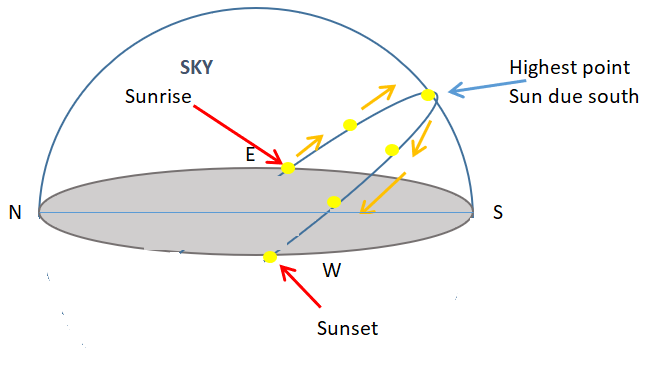
The path of the Sun in Manchester, England in September. For places in the Southern Hemisphere, the highest elevation is achieved when the Sun is due North
When the Sun is at its highest in the sky it crosses an imaginary line drawn between north and south known as the meridian. The time when the Sun crosses the meridian is defined as noon,
- the hours before noon are known as AM (an abbreviation for ante meridiem- Latin for before the middle of the day)
- those after noon as PM (an abbreviation for post meridiem – Latin for after the middle of the day).
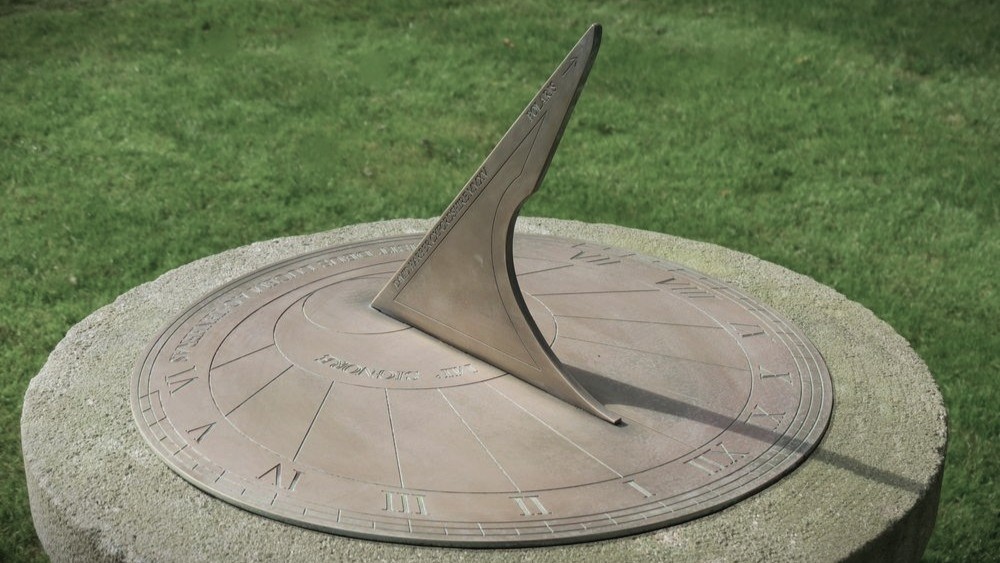
This ‘natural time’ measured by the position of the Sun is called apparent solar time and is the time measured by a sundial (provided the Sun is shining!). The interval between one solar noon and the next is a solar day.
Interestingly, the length of the solar day isn’t constant. Its average value over an entire year is 24 hours but it varies throughout the year in a predictable way between a minimum of 23 hours 59 minutes and 39 seconds in mid-September and a maximum of 24 hours 30 seconds just before Christmas day. The reasons for this variation are twofold: firstly, the Earth moves in an uneven speed in its elliptical orbit around the Sun and secondly the Earth’s axis is tilted. This discussed my post How the length of a day changes over the year

How the length of an apparent solar day differs from its average value of 24 hours.
The y-axis shows the difference in seconds between the length of a solar day and 24 hours on a given date measured in seconds. So, for example:
- 10 means the day is 24 hours 10 seconds long
- 20 means the day is 24 hours 20 seconds long
- -10 means the day is 23 hours 59 minutes 50 seconds long
Mean solar time
Over the centuries we became able to measure time more accurately and the concept of mean solar time became established. In mean solar time every day is exactly 24 hours long. Because the length of the solar day varies throughout the year, mean solar time is in general out of step with apparent solar time.
In mean solar time although on average the Sun is at is highest in the sky at noon, on some days of the year the Sun is at its highest before noon and other times after noon. This difference between apparent solar time (in which the Sun is always at its highest at noon) and mean solar time is known at the equation of time and follows a yearly cycle.
- On February 12 the Sun is at its maximum elevation in the sky at 12.14 PM (mean solar time) , but the time shown on a sundial would be 12 noon. So, a Sundial would be 14 minutes slow compared to mean solar time.
- On November 3 the Sun is at its maximum elevation in the sky at 11:44 AM (mean solar time), but the time shown on a sundial would be 12 noon. So, a Sundial would be 16 minutes fast compared to mean solar time.
The Standardisation into Time Zones
Because mean solar time is defined so the Sun is at its highest in the sky at on average 12 noon each day, this means each place has its own mean solar time which depends on its longitude. For every 15 degrees of longitude east mean solar time moves one hour ahead and for every 15 degrees of longitude west mean solar time lags one hour behind.
Even in a relatively small country like the UK
- Lowestoft (Low) is 1.75 degrees east of London. Its mean solar time is ahead of london. A mean solar time of 12-noon in Lowestoft is the same time as a mean solar time of 11.53 AM in London.
- Penzance (Pen) is 5.5 degrees west of London. Its mean solar time is behind london. A mean solar time of 12-noon in Penzance is the same time as a mean solar time of 12:22 PM in London.

The advent of the railways in the nineteenth century, allowed people to move rapidly between cities and ran to a timetable. To make timetables workable, it became important that all regions of the country used the same time. 1:00 PM in London, would need to be the same as time as 1:00 PM Bristol which was nearly 200 km further west
In addition, the invention of the telegraph enabling people to send messages almost instantly meant that any ambiguity about the time messages were sent and received needed to resolved. So, in 1880, the whole of Great Britain standardised on Greenwich Mean Time (GMT). GMT is the mean solar time at Greenwich in the East of London and lies on the zero degrees longitude line. Other countries standardised their timekeeping at roughly the same time and the concept of time zones was born.
The world’s current times zones are shown in the map below. In most areas the civil time, used for day to day timekeeping, is a whole number of hours fast or slow of GMT, although for precise writing the term UTC (coordinated Universal Time) is now preferred to GMT.
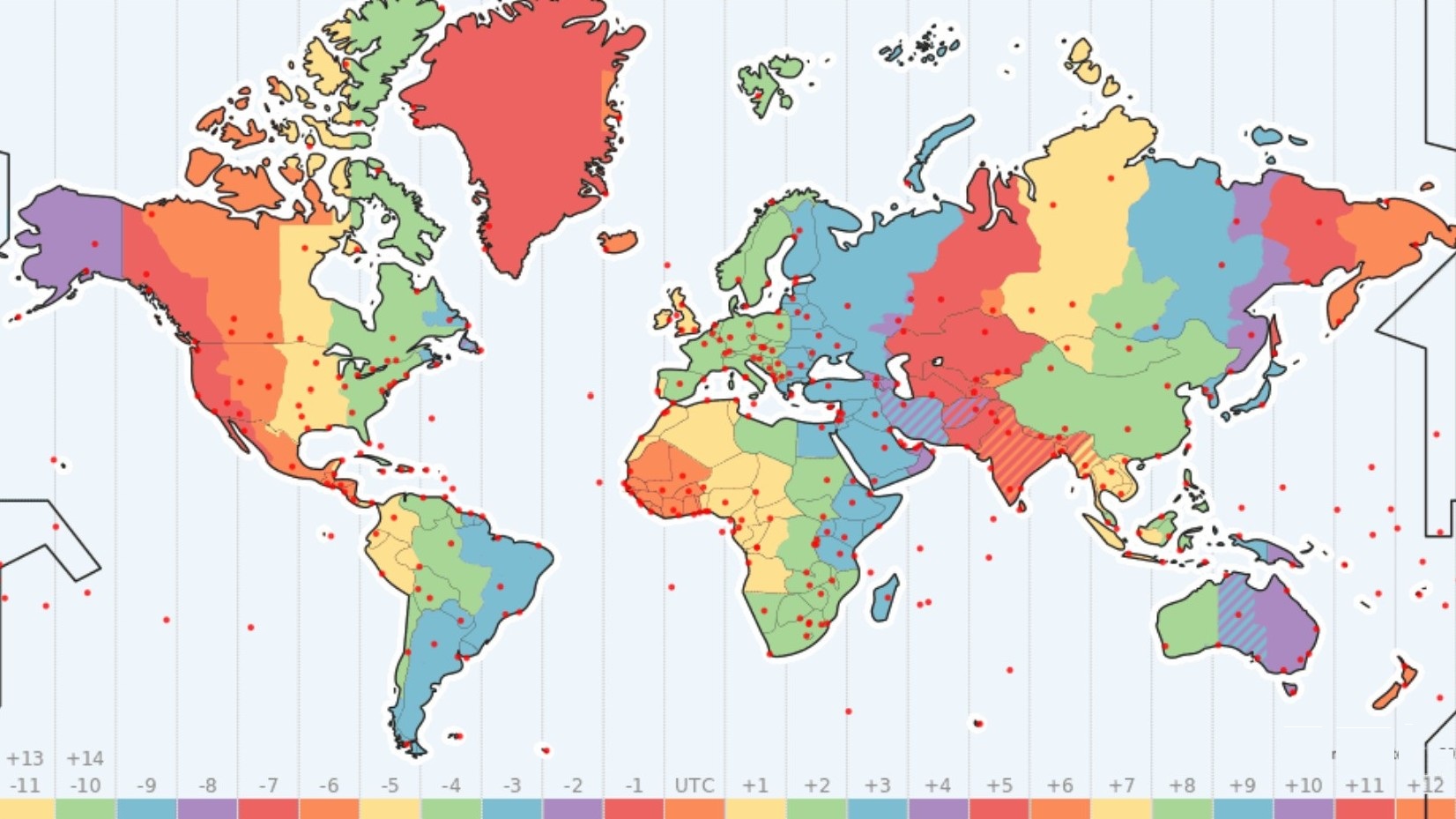
The world’s time zones on 3 June 2026, from timeanddate.com – The times zones shown include Daylight Saving Time if applied on that date. For example The UK is shown as UTC+1, whereas in in winter time it uses UTC.
Most large countries which span a range of longitudes (e.g. USA, Canada, Russia ) have multiple time zones. This ensures that at a particular location the civil time isn’t too far from the local solar time.
Lack of Time Zones in China
Interestingly, for political reasons, China does not have any time zones. The whole country in on Beijing time which is UTC+8. This means that in western China the civil time used by the government is out of step with the local solar time. In the city of Kashi in the far west of China the Sun is on average at its highest in the sky at 2:56 PM. Because the official time is so out of step with the rising and setting of the Sun, many of the non-Chinese locals simply ignore the official Beijing time and use their own unofficial time zone which is UTC+6!
And Finally…
I hope you have enjoyed this post. I’ve put a summary of the three different ways of measuring time below.

You may be interested in these other related posts from Explaining Science
- The Equinoxes the two times of year when the length of day and night are almost equal.
- The solstices when the either the North Pole or South Pole is tilted at the maximum angle towards the Sun.
- And for those of you who like a little mathematical detail, an explanation of why the Earth is spiralling out from the Sun at rate of 1.33 cm per year
- The switch from the Gregorian to the Julian calendar and the impact on the dates of Christmas and Easter
- The Three Types of Year: Sidereal, Tropical, Anomalistic all of which have different lengths
Discover more from Explaining Science
Subscribe to get the latest posts sent to your email.


[…] talked about in my previous post, within the early hours of Sunday 27 October the clocks return an hour all through the European […]
LikeLike
[…] mentioned in my previous post, in the early hours of Sunday 27 October the clocks go back an hour throughout the European Union […]
LikeLike
Thanks for all your great and interesting articles. Of course here in Bristol we still run on “Bristol time” and have the clock in corn street showing this. It takes us a while to catch up but apparently we did switch to decimalisation last year but not every one is going to join though!
LikeLiked by 1 person
😉
LikeLike
[…] mentioned in my previous post, in the early hours of Sunday 27 October the clocks go back an hour throughout the European Union […]
LikeLike
I can remember being told at school the sun moves through 15 degrees each hour and how the longitude lines split the earth into 15 degree portions and that makes the earth 24,000 miles in circumference. We love things cut and dried but as you’ve made clear that is far from accurate.
LikeLiked by 3 people
As an amateur astronomer, daylight saving gives me dark thoughts about the people responsible for the loss of one prescious hour of my evening at the telescope.
Surely we should put the clocks back one hour in summer, not forward! 🥺
LikeLiked by 2 people
An interesting thought, but I suspect that, if we did this, it would not go down too well with people who enjoy outdoor sports in summer !
😉
LikeLiked by 1 person
[…] Source link […]
LikeLike