
Like many of you, in December last year I followed with interest the news reports from COP28. As it concluded, there was much written in the media about whether the nations of the world would actually do what is needed to restrict the rise in average global temperature to 1.5 degrees Celsius above pre-industrial levels. Now that a month has passed, the media’s attention has faded a little, particularly with all the other events happening across the globe
However the question still remains:
Will humanity do enough over the coming decades to reduce emissions of greenhouse gases (the most important of which is carbon dioxide) ?
My pessimistic view is that this won’t happen. In the past decades, short term national interest has taken priority over doing what is needed to reduce global warming. A good illustration that not enough has been done is the graph below. This shows the annual average carbon dioxide levels for the years from 1990 to 2022.

Data from the Global Monitoring Laboratory at Mauna Loa in Hawaii https://gml.noaa.gov/ccgg/trends/
Since 1995, there have been 28 United Nations COP conferences and despite all the discussion amongst the tens of thousands of participants (COP28 had 85 000 who flew in from all around the world) the rise in global carbon dioxide levels has continued at a steady rate of two parts per million per year. It appears that despite all the discussions which have happened at these conferences this hasn’t resulted in effective action. If we look at all the previous COP conferences two in particular stand out.
- COP3 in 1997, which adopted the Kyoto Protocol in which most industrialised countries agreed to reduce their greenhouse gas emissions by an average of 6 to 8% below 1990 levels between the years 2008–2012. However the US government did not ratify the agreement on the grounds that it would damage the US economy.
- COP21 in 2015, which adopted the Paris agreement. Participants agreed emissions should be reduced as soon as possible and reach net zero by 2050. Each party to the Paris Agreement was required to establish a Nationally Determined Contribution (NDC). a climate action plan to cut greenhouse gas emissions, and update it every five years.
- On June 1, 2017, US President Donald Trump announced that the United States would cease participation in the Paris Agreement stating that the agreement undermines the U.S. economy. This decision was reversed following the election of Joe Biden.
Putting the discussions aside, what is really happening?
A recent UN report pointed out that the government plans and projections from the major fossil fuel producers would lead to an increase in global coal production until 2030, and in global oil and gas production until at least 2050. This conflicts with national commitments under the Paris Agreement, and the widely-held expectation that global demand for coal, oil, and gas will peak within the 2020’s and then fall rapidly.
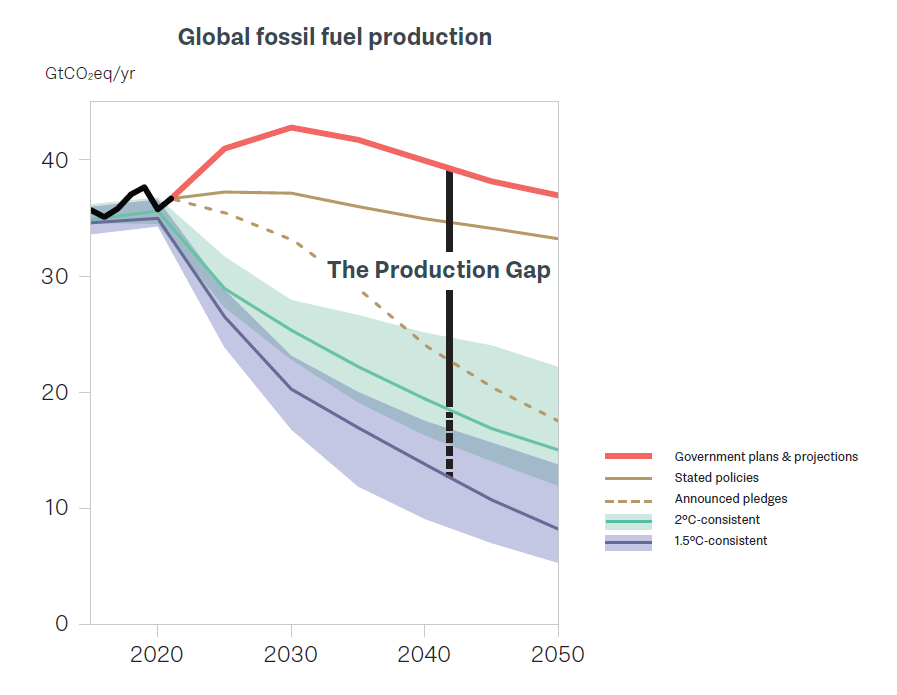
A summary of the UN report can be downloaded here.
It is clear that all the actions which been taken so far haven’t reduced the annual increase in carbon dioxide levels. However, it is certain that if nothing had been done at all and no effort had been made over the last few decades to switch to renewable sources of energy and away from coal to natural gas (which although a fossil fuel emits less carbon dioxide than burning coal) then global carbon dioxide levels would be higher still. The UK (like most European countries) has significantly reduced its carbon dioxide emissions. In 1980 the UK generated 70% of its electricity by burning coal, today this figure is less than 1%. This is not true for all countries , In India, which with a population of 1.44 billion is now the most populous country in the world, carbon dioxide emissions are rapidly rising.

Source https://ourworldindata.org/co2-and-greenhouse-gas-emissions
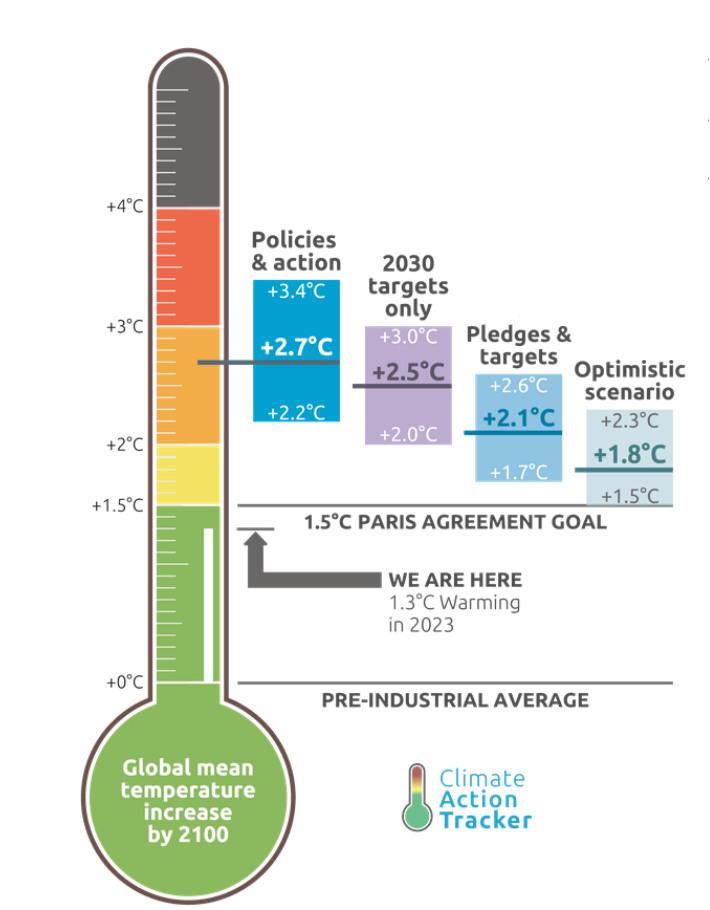
Modelling done by group of scientists who call themselves the Climate Action Tracker concluded that, based upon current behaviour (rather than agreements made at conferences aren’t always stuck to) the likely global temperature rise from pre-industrial levels will be between 2.2oC and 3.4oC by the end of the century. If this proves to be correct then it would have a massive effect on the Earth’s climate and possibly even humanity itself. A sobering thought!!

 Explaining Science
Thanks, Steve. Reading the post illustrates the huge challenge facing anyone trying to make sense of global warming, and particularly those trying to educate the young. Part of the challenge is that the science (what’s happening / how does it happen / how fast is it happening) and what we might sensibly do about it (practical socio-economic steps) are inevitably intertwined. Whilst the “what / how” of global warming is understood and very broadly agreed, the speed of the change that we shall likely experience is contested as this largely depends on which future projection is chosen – and there are plenty to choose from, even within the IPPC reports. Maybe you will write about this, Steve.
LikeLike
Yes, it is a complex subject and to be honest it can’t be fully explained in a blog post of 2000 words or less. What is clear is that the atmospheric carbon dioxide levels have been rising at steady rate of 2 parts per million per annum for the last 40 years and this has not stopped despite all the international conferences which have taken place.
What is less clear is
when these levels will stop rising ?
What will be the atmospheric carbon dioxide levels then?
What amount of global warming will have occurred by this time? (we also need to consider the effects of other greenhouse gases – particularly methane)
What will be the effect on sea levels?
What will be the effects on the climate of different regions of the world?
E.g. the UK is warmer that it should be for its latitude because of the warming effects of the Gulf Stream. Will this still be the case in the future?
LikeLike
I console myself with the reflection that in another two billion years the sun will have gone out: long term, there IS no future.
LikeLike
A sobering thought
LikeLike
There is a big difference between what people and countries say and what they ultimately do. It makes me pessimistic.
LikeLike
True ! in the end national self interest usually comes first!
LikeLike
“However the US government did not ratify the agreement on the grounds that it would damage the US economy.”
This lame excuse has been used by the leaderships of many nations, including here in Australia, as a reason to not do what needs to be done.
These fools, who could not see beyond the next election, said that fixing global warming would be too costly. History will rightly condemn these self-serving politicians for it. If of course, ultimately there is a history.
We spent far too much time and effort on debating whether climate change is real, instead of listening to the scientists and acting on their advice.
LikeLiked by 1 person
Very true, UK then a still a significant number of politicians who deny the reality of climate change
LikeLike
I’m not sure that “like” is the correct response to this post. I too am pessimistic and frankly fearful not only for my children’s generation about the inheritance we are leaving them but increasingly the impacts on my generation.
Frankly I see many reasonable people agree that climate change is an existential threat and go jetting off around the world buying gas guzzlers and so on. Disheartening.
Ona positive note: I really appreciate your posts!
LikeLike
Sadly, I think at the moment there isn’t the will to do what is required
LikeLike