
Revised 18 December 2025 -original post published in 2024
In 2024, for the majority of the world’s Christians, March 31 was Easter Sunday, one of the most important dates in the calendar.

Although Easter originated as the festival celebrating the resurrection of Jesus Christ from the dead, it is also widely marked by non-Christians in the UK, particularly as there are two very welcome public holidays on the preceding Friday (Good Friday) and the following Monday. In the UK, as in many other countries, chocolate Easter Eggs and Easter Bunnies are bought by much of the population regardless of their religious beliefs.

Easter Sunday is a movable feast, so the day on which it occurs varies from year to year. This means that other dates linked to Easter also vary.
- Lent is the period of 46 days leading up to Easter during which devout Christians (and sometimes also people more generally interested in self-improvement!!) abstain from luxury and give up bad habits. (Interestingly the Sundays during Lent are not counted as lent days – originally to allow people to have a break from fasting. This is why Lent is 46 days rather than the 40 days that Jesus was fasting in the wilderness before his return to Jerusalem to face trial and crucifixion.)
- The day before Lent begins, 47 days before Easter, is called Shrove Tuesday. It is commonly called Pancake Day in the UK, as sweet pancakes were traditionally made to use up the rich foods in the household before the time of abstemiousness began. It is probably fair to say that most people now enjoy the pancakes with no intention of giving up luxury foods at all! In some other countries this day is known as Mardi Gras, and is celebrated with parades and festivals.

- In the UK, Mother’s Day is the fourth Sunday in Lent and is therefore always three weeks before Easter Sunday. Although in the US, a secular Mother’s day is celebrated on the second Sunday in May.
How is the date of Easter calculated?
Early Christian decision makers in the fourth century established that Easter would be held on the first Sunday after the first [ecclesiastical] full moon occurring on or after the March equinox (which they assumed to always take place on March 21) and this is still the definition used today. (In the early church, Easter was being celebrated at different times across the many different Christian communities and it was the Roman Emperor Constantine who ordered it to be standardized.)
There are two interesting features to this definition. The first one is that as discussed in The Equinox the date of the March equinox isn’t always March 21. It varies from year to year and also from place to place on the Earth.

The second point is that the ‘ecclesiastical full moon’, isn’t the same as the full moon we see in the sky. It is a calculated full moon based upon a rather complicated set of rules which have been developed and refined over centuries to approximate the phases of the Moon. The date of the ecclesiastical full moon can be up to three days out with respect to the date of the real full moon.
On what dates can Easter occur?
Using these rules Easter can occur on any date between March 22 and April 25, a total of 35 possible dates.
- If the full moon were calculated to fall on March 21 which happened to be a Saturday, then Easter would fall on March 22.
- If the full moon were calculated to fall on April 18 which happened to be a Sunday, then Easter would fall on April 25.
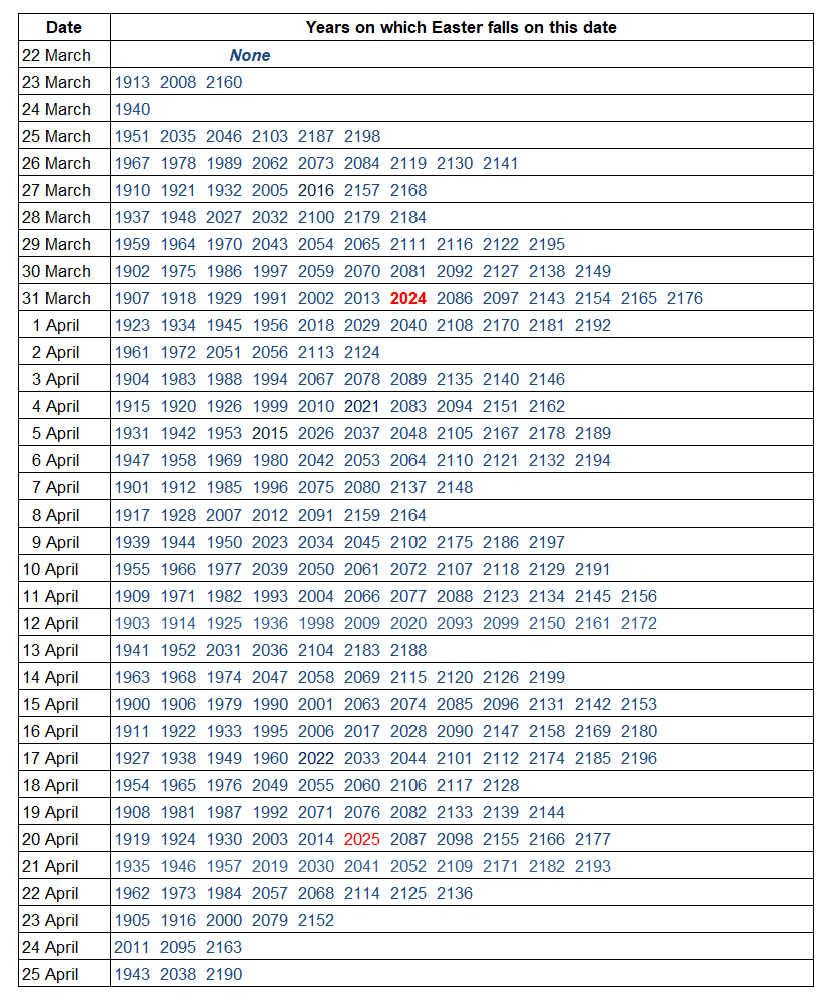
The table below lists all the dates on which Easter has fallen, or will fall on, for all years between 1900 and 2199.
Orthodox Easter 5 May
As mentioned in my previous post Christmas Day – December 25th or January 7th? ,most Orthodox churches still use the Julian Calendar and will not accept a calendar which they see as being imposed by the Catholic Church. The Julian Calendar lags 13 days behind the Gregorian Calendar, the civil calendar used by almost every country in the world.
The Orthodox Church uses the same rule that Easter takes place on the first Sunday after the first ecclesiastical full moon occurring on or after March 21. However, they use March 21 in the Julian Calendar which is equivalent to April 3 in the Gregorian calendar. This, coupled with the fact that the Orthodox churches use a slightly different way of calculating the ecclesiastical full moon, means that, in most years, the Orthodox churches celebrate their Easter on a later date than the other Christian churches.

Problems with a varying date of Easter
The main problem caused by the date of Easter varying from year to year is that it can cause difficulties of co-ordination with the civil calendar. For example, in the UK, schools normally have a two week break around Easter. If Easter falls very early or very late in a particular year this can cause the lengths of the school terms to be unbalanced. Some of you may recall back in 2008 when Easter was exceptionally early (it fell on March 23) many schools closed just for the two days either side of the Easter weekend and had their two-week spring holiday in April. The same thing also happened to a lesser degree in 2016 when Easter fell on March 27.
Reform of the date of Easter
To address the practical problems of Easter varying over a wide range of dates, there have been attempts to redefine the date of Easter so that it occurs over a narrow range. Over 90 years ago in the UK the Easter Act 1928 was passed. This legislation sets the date of Easter to be the first Sunday after the second Saturday in April and would mean that Easter would fall within the date ranges April 9 to April 15. Although this act remains on the statute book no UK government has ever tried to implement it [1]
According to a report on the BBC website [2], back in 2016 Justin Welby (who was the Archbishop of Canterbury) was working with other Christian churches to agree on a fixed date for Easter. However, since then ten years has passed there have been no major announcements. So, I suspect that there are quite a few obstacles in the way to get agreement of all the major Christian denominations.
And finally…
I hope you have enjoyed this post and have a great Easter in 2026 when it falls on 5 April (or 12 April in the Orthodox churches 😉 ).
References
[1]The Guardian (2011) Unthinkable? Implement the Easter Act 1928, Available at:http://www.theguardian.com/commentisfree/2011/apr/16/unthinkable-implement-easter-act-editorial (Accessed: 18 December 2025).
[2] Archbishop Justin Welby hopes for fixed Easter date. (2016). BBC News. [online] 15 Jan. Available at: https://www.bbc.co.uk/news/uk-35326237. (Accessed: 18 December 2025).

 Explaining Science
A really interesting thought David!!!
LikeLike
Hi Steve,
Interestingly, your list of dates for Easter seems to indicate a wave output with a period of around five days between peaks. It seems a bit strange but there is probably a logical explanation!
LikeLike
Yes an interesting thought. I should probably analyse it further and plot the data another way.
LikeLike
Hi Steve,
Thanks for the article: interesting & very informative, as always.
Part of the problem for agreeing on a (historically accurate) fixed Easter is that the theologians don’t know the year that the resurrection -supposedly- took place; for instance 30 AD is a popular assumption but a few years either way are also possible.
If they did know, then the event could be positively dated relative to the Jewish passover for that year. It would be a routine calculation (well, fairly routine; even a theologian is presumably allowed to resort to a computer).
And in that case, the various factions, civil or ecclesiastical, would find it very hard not to accept the result.
LikeLiked by 1 person