
Revised and updated 12 February 2026
July 25, is one of the four days a year in which the length of the apparent solar day, the natural day measured by the rising and setting of the Sun, is 24 hours. I have written about this in previous posts but I thought it be worth mentioning it again because it something that isn’t widely known by non-astronomers.
Variation in the length of the solar day
For practical timekeeping purposes the length of day is 24 hours. Astronomers call this the mean solar day. However, actual length of the apparent solar day, which is the time difference between two successive occasions when the Sun is at its highest elevation in the sky, varies throughout the year. It’s at its longest, 24 hours 30 seconds, around Christmas Day and is at its shortest, 23 hours 59 minutes 38 seconds, in mid-September.
(For clarity, throughout this post, when I talk about the solar day I will always mean the apparent solar day and not the mean solar day.)

How the length of a solar day differs from its average value of 24 hours.
The y-axis shows the difference in seconds between the length of a solar day and 24 hours on a given date .So, for example:
- 10 means the day is 24 hours 10 seconds long
- 20 means 24 hours 20 seconds
- -10 means 23 hours 59 minutes 50 seconds.
Almost all variation in the length of the solar day is not due to the change in the Earth’s rotation speed. Although the Earth’s rotation speed does vary, the effects are very small and unpredictable. The time for the Earth to turn once on its axis varies by only 0.005 seconds during a year. Whereas, the variation in the length of a solar day is both predictable and much larger.
There are two different causes of this variation. Firstly, the Earth moves in an elliptical orbit around the Sun. Secondly the Earth is tilted on its axis. I’ll talk about each of them now.
Cause 1 The Earth has an elliptical orbit
The Earth takes roughly 23 hours and 56 minutes to make a complete rotation on its axis. However a day is clearly not 23 hours and 56 minutes long! This is because during the time it has performed one rotation the Earth has moved around the Sun a little. So if we take the point in time when the Sun is at its highest in the sky the Earth needs to make slightly more than one complete turn for the Sun to be at the highest point in the sky on the following day (1.00274 of a turn to be precise). It takes an extra 4 minutes to make this extra small fraction of a turn, which is why a day is, on average, 24 hours long. This is shown in the diagram below.
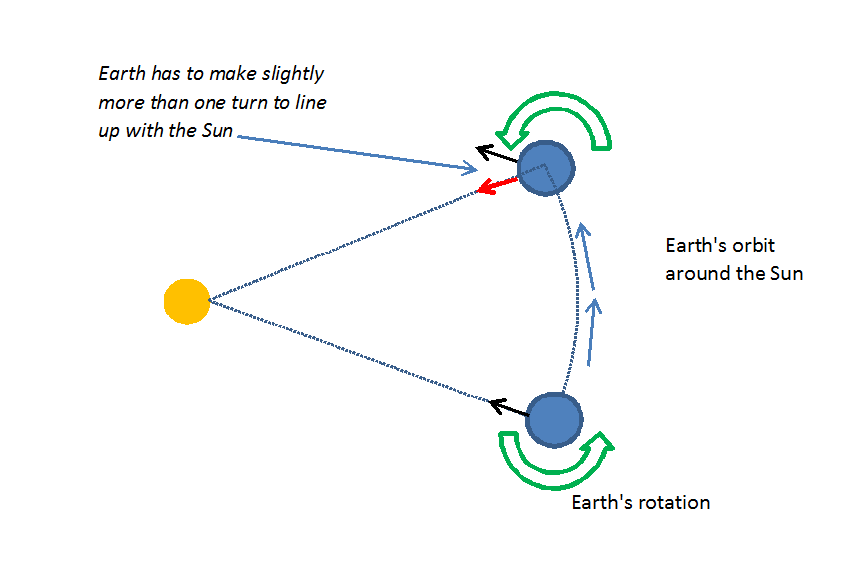
If we take a point on the Earth when the Sun is highest in the sky, then after 1 rotation the Sun won’t be at the highest in the sky again. The Earth has to make slightly more than one rotation for this to happen.
However, because the Earth’s orbit is elliptical its distance from the Sun varies throughout the year. It is at its closest in early January (known as the perihelion) and its furthest away in early July (known as the aphelion). When the Earth is closest to the Sun it moves more rapidly in its orbit and, when it furthest away, it moves more slowly.

- Around the time of perihelion, when the Earth is moving faster in its orbit, if we take a point in time when the Sun is at its highest in the sky the Earth needs to make slightly more than 1.00274 of a turn for the Sun to be at the highest point in the sky on the following day. So a solar day is slightly longer than 24 hours.
- Around the time of aphelion,, when the Earth is moving more slowly in its orbit, the Earth needs to make less than 1.00274 of a turn for the Sun to be at the highest point in the sky on the following day. This would make a day shorter than 24 hours.
If the ellipticity of the Earth’s orbit were the only cause then the length of a solar day would be longest at 24 hours and 10 seconds at perihelion (i.e around Jan 2 each year) and shortest at 23 hours 59 minutes 50 seconds at aphelion (i.e around July 4 each year) However, that isn’t the case the tilt of the Earth’s axis causes a larger variation in the length of a solar day than that caused by the ellipticity of the Earth’s orbit.
Cause 2 the tilt of the Earth’s axis
This is harder for many people to visualise. Therefore, rather than try to explain it in a blog post, I have created a video on my Explaining Science YouTube channel.
Putting the two causes together
The combination of the two is as follows:

- The vertical axis gives the difference in the length of a solar day from 24 hours in seconds. So, as before 10 means 24 hours 10 seconds, 20 means 24 hours 20 seconds, -10 means 23 hours 59 minutes 50 seconds.
- The blue line gives the difference due to the tilt of the Earth’s axis.
- The red line gives the difference due to the ellipticity of the Earth’s orbit.
- The black line gives the overall effect which is the combination of the blue and red lines. As you can see the solar day is only 24 hours long on four days during the year
- February 12
- May 14
- July 25
- November 3
The Equation of Time
Because the length of a solar day varies throughout the year, the natural time measured by a sundial, drifts up to 15 minutes ahead or behind the time measured by an accurate clock -which is of course based upon a mean solar day of exactly 24 hours. Astronomers call this difference the “equation of time”.

Further reading
I hope you have enjoyed this post. For further reading, here are some posts on related topics.
Leap seconds need to be added periodically to bring the time we measure with accurate atomic clocks in line with the natural time which results from the rotation of the Earth.
In the Northern Hemisphere, it gets lighter in the evenings before the December solstice, but it does not start to get lighter in the mornings until early in the new year.

 Explaining Science
[…] https://explainingscience.org/2024/07/18/understanding-solar-day-length-variation/ […]
LikeLike
Thanks Steve,
Brilliant presesntation as usual.
David.
LikeLike
thank you David
LikeLike