Updated 21 November 2025
In 1.3 million years’ time the star Gliese 710 is forecast to pass within 0.166 light years of the Solar System, 25 times closer than Proxima Centauri which is our current nearest star (excluding the Sun of course). The close approach of Gliese 710 will be the strongest disrupting encounter known to effect the Solar System.
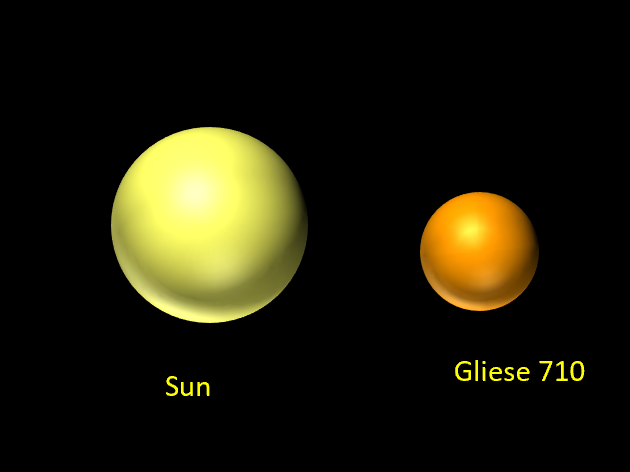
Relative Sizes
Gliese 710 is a fairly insignificant orange star, located in the constellation Serpens – the Serpent. Compared to our Sun it is smaller having only 58% of the radius. Its surface is cooler, 3870 oC versus 5500 oC for the Sun. Its smaller size and lower surface temperature means that it has only 4.5% of the luminosity of the Sun. It lies at a distance of 62.3 light years from us. Its distance and luminosity give it a magnitude of 9.66, making it too faint to be seen with the naked eye. It is not known if Gliese 710 has any planets
Gaia results
In 2013 ESA launched the Gaia spacecraft. (https://www.esa.int/Science_Exploration/Space_Science/Gaia). Gaia has instruments to measure the positions of celestial objects, photometers to measure their brightnesses at different wavelengths and a high resolution spectrometer to measure the blue or red-shift of spectral lines in the near infrared region of the spectrum.

Gaia’s mission is still underway. One of the things it is creating is an accurate three-dimensional map of more than a billion stars throughout our Milky Way galaxy. Its instruments will record their motions, luminosities, temperatures and composition.
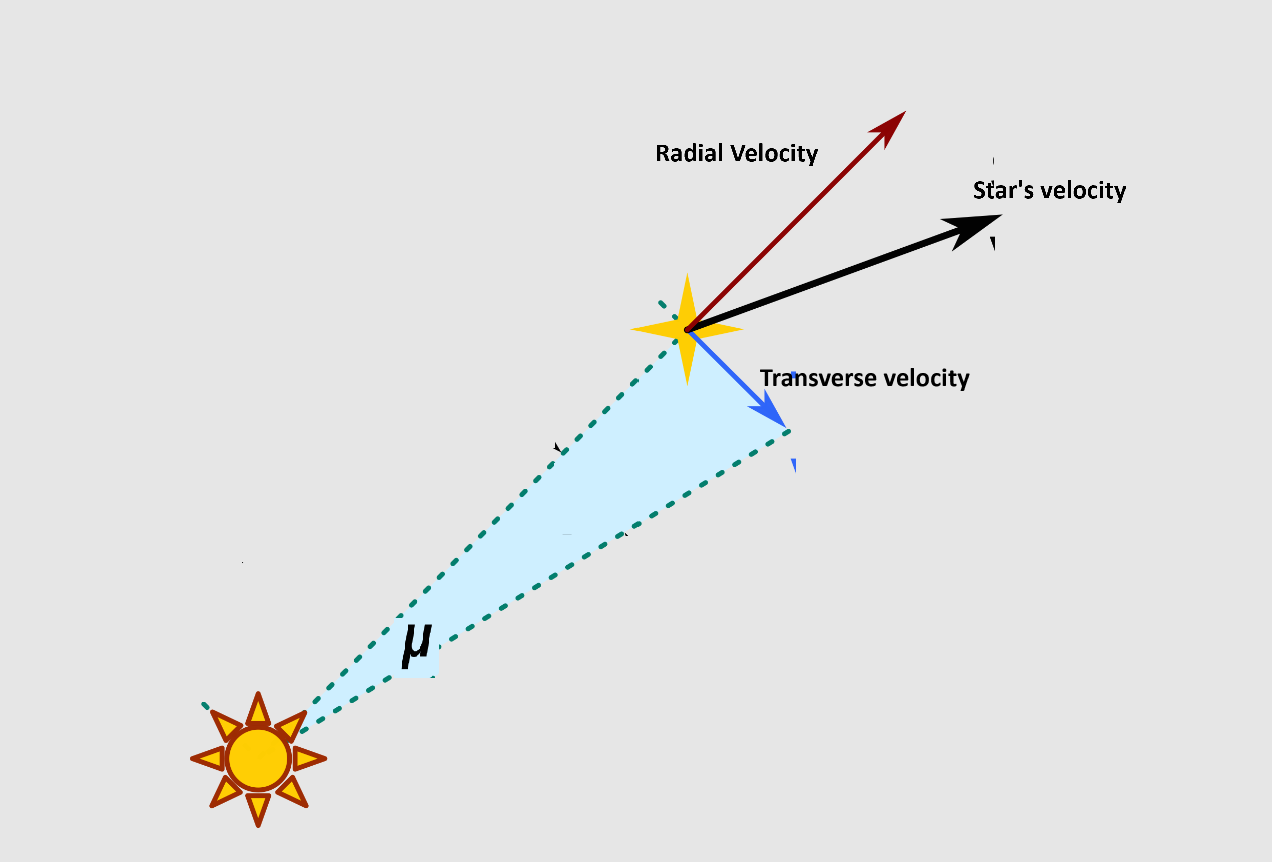
The velocity of a star has two components. The radial velocity is the component along the line of sight and the transverse velocity is the component at ninety degrees to the line of sight.
- The radial velocity is how fast the star is moving towards or away from us and can be measured by the shift in the wavelength of spectral lines. A red shift indicates that the star is moving away from us and a blue shift indicates that it is moving towards us.
- The proper motion which is usually given the symbol of the Greek letter μ (mu) is how fast the star is moving across the celestial sphere with respect to more distant background objects. It is determined by recording the change in position of the star over time, measured as the change in angle per year. Because stars lie at great distances from us, the proper motion is small. For nearby stars it is typically expressed in arcseconds per year – one arcsecond = 1/3600th of a degree.
Once the distance to the star is known, the transverse velocity which is equal to the proper motion ( in radians) multiplied by the star’s distance can be estimated.
As an example…
A star lies at a distance of 10 light years and is moving with a proper motion of 1 arcsec/year (= 0.000 00485 radians/year)
Its transverse velocity is 10 light years x 0.000 00485 radians/year
= 0.000 0485 light years/year
Which works out at 14.5 km/s
Gliese 710 measurements
Measurements from Gaia indicated that Gliese 710 had
- A radial velocity of -14.5 (± 3%) km/s. The negative sign indicates that Gliese 710 is moving towards the Solar System.
- A proper motion of 0.429 (± 5%) milliarcsec/year. Giving a transverse velocity of 0.039 km/s
Source Fuente Marcos, R. de la and Fuente Marcos, C. de la (2020).
The very small transverse velocity and large radial velocity towards us indicated that Gliese 710 will pass very close to us at some point in the future. Fuenta Marcos and Fuenta Marcos ran a detailed simulation using the Gaia data.

One parsec (pc) is equal to 3.26 light years
Their results indicated that in 1.28 million years’ time at its closest approach Gliese 710 has a 99% probability of getting between 0.147 and 0.189 light years of the Sun. The mean value they calculated was 0.166 light years. No star is predicted to get as close to the Solar System in the future and no star has passed as close to our Sun in the past few million years.
What does it mean?
Taking the mean value of 0.166 light years for its closest approach. Gliese 710 will be 140 000 times brighter than it is today. It will have a magnitude of -3.2. Of the natural objects in the sky, only the Sun, the Moon and Venus will be brighter. Although it is possible that if humanity is still around in 1.3 million years’ time, the night sky will be covered in bright satellites. Or perhaps, the Earth will be devoid of life at such a far distant point in the future? Perhaps humanity’s descendants will have abandoned Earth and be living on other planets?
Putting this speculation aside, if there are any observers around to see Gliese 710, they will see that its angular diameter at its closest approach is 0.1 arcseconds. This is larger than any star we can see today and more than twice the angular diameter of Betelgeuse. It is roughly the angular diameter of the dwarf planet Pluto, and it could be resolved into a disk by a 1.3 metre telescope if there were no distortions due to seeing (astronomical turbulence)
Effect on the Solar System
The Solar System is surrounded by a vast cloud of small icy bodies known as the Oort cloud. The Oort cloud can be divided into the spherical outer Oort cloud which lies between 0.3 and 0.8 light years from the Sun and the inner Oort cloud which is in the shape of a thick disk and lies between 0.03 and 0.3 light years from the Sun.
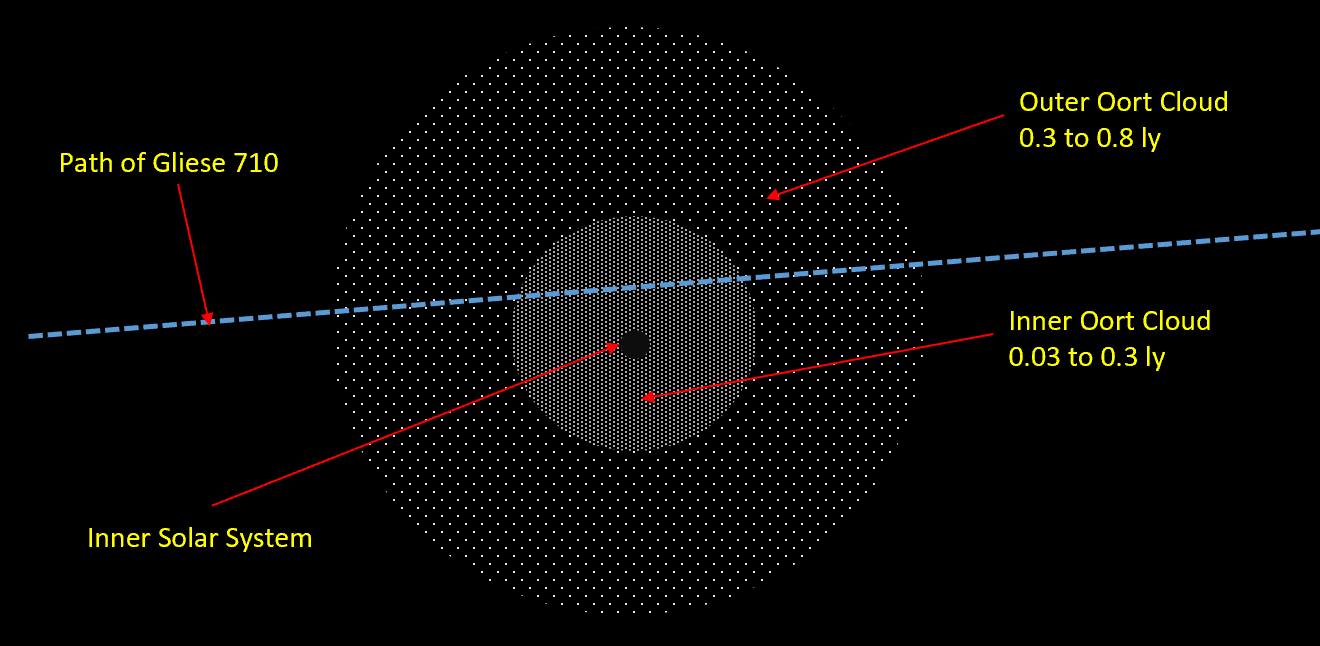
Although Gliese 710 is considerably less luminous than the Sun, it has roughly 60% of its mass. This makes it 600 times more massive than Jupiter or 190 000 times more massive than the Earth. The close approach of Gliese 710 will be the strongest disrupting encounter known in the future and the past history of the Solar System. Although if we go back hundreds of millions of years there may well have been stars which approached even closer.
Gliese 710 will plough through the inner Oort cloud at a velocity of 14.5 km/s, as it does so it will cause significant disturbance. Such disturbance would over a period of a few million years send showers of comets to the inner solar system. Some of these new comets may approach quite close to the Earth and the likelihood of a major impact event with the Earth will be increased. Any attempt to put a number on this is difficult and despite some wild speculation it is impossible to say whether there will any significant impact on the Earth.
To find out more please take a look at my video on the Explaining Science YouTube channel
References
Fuente Marcos, R. de la and Fuente Marcos, C. de la (2020). An Update on the Future Flyby of Gliese 710 to the Solar System Using Gaia EDR3: Slightly Closer and a Tad Later than Previous Estimates. Research Notes of the AAS, 4(12), p.222. doi:https://doi.org/10.3847/2515-5172/abd18d.

 Explaining Science
[…] 1.28 million years from now, a small orange star named Gliese 710 will make a close approach to our Solar System at a distance of 0.166 light years. Gliese 710 is a little more than half the size of our Sun. […]
LikeLike
[…] Gliese 710 […]
LikeLike
Very interesting indeed. But meanwhile I have Alastor 2262, Alastor 1716 and Alastor 933 at arm’s length. Nice weekend 🙂
LikeLiked by 1 person
🙂
LikeLike
Fascinating. Good to be reminded of our impermanence and insignificance in deep time!
LikeLike
Very true
LikeLike
Based on the idea of “we’re not special” I think it’s a good guess that Gliese 710 also has an Oort cloud of its own. So not only would it disrupt our cloud, we would likewise disrupt it’s cloud. Overlaying a second Oort cloud on the diagram above might be a good illustration of how much chaos is likely to ensue.
LikeLiked by 1 person
You raise an interesting point
LikeLike