
Updated 23 December 2025
In what is a departure from my usual topics of astronomy and space science, I have written a series of posts on the transition to electric vehicles.
Like most countries in the world, the UK is phasing out motor vehicles powered by the internal combustion engine (ICE), in favour of “zero emission vehicles” which in practical terms means electric vehicles (EVs). However, there are still significant challenges which remain to achieve this goal. In these posts I’ll discuss them and although I’ll focus on the UK, many countries in the world face similar issues, so these articles should be of interest to all my readers across the globe.
When will electric vehicles be mandatory
The current deadline is that the sale of new cars and vans powered by an internal combustion engine will be banned by 2035. [1] Prior to this there will be a phased transition away from the ICE. In 2025, the rule which will apply to all manufacturers selling cars in the UK, is that 28% of car and van sales must be zero-emission. This fraction will be increased year on year. By 2030 80% of car and van sales must be zero-emission and by 2035 the figure will be 100%. Manufacturers who fail to meet the target will face stiff financial penalties.
Diesel buses and trucks can continue to be sold after 2035. The current plan is to phase out the sales of new buses and trucks which aren’t zero-emission by 2040.
Following the change of government in the UK in 2024, the recent decision by the EU to delay full implemenation of the zero emission targets and pressure from the motor industry all these deadlines are under review. It won’t be until 2027 when the UK government will announce new targets [2]
Improvements to the Internal Combustion Engine
Huge steps have been made in cleaning up ICE vehicle emissions over recent decades. For example, if we go back over 40 years to 1985, cars were far more polluting than they are now. In the UK, most petrol (gasoline to my readers in the US) sold was leaded petrol which contained the highly toxic chemical tetra-ethyl lead as an additive.

When leaded-fuel was burnt in vehicle engines, lead compounds were released into the atmosphere and found their way into plants, animals, and humans. Significant levels of lead in the human body are extremely harmful and cause developmental abnormalities and brain damage. The sale of leaded petrol was stopped in the UK in 2000, and its use has been completely phased out worldwide. As a result, the atmospheres of our cities contain much lower levels of lead than they did forty years ago.
Despite being so toxic, tetraethyl lead continues to be used as an additive. A fact which isn’t widely known. The fuel used by propeller planes and helicopters still contains high level of ths poisonous compound. E.g. Avagas contains 0.56 grammes of tetraethyl lead per litre which is roughly double the amount in leaded petrol before its phaseout. This has been shown to increase the blood lead levels of children living near to small airports to clinically significant levels [3]
In addition to not emitting toxic lead compounds, modern road vehicles produce much lower levels of other pollutants. Carbon monoxide (CO) is a highly toxic gas and is produced when fuels containing carbon are burnt in a limited supply of oxygen. Breathing air containing as little as 0.08% (800 parts per million) of carbon monoxide can be fatal within one to two hours.
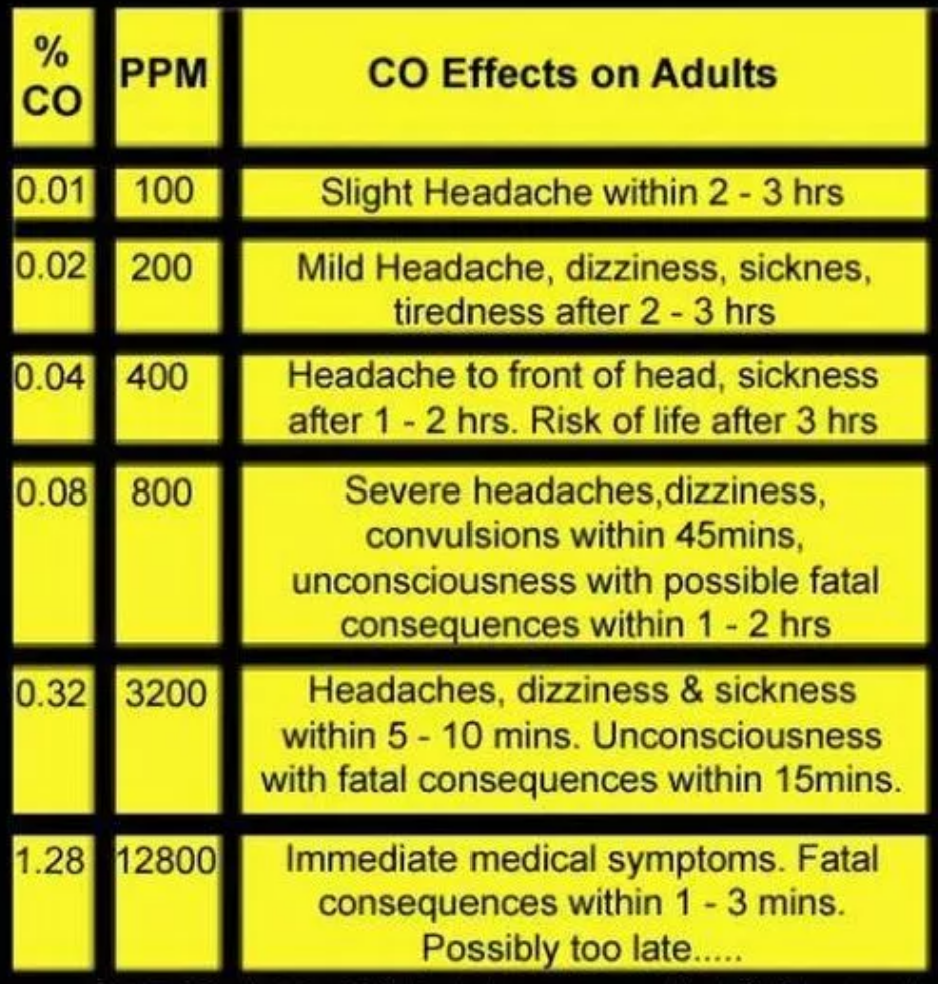
Chronic exposure to carbon monoxide at levels as low as 10 parts per million causes an increased risk of heart disease and other cardiovascular issues. The development of systems such as catalytic converters mean that modern exhausts contain around 0.1% carbon monoxide, whereas in the 1980s they contained 2-3%. As a result, deaths from breathing car exhausts fumes in a confined space are now relatively rare. Modern vehicle exhausts also contain lower levels of soot like particles, unburnt hydrocarbons and oxides of nitrogen which can cause respiratory problems.
However, when any fuel containing carbon is burnt the main end product is carbon dioxide (CO2). Carbon dioxide is non-toxic and exists naturally in the atmosphere. Indeed, without atmospheric carbon dioxide there wouldn’t be any plant or animal life on Earth.Levels of CO2 have steadily risen over the years, and it is the most significant greenhouse gas responsible for global warming

The burning of hydrocarbon fuels for transport contributes roughly 15% of global carbon dioxide emissions and if we can phase out the ICE and switch to greener alternatives there would be a big reduction to be made. There are significant challenges to achieve this. These include
- The limited range of EVs and high cost of public charging
- Insufficent public charging facilities when charging home is not possible and the fact that it takes much longer to charge an EV compared to filling a car with fuel
- Lifetime, weight and cost of EV batteries
None of these are deal-breakers which will prevent the phase out of the ICE. I discuss them in detail in my following posts, but first it is worth going through the definitions of energy and power since they are fundamental to what I’ll talk about later
Definitions of Energy and Power
Energy can exist in many forms. Examples of energy are heat, light, chemical energy – for example, the energy which is in fuels such as petrol (gasoline to my readers in the US), electrical energy and kinetic energy (the energy of moving bodies). The unit of energy in the international system of units used by scientists is the joule. However, in this post I will use the kilowatt-hour (kWh). This is the unit used to measure domestic electricity and gas consumption in the UK. The capacity of EV batteries is also measured in kWh. One kilowatt-hour equals 3 600 000 joules.
Power is the rate of using or transferring energy. The standard unit of power is the watt but these posts I use kilowatts (kW). One kilowatt equals 1000 watts.
Energy flow of a vehicle powered by an internal combustion engine

The fuel tank stores chemical energy in the form of a fuel, normally petrol or diesel. This is pumped into the engine where it is burnt and chemical energy is converted to the energy of motion (kinetic energy) and heat. The engine gets hot when it is running and needs to be cooled down by the cooling system. Heat is also taken away in the hot exhaust gases. The efficiency of a petrol engine is typically 25% meaning only 25% of the chemical energy in the fuel is converted into useful kinetic energy. The remaining 75% being wasted as heat.
Energy flow of an electric vehicle

When the battery charges, electrical energy from an external charger is converted to chemical energy stored in the vehicle’s battery.
When running the vehicle, the battery discharges, the chemical energy is converted back to electrical energy which is converted to kinetic energy in the electric motor which powers the vehicle. EVs have mechanisms to recover kinetic energy lost when they decelerate or break. The recovered kinetic energy is converted back to electrical energy and used to charge the battery. This is shown as the dotted line in the diagram. In an EV about 85% of the chemical energy stored in the battery is converted to kinetic energy with only 15% being wasted as heat.
In my next post, I discuss some of the challenges the UK faces as it phases out the ICE and moves to electric vehicles.
Other Related Posts
I hope you have enjoyed this post. It is part of series of five(listed below) about the transition to zero emission vehicles and some of the challenges it poses.
- Understanding why we are shifting away from the internal combustion engine.
- The limited range of electric vehicles and the relatively high cost of public charging.
- Lack of available of public charging and the relatively long time it takes to charge an EV battery.
- Some of the challenges of EV battery technology and their high cost.
- Could hydrogen-powered vehicles be an alternative to electric vehicles?
References
[1] https://assets.publishing.service.gov.uk/media/679382182de28ea2d392f37f/phasing-out-the-sale-of-new-petrol-and-diesel-cars-from-2030-and-support-for-the-zero-emission-transition.pdf (Accessed 22 December 2025)
[2] Partridge, J. (2025). UK government plays down reports of plan to bring EV sales target review forward. [online] the Guardian. Available at: https://www.theguardian.com/business/2025/dec/17/uk-to-bring-forward-review-of-ev-sales-targets-from-2027-to-next-year. (Accessed 22 December 2025)
[3] Mills, A. and Peckham, S. (2022). Lead exposure from general aviation emissions in the UK: a review and call for action – Kent Academic Repository. Kent.ac.uk. [online] doi:https://kar.kent.ac.uk/97048/11/Lead%20exposure%20from%20general%20aviation%20emissions%20in%20the%20UK%20-A.%20Mills%20-%20Published.pdf.

 Explaining Science
Thanks for a very clear introduction to this important subject – it will be a challenge for us to reach those targets, but fingers crossed. Looking forward to the next one.
LikeLike
Thank you Barbara
LikeLike