Anybody who has observed the eastern sky just before sunrise in the last few weeks will have noticed a brilliant white object – the planet Venus, also known as the morning star. It is brighter than any other planet and at its brightest ten times brighter than Sirius the brightest star.

Its brightness has often lead people to mistake it for a UFO. In 1969 future US president Jimmy Carter, who was then governor of Georgia, having seen a very bright object low in the sky filed a UFO sighting report. It may well have been Venus that Carter saw. At the time it was in roughly the same position in the sky that he claimed to have observed the UFO.
For more details on Carter’s UFO sighting click here https://explainingscience.org/jimmy-carter-ufo-sighting/
There are three reasons why Venus is so bright.
- Firstly, it comes closer to the Earth than any other planet.
- Secondly, it is relatively large in apparent size compared to other inner planets. Although the giant planets – Jupiter, Saturn Uranus and Neptune – are larger in actual size than Venus, they are further away and so appear smaller.
- Thirdly, the thick clouds which completely cover Venus reflect most of the light back into space. In fact Venus reflects 77% of the sunlight hitting it, more than any other planet.
Venus is so bright that it is just about possible to see it during daylight. If you know exactly where to look it appears as a faint white dot against the bright blue sky
Viewing Venus in 2025 and 2026
Venus is both closer to Sun and moves faster in its orbit than the Earth. It takes 224.7 days to orbit the Sun, whereas the Earth takes 365.26 years. The Earth and Venus are like two runners in a race. It takes on average 584 days for Venus to gain a lap on the Earth and for them line up in the same position with repect to each other and the Sun.
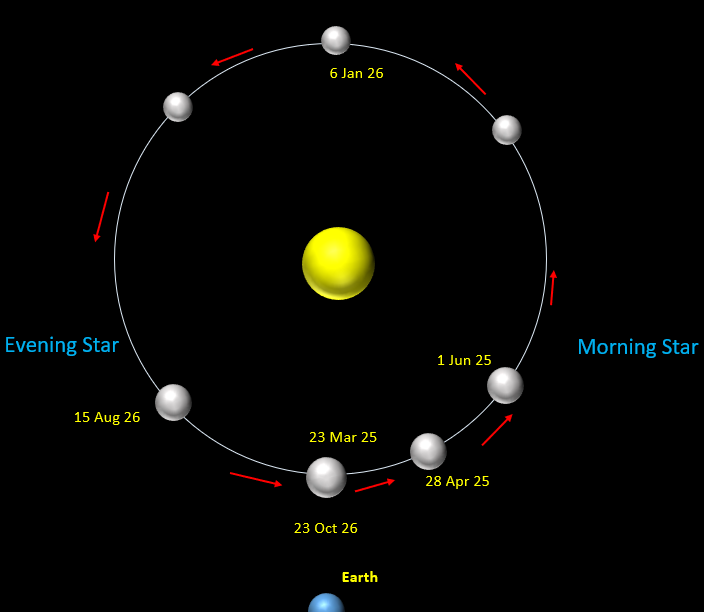
On 23 March 2025 Venus passed between the Earth and the Sun. Astronomers call this the inferior conjunction. It appeared very close to the Sun in the sky and for a couple of weeks either side of this date was difficult to observe – lost in the Sun’s glare.
As seen from Earth, Venus is now moving away from the Sun and appears in morning in the east, before sunrise as the morning star. On 28 April, the date of writing this post, it rose at 4:32 am local time in Manchester England. This was 68 minutes before sunrise.
Over the next 5 weeks it will appear further away from the Sun in the sky. On 1 June it will reach its greatest morning elongation when it will appear about 46 degrees from the Sun in the sky. On that date it will rise at 3:24 am, which is 82 minutes before sunrise.
After then it will start to move closer to the Sun in the sky. On 6 January 2026 it will be almost directly in a straight line with the Earth and the Sun. Astronomers call this the superior conjunction. It will appear very close to the Sun in the sky and for a couple of weeks either side of this date its proximity to the Sun will make it difficult to see.
After this, Venus will move away from the Sun and will appear in the evening in the west, after sunset, as the evening star. On 15 August 2026 it will reach its greatest evening elongation when it will appear about 46 degrees from the Sun in the sky. On that date it will set at 9:33 pm, in Manchester, 56 minutes after sunset.
After then it will start to move closer to the Sun in the sky. On 23 October 2026 it will once again be at inferior conjunction
Transit of Venus
The diagram only shows the picture in two dimensions. Because the orbit of Venus is tilted with respect to the Earth’s , at inferior conjunction it normally passes above or below the Sun.

Rarely at inferior conjunction Venus will pass directly in front of the Sun. When this occurs it is known as a transit of Venus. This last occured in 2012 and won’t happen again until 2117! . Observations of the transit of Venus played a key role in development of astronomy as a science including estimating the Earth-Sun distance.
The Phases of Venus
As seen from the Earth over the 584 day cycle, Venus goes through a full set of phases in a similar way to the Moon. However, because Venus appears so much smaller than the Moon, these are only visible through a telescope.

At inferior conjunction, point A in the diagram above, when Venus is between the Earth and the Sun, the sunlit part of Venus faces away from us making the planet almost invisible. The amount of the sunlit part of Venus we can see gets larger or waxes through to a crescent phase (B), to a half Venus (C) at the greatest elongation and then to a full Venus at superior conjunction (D), when the whole sunlit side facing the Earth is illuminated. It then gets smaller or wanes back to a half Venus (E) at greatest elongation, then to a crescent (F) and then finally back to being almost invisible at inferior conjunction
Galileo’s discovery
The first person to discover the phases of Venus was the Italian astronomer Galileo Galilei (1564-1642).

Image from Wikimedia Commons
In 1543, just before his death, Nicolas Copernicus (1473-1543) had published the theory of heliocentrism which was completely revolutionary in its day – that the planets orbit the Sun. However, in Gallileo’s time, the teaching of the Catholic church favoured geocentrism, the widely held view that the Earth was the centre of the Universe and the stars, planets, the Sun and the Moon were in orbit around it. Indeed certain verses of the bible could be interpreted as supporting that viewpoint, such as Psalm 104:5
“the Lord set the earth on its foundations; it can never be moved.”
However, the phases of Venus and the way that it appears smaller when it is a full Venus can only be fully explained by Venus orbiting the Sun, not the Earth. Therefore, Galileo concluded that the geocentric theory was incorrect. Unfortunately for Galileo, in 1616 the Catholic church declared heliocentrism to be heresy. Heliocentric books were banned and Galileo was ordered to refrain from holding, teaching or defending heliocentric ideas.
Despite this ruling Galileo continued to defend heliocentrism, and in 1633 the Roman Inquisition found him “vehemently suspect of heresy”, sentencing him to indefinite imprisonment. Galileo was kept under house arrest until his death in 1642.
However the facts cannot be disputed. When viewed through a telescope Venus does show changes in size and shape, which can only be satisfactorily explained in a heliocentric model. Eventually, in 1758, the Catholic Church dropped the general prohibition of books advocating heliocentrism.
And finally….
If you want to find out more about Venus, I have have revised, updated and expanded my e-book about our sister planet. To find out more and read a sample without any obligation to buy please click here.

There is also a video on the Explaining Science YouTube Channel which describes Venus’s orbit and phases and goes into much more detail Jimmy Carter’s alleged UFO sighting.
References
Espenak, F (2014) 2017 calendar of astronomical events, Available at: http://www.astropixels.com/ephemeris/astrocal/astrocal2017gmt.html (Accessed: 6 January 2017).

 Explaining Science
What I really want to learn about is the thick atmosphere, how it slows the spin of Venus, what it is made up of, and how it formed. I’m not sure waht the latest research is on this but it is unique.
LikeLike
Hi very true. Venus is a unique world !
This may be of interest
or it may be worth looking at the video which touches non this topic a little
LikeLike
So, just to clarify, the difference between a superior conjunction and an inferior conjunction is whether the sunlit part of Venus faces towards us or away from us?
LikeLike
yes that’s right
LikeLiked by 1 person
Thanks for your fine blog Steve. I note the reference to Fred Espenak, which is poignant given the recent (mid April) announcement by him on FaceBook that he was entering hospice care. See also https://en.wikipedia.org/wiki/Fred_Espenak
Interesting that you work in IT. Me too. I’m a software engineer, for the last decade in a research organisation. My primary astronomical interest for the last 10+ years has been variable stars which I blog about here: https://strangequark.me/category/astronomy/variable-stars/
LikeLike
Thanks for the link to your blog. It looks interesting.
And really sorry to hear about Fred Espinak
Steve
LikeLiked by 1 person