
In March 2019 the American Vice President Mike Pence surprised many people when he announced an extremely ambitious plan to put American astronauts on the Moon in 2024. NASA named its new crewed Moon programme Artemis, after Apollo’s sister in Greek mythology.

Perhaps unsurprisingly, the dates have slipped since this extremely ambitious announcement. After numerous delays, the first Artemis mission launched on 16 November 2022 and returned successfully back to Earth 25 days later. This was a crewless spaceflight to test the booster, known as the Space Launch System, and the Orion capsule which will carry four astronauts to the Moon.
The next flight, Artemis 2, which NASA plan to launch in 2026 will have four astronauts aboard and will orbit but not land on the Moon. This will be the first time that humans have travelled outside low earth orbit since the final Apollo mission in 1972. The main objective will be to confirm that all of Orion’s systems operate in space with a crew aboard. This includes extensive testing of its life support systems, communication systems, and crew interfaces.
On the third flight which won’t take place until 2027, the Orion spacecraft will take a crew of four into a lunar orbit. The spacecraft will dock with the lunar lander, the Starship HLS built by Elon Musk’s company SpaceX. This will have been previously launched into lunar orbit and refuelled prior to the mission. After docking, two astronauts will board the lander and make the journey to the lunar surface. They will land near the Moon’s South Pole and spend about a week on the lunar surface. (Source https://www.nasa.gov/humans-in-space/artemis/)
The Moon’s South Pole
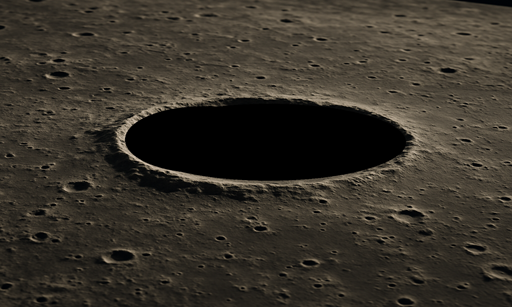
The area near the Moon’s South Pole was chosen for a number of reasons. One of the key ones is the existence of permanently shadowed craters. The Moon’s axis of rotation is tilted at 1.54 degrees to the plane of the Earth’s orbit around the Sun (the ecliptic). This small axial tilt means that there is very little seasonal variation in the amount of daylight during the course of the year but also causes permanently shadowed craters.
In comparison, the Earth’s axial tilt is much greater at 23.44 degrees. It is this axial tilt which is responsible for the seasons. In Manchester, England (latitude 53.5 degrees N) at the summer solstice the Sun is above the horizon for 17 hours 2 minutes and reaches a maximum elevation of 60 degrees in the sky at midday. At the winter solstice the Sun is above the horizon for only 7 hours 28 minutes and is low in the sky. It reaches a maximum elevation of only 13.2 degrees.

If we take a location with a lunar latitude of 53.5 degrees N, at the lunar summer solstice, the Sun reaches a maximum elevation of 38 degrees. At the lunar winter solstice, the Sun reaches a maximum elevation of 35 degrees – hardly any difference at all. The variation in the amount of daylight between the longest lunar day around the lunar summer solstice and the shortest lunar day around the lunar winter solstice is only three percent. At all locations on the Moon, other than close to the poles there is hardly any seasonal variation in the amount of daylight
At the poles on both the Moon and the Earth, the Sun is above the horizon for half the year and below the horizon for half the year. On the Moon, the Sun never rises more than 1.54 degrees above the horizon or drops more than 1.54 degrees below it. The low angle of the Sun in the sky means shadows at the lunar poles are always very long. Even when the Sun is at its maximum elevation of 1.54 degrees and shadows are at their shortest, an object 20 metres high would cast a shadow 740 metres in length. So, the bottom of a crater which had walls 20 metres high and was less than 740 metres in diameter never receive any sunlight and would be in permanent shadow. As the Moon has no atmosphere to transport heat from warmer to cooler regions it would get very cold.
In these permanently shadowed polar craters the temperature always remains below minus 220 degrees Celsius. This is cold enough for ice to exist. At higher temperatures ice would rapidly sublime into water vapour which would then escape away into space. Permanantly shadowed craters are more common in the area around the Moon’s South Pole than around its North Pole and in some of these craters ice has been discovered. Although without further investigation is unclear how extensive these ice deposits are.
In addition to the presence of ice there is another reason for exploring the permanently shadowed craters. As well as receiving no sunlight they also receive no ultraviolet light or charged particles from the Sun, which cause degradation and erosion of material on the surface. So, any material deposited in them may have been unchanged for billions of years. In effect the permanently shadowed craters act as a time capsule.
The presence of water in the form of ice makes the region around the Moon’s South Pole an attractive place to build a colony. Water is essential for life. In addition, it can be broken down into its component elements hydrogen and oxygen which can be used to make rocket fuel. Finding extensive deposits of water on the Moon would make colonising the Moon much cheaper and easier than if it all had to be brought from Earth.
The Moon’s South Pole – A good location for a solar power station?
The curvature of the Moon’s surface means it is possible to see the Sun from a high enough vantage point when it is below the horizon at ground level. Because the Sun never drops more than 1.54 degrees below the horizon, a location would only have to be 630 metres above the Moon’s surface for the Sun to be permanently visible.
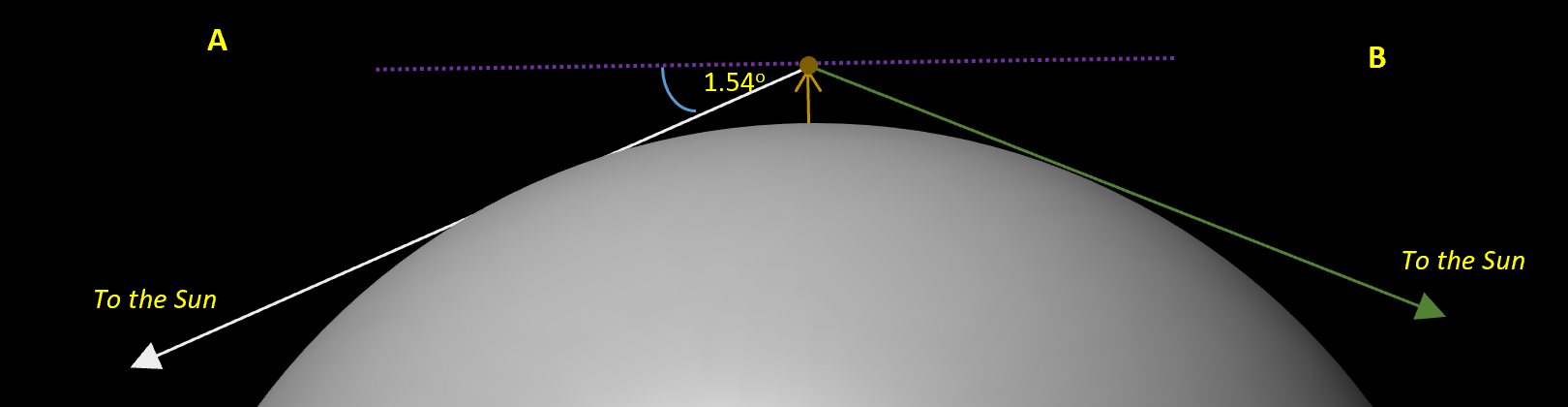
The dark brown circle marks a location near the Moon’s poles 630 metres above the lunar surface. Near the lunar winter solstice, the Sun is at its lowest elevation, 1.54 degrees below the lunar horizon, but is still visible from this location – shown as A. During the lunar day the Sun moves in a circular path around the lunar sky but seen from the dark brown circle it never drops below the horizon. Half a lunar day later, the Sun appears in the opposite direction – shown as B.
If solar panels were attached to the sides of a high enough lunar mountain, then as the Sun moved through the sky there would always be a side facing the Sun and continuous electric power would be available.

What will the Artemis 3 astronauts do on the Moon?
As with the Apollo missions, the astronauts will conduct a number of moonwalks where they will take images, video and gather samples. Although the date of the Artemis 3 landing hasn’t been announced I assume it will be in the Southern Hemisphere Spring or summer when the Sun will be above the horizon and there will be some daylight . However, exploring the dark permanently shadowed craters will require the astronauts to have headtorches.
NASA originally planned to provide the astronauts with a Moon buggy similar to that carried in the Apollo 15, 16 and 17 missions. However, the development of this vehicle, known as the Lunar Terrain Vehicle, has been delayed and it now won’t be available until 2030. So, the Artemis 3 astronauts will have to travel on foot wearing their bulky spacesuits, which will limit the distance they can cover.
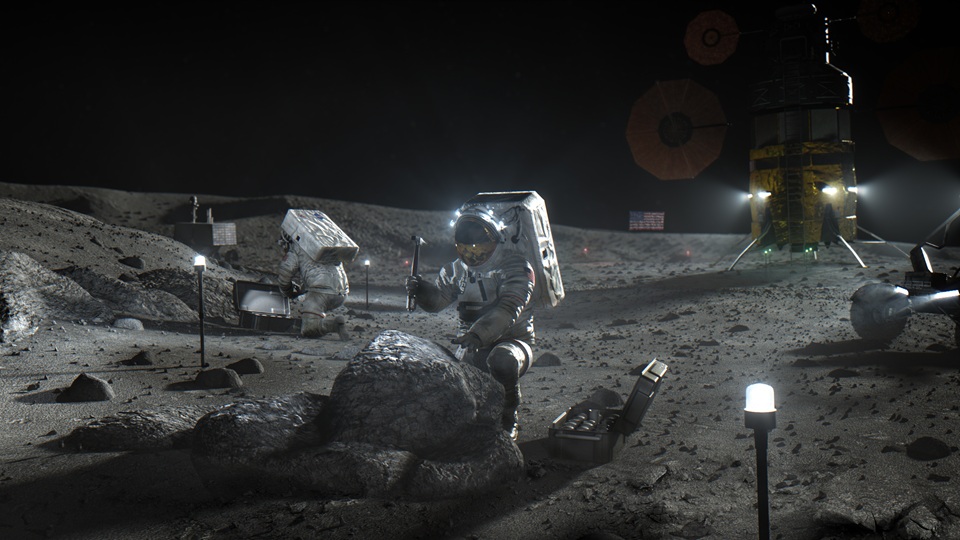
Image Credit NASA
On the Earth when the Sun is low in the sky the Sun’s rays pass through hundreds of kilometres of atmosphere which absorb and scatter its light. This is why it is safe to look directly at the Sun just after sunrise and just before sunset. However, because the Moon doesn’t have an atmosphere, the strength of sunlight when the Sun is at a low angle in the sky isn’t attenuated to the same degree it is on Earth and it would always be dangerous to look directly at the Sun. When it is one degree above the horizon the intensity of sunlight hitting the surface would be roughly one sixtieth the strength of when it is directly overhead. This is still quite bright – being 30 times stronger than the typical light level in a room illuminated by electric lighting.
The crew of the Artemis 3 mission has not yet been announced. All the Apollo astronauts were white males which did not reflect the demographic mix of America. In 2021, NASA indicated that of the two astronauts to land on the Moon, one would be a woman and the other a person of colour https://www.space.com/nasa-sending-first-person-of-color-to-moon-artemis. However, there is no longer any mention of this on the NASA website.
Artemis 4 and beyond
After Artemis 3, an Artemis 4 mission has been planned. On this mission four astronauts are planned to travel on the Orion spacecraft to the Lunar Gateway. This will be a small space station orbiting the Moon. It will be constructed in a modular way with components being brought up on separate flights and assembly taking place in situ. The International Space Station (ISS) was built in a similar manner but on a much larger scale.
Artemis 4 is planned to install the crew habitation module on the Lunar Gateway – enabling astronauts to live and work there. Two astronauts would then leave the Lunar Gateway and journey to the Moon’s surface making it the second lunar landing of the Artemis program.
The next mission, Artemis 5, which had been planned for 2030 would deliver two more modules to the Lunar Gateway. As with the Artemis 3 and 4 missions, two astronauts would travel to the lunar surface. On this mission they would have the Lunar Terrain Vehicle enabling them to cover greater distances and thus explore more varied terrain.
However, the situation is very unclear at the moment. On 2 May 2025, the White House released a summary version of its budget proposal for fiscal year 2026 . This reduced NASA’s budget by 25% from $25 billion to $19 billion. The Artemis program was badly hit by this announcement. The budget proposal cancelled the Lunar Gateway and there would be no more flights of the Space Launch System and Orion spacecraft after Artemis 3. These would be replaced by spacecraft developed by commercial companies which would hopefully be cheaper and more cost effective.
…. The Budget phases out the grossly expensive and delayed Space Launch System (SLS) rocket and Orion capsule after three flights. SLS alone costs $4 billion per launch and is 140 percent over budget. The Budget funds a program to replace SLS and Orion flights to the Moon with more cost-effective commercial systems that would support more ambitious subsequent lunar missions. The Budget also proposes to terminate the Gateway, a small lunar space station in development with international partners, which would have been used to support future SLS and Orion missions….
It’s important to remember that these are budget proposals, and Congress has the final say on NASA’s funding. There are ongoing discussions and concerns among lawmakers and space advocates about the potential impact of these cuts, particularly on lunar science and international collaborations.
At the time of writing this (late June 2025), Artemis 4 is still showing as a planned mission on the NASA website (https://www.nasa.gov/humans-in-space/artemis/ ). Artemis 5 is no longer listed as a planned mission, but it was when I started researching this post at the beginning of June.
It will be interesting to see how the US programme to explore to the lunar surface develops over the next decade. My assumption is that Artemis 3 will proceed as planned and America will beat China to be the first nation to land astronauts on the Moon in the twenty first century. Artemis 4 and 5 will be cancelled and there will be a pause in any further crewed lunar missions while America develops cheaper and more cost effective spacecraft to get astronauts there.
And finally
I hope you have enjoyed this post. I talk about the Moon’s South Pole in my e-book about the Moon which I created back in 2015 and which I have now rewritten and revised. You can get it by clicking here.


 Explaining Science
hmmm who knows what they’ll do, plan, or un-plan these days. But a lunar colony in a permanently shadowed crater….. doesnt appeal, think I’ll stick with Earth and trying not to wreck it! Very interesting post Steve.
LikeLike
Thanks Margaret, I don’t there will be moonbase for some time. The focus will be on getting to Mars at some point. Until plans and priorities change 🙂
LikeLike
Exciting prospects, lunar buggy or no!
LikeLike
indeed. Let’s hope it happens and we have a lunar landing some time in 2027!!
LikeLiked by 1 person