
Updated April 2026 – A friend of mine recently asked me whether it was possible to have a lunar-stationary orbit. This would be the equivalent of a geostationary orbit, but around the Moon rather than the Earth.
To an observer on the Moon, a lunar-stationary satellite would appear fixed in the sky and if a dish were pointed at it to receive its transmissions the dish wouldn’t need to track the satellite. Sadly, for reasons I’ll explain, such an orbit isn’t possible . So, if humanity eventually colonises the Moon, inhabitants living on any future moonbases won’t be able to set up their fixed satellite dishes to receive TV transmissions.
Geo/lunar stationary orbits – the basics
A geostationary orbit is a circular orbit where:
- the orbit is in the plane of the Earth’s equator
- the satellite orbits in the same direction as the Earth’s rotation (i.e. looking from the North Pole it is anticlockwise)
- the orbital period is exactly the same as the Earth’s rotation period 23h 56 m 4.1 sec
The radius of an orbit around a massive body is related to the orbital period and the body’s mass. Orbits with a longer orbital period have a larger radius. (For more details see https://explainingscience.org/stationary-orbits-and-the-hill-sphere/ )
For a geostationary orbit (period 23h 56 m 4.1 sec) around the Earth the radius is 42164 km.

Communications satellites are often placed in a geostationary orbit so that Earth-based satellite antennas do not have to move to follow them but can be pointed permanently at the position in the sky where the satellites are located. Weather satellites are often placed in geostationary orbits for real-time monitoring and data collection, as are navigation satellites used to enhance GPS accuracy.
Interestingly, back in 1945, the British science fiction writer Arthur C Clarke predicted that one day, worldwide communications would happen using three geostationary satellites spaced at equal intervals around the equator.
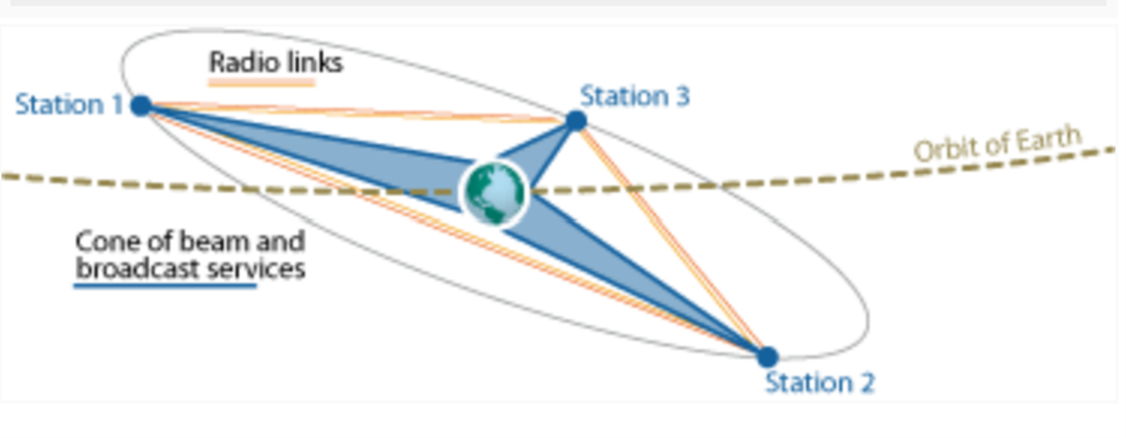
Diagram adapted from Arthur C Clarke’s 1945 paper. For those wanting to know more I have put a copy of Clarke’s classic paper here https://explainingscience.org/references/.
Clarke’s prediction was well ahead of its time. The year he made it was 12 years before the launch of Sputnik 1, which started the space age, and 18 years before the launch of the first geostationary communications satellite. For this reason, a geostationary orbit is sometimes called a Clarke orbit. Today there are more than 500 active satellites in geostationary orbits.
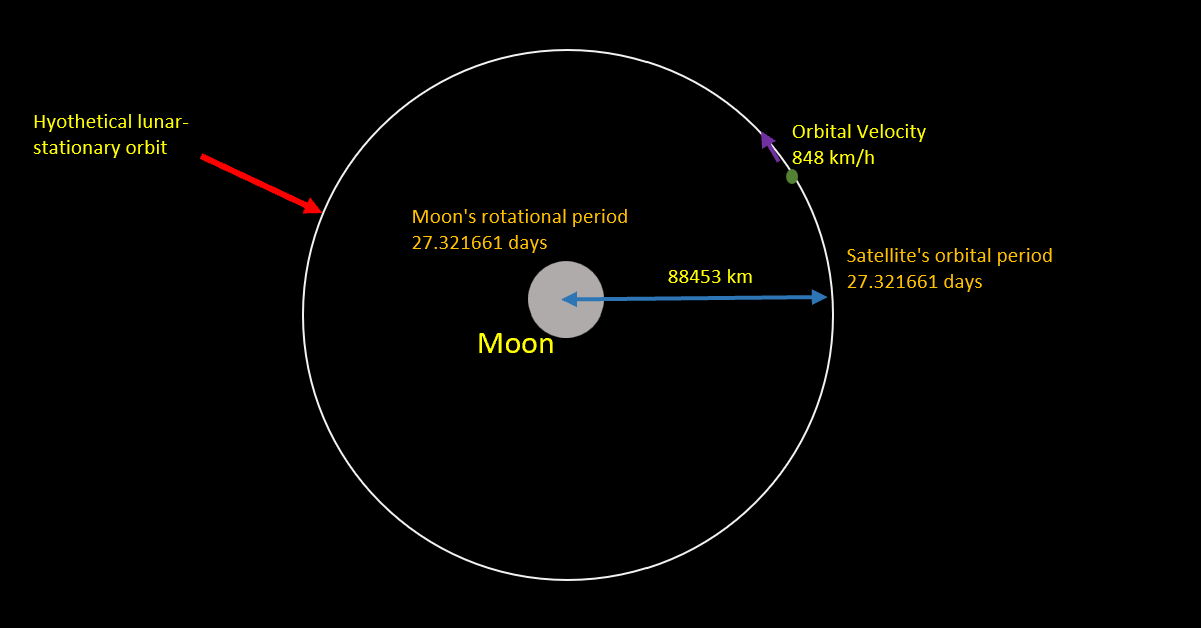
If we calculate the radius of a hypothetical lunar stationary orbit, which would have an orbital period of roughly 27.3 days, tthe slow rotation of the Moon means that it has a much larger value than the radius of a geostationary orbit – 88453 km.
The Hill sphere.
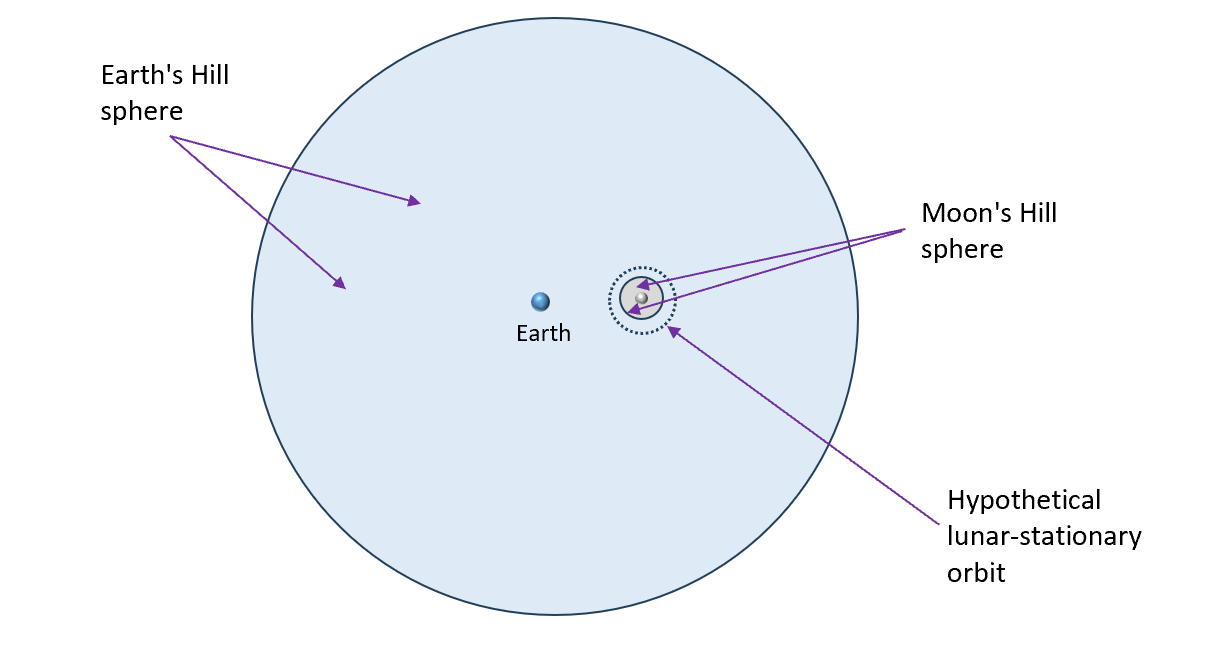
Consider two bodies in which the lighter one orbits the more massive one, e.g. the Moon orbiting the Earth or the Earth orbiting the Sun or the Sun orbiting the centre of our Milky Way galaxy, then the Hill sphere of the lighter body is the region of space where its gravity is the dominant force and a satellite can have a stable orbit around it. It is named after the American astronomer and mathematician George William Hill (1838 – 1914). Hill was able to quantify the gravitational sphere of influence of an astronomical body in the presence of other heavy bodies,. The radius of the Hill sphere depends upon the ratio of the masses of two bodies and the distance between them
For the Earth-Sun system, the radius of the Earth’s Hill sphere is approximately 1.5 million km. For the Earth-Moon system, the radius of the Moon’s Hill sphere is approximately 60 000 km. Because the orbit of our hypothetical lunar stationary satellite is well outside the Moon’s Hill sphere it would not be a stable orbit. The satellite would leave the Moon’s gravitational influence and go into orbit around the Earth.
And Finally…
I hope you’ve enjoyed this post. On the subject of the Moon, if you’ve not done so already you may wish to take a look at my e-book about the Moon which I’ve just revised and updated for more details click below


 Explaining Science

very interesting !
LikeLike
Thank you
LikeLike
LikeLike
Hill sphere … it was someone called Hill who worked that out? When?
Though I do enjoy these articles, I often feel a little bit more detail would be good.
After I read about China’s efforts, and the big three intending to mine the Moon, it feels we all need to know more about it.
LikeLike
Thanks for the feedback and I am glad you’re enjoying my log. I will add a little more about the Hill sphere in the supporting page
LikeLike
Great article, Steve! The section on the Moon’s Hill sphere really made it clear why a lunar-stationary orbit just isn’t feasible. At roughly 88,000 km out, a satellite would end up outside the Moon’s sphere of influence and get pulled into an Earth orbit instead. Thanks for breaking down the orbital mechanics and linking it back to geostationary orbits—it was a fascinating read.
LikeLike
Thank you and glad you enjoyed the post!
LikeLike
Hi Steve,
You say “I hope you’ve enjoyed this post …” Don’t worry, we always do!
It’s worth noting that we could of course maintain a satellite in a ‘luna-stationary’ orbit indefinitely – if we really needed to– but at the cost of (a very modest amount of) fuel. I’ve not done the arithmetic, but suspect it would be quite feasible for it to be solar-powered.
Though on second thoughts, even then, we’d need to replenish the propellant from time to time which might make it more trouble than it was worth.
David.
LikeLike
Thankd David some interesting points
LikeLike