
This gives a simple derivation of the formulae to determine
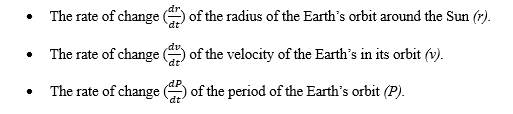
due to the Sun’s mass loss caused by solar wind from its surface and fusion at its core.
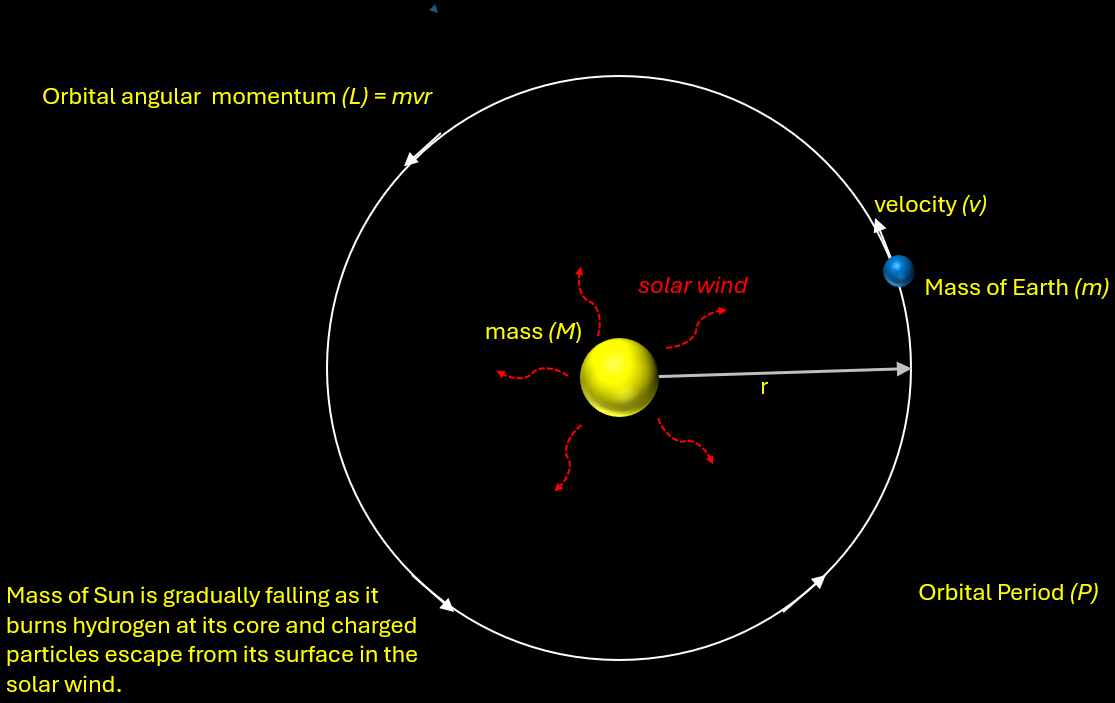
For simplicity it is assumed that the Earth’s orbit around the Sun is circular, in which case the rules of orbital mechanics means it must move with a constant velocity.
Fundamental Principal – The Conservation of Angular Momentum
As the Sun loses mass its gravitational pull on the Earth weakens, as a result the Earth spirals out to a higher orbit, its orbital speed slows and its orbital period lengthens. To calculate the magnitude of these changes we use the fact that the changes to the Earth’s orbit must obey the law of conservation of angular momentum.
This states:
“the total angular momentum of a system (e.g. the Earth orbiting the Sun) remains constant if no external torque (i.e. a twisting force) acts upon it”
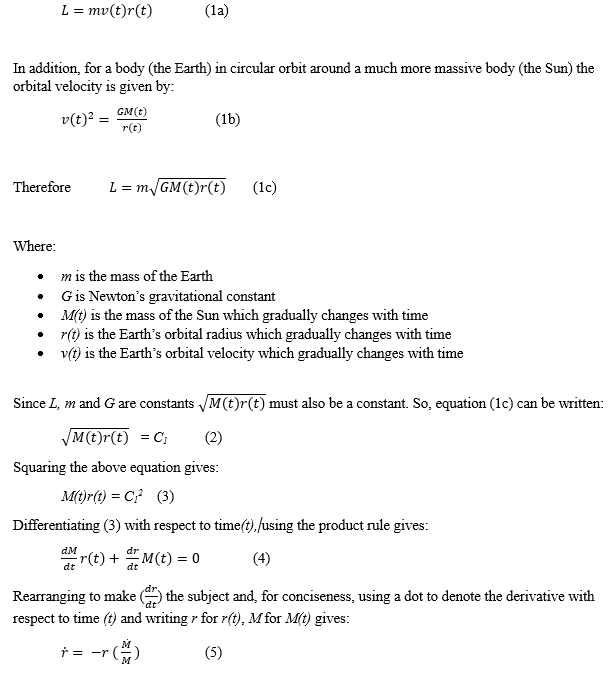
Derivation of the Formula for the Rate of change of Orbital Radius
The Earth’s orbital angular momentum L is given by:
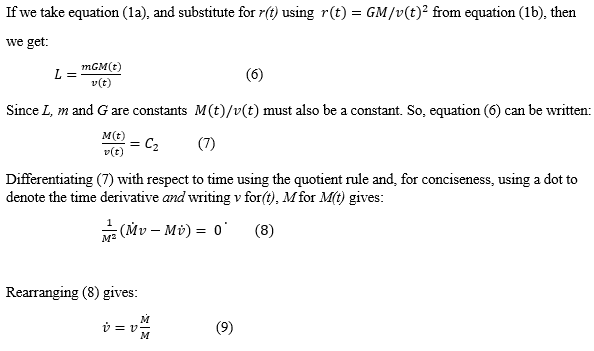
Derivation of the Formula for the Rate of Change of Orbital Velocity
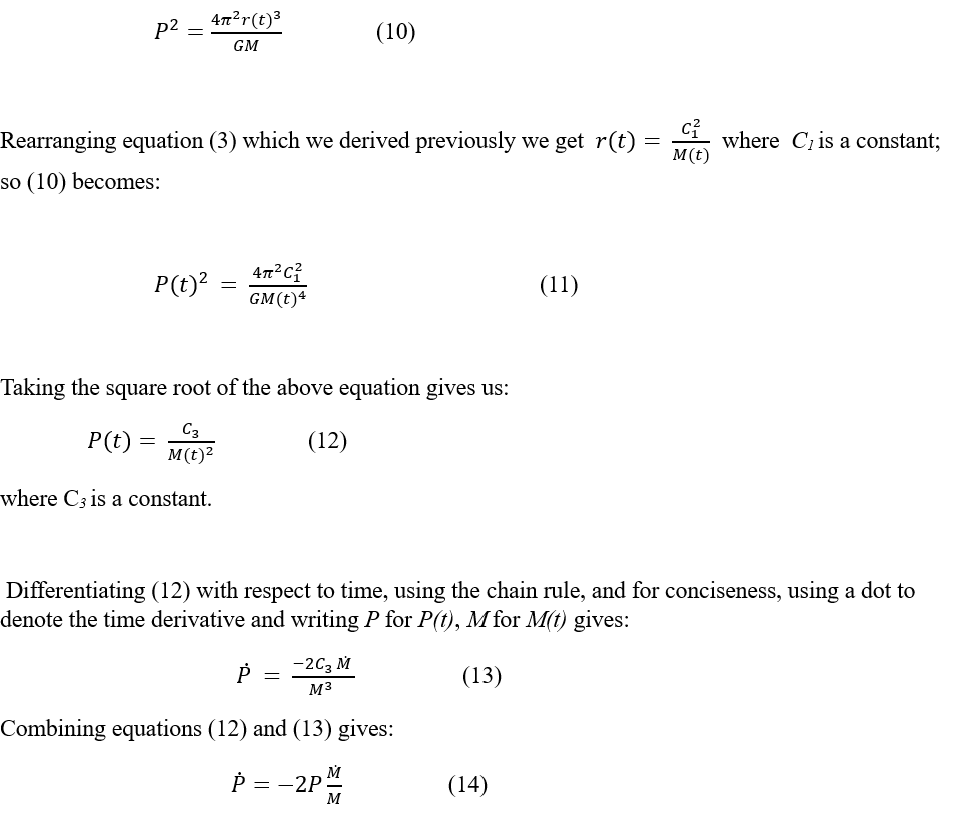
Derivation of the Formula for the Rate of Change of Orbital Period
For a circular orbit the orbital period is given by:
Calculation of the Rates of Change
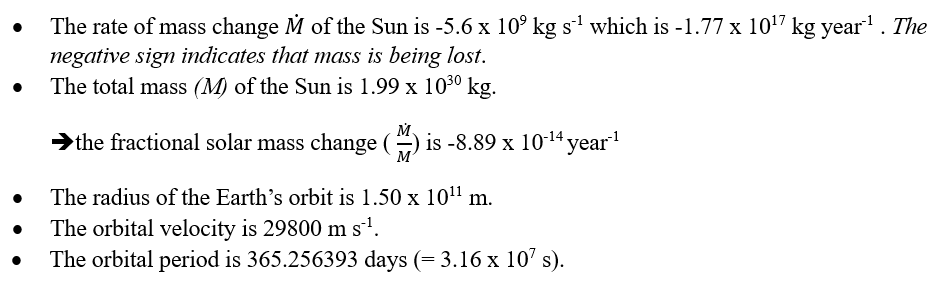
To calculate the actual rate of change we will assume the following.
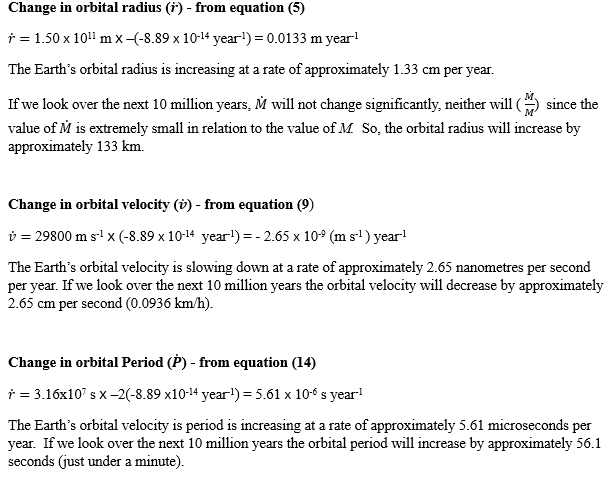
Using the previous formulae, we obtain:
And Finally...
I hope this article been interesting and valuable. A pdf version can also be downloaded
Solar Mass Loss and Earths Orbital Parameters pdf
Explaining Science
I started the Explaining Science blog back in 2014. Its main focus is tronomy, space and space travel – written at a level which is easily accessible to the non-scientist but without being dumbed down. But as well astronomy there are plenty of articles on many other scientific topics e.g.
- The switch to zero emission vehicles
- Time and time zones, daylight saving time, solstices, equinoxes, The date of Easter, the calendar
- The seasonal changes in an English garden
- Global warming and our attempt to reduce greenhouse gas emissions, rising use of fossil fuels by developing countries , opportunities for solar energy
- The origin of the word Eureka!
- There are also posts from the abstract world of pure math
And unlike many quality educational blogs, my blog is entirely free of adds
 Explaining Science