
Updated 10 December 2025
This post continues my previous two posts on Saturn’s icy Moon Enceladus which many scientists now believe is the most likely place in the solar system, other than the Earth, to harbour life. and discusses how we might get there
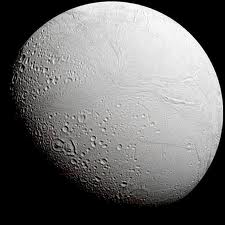
Image from NASA
There are two possibilities .
(a) the one way trip (the cheaper option)
NASA’s Cassini mission was launched in 1997 and arrived at Saturn in 2004 to study the planet and its moons. It flew past Enceladus a number of times and one flyby in particular, in October 2015 passed only 50 km above its surface.
A new mission could fly much closer to the “water volcanoes” than the current Cassini mission, and might even fly through one while it was erupting. It could have specific experiments to look for life, and more up to date instruments to analyse the chemical contents of the volcanic plumes in more detail. The mission could have a probe to land on the surface, perhaps near one of the water volcanoes and analyse material which had gathered nearby.
The Cassini spacecraft carried a probe Huygens (built by the European Space Agency) which landed on Saturn’s giant moon Titan in January 2005.

Titan Image credit NASA
(b) the return trip
Another more exciting possibility would be to have a return mission which would land on Enceladus, capture some material, and then return it back to Earth. This would enable a much more through analysis with state of the art equipment.
At the moment such a mission is sadly beyond the technical capabilities of any nation – a sample return mission has still not been attempted for Mars which is much closer and thus far easier to get to than Enceladus. However, technology is continually evolving and such a mission might be feasible in 80 to 100 years time. So I guess most of my readers will not be around to see it!
How Long Would the Mission take?
The mission would probably take a similar amount of time to reach Saturn as did the Cassini space probe which is currently in the area. This was launched in October 1997 and arrived at Saturn in July 2004, nearly seven years later. Cassini’s trajectory is shown below:
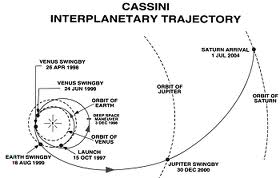
Cassini Trajectory (from NASA)
As you can see from the picture above, the mission used the gravity of the planet Jupiter (see Notes ) to attract the probe, speed it up and ‘slingshot’ it onto Saturn. Using the slingshot, or to be more precise, ‘gravitational assist’, means that the gravitational field of Jupiter does much of the work. This has cost implications for the mission: because the spacecraft needs to contain less fuel, it is much lighter, so the rocket required to launch it into space is smaller – and cheaper.
There have been four missions so far to Saturn and all four spacecraft have used the gravitational assist. Indeed I would go so far as to say that, using today’s rocket technology, it would not be possible to launch a complex spacecraft to Saturn without using a Jupiter gravitational assist. The costs would be astronomical (if you pardon the pun 🙂
Limitations of the Gravitational Assist
The limitation of the gravitational assist is that Jupiter and Saturn need to be in the correct alignment for it work and this only happens every 20 years. The last time was in 2020, the next opportunity will be in the year 2040
Because it always takes at least five years to get from the financial approval of a mission to the actual launch date, plus up to three years to get to from Earth to Jupiter, I think that the chances of getting a mission in place for the Jupiter/Saturn alignment of 2040 are very unlikely.
Notes
* Cassini actually performed two flybys of Venus and one of Earth, bfore heading to Jupiter. Although this meant that the spacecraft took longer to reach Jupiter than if it had flown there directly, it meant that the amount of fuel needed was kept to a minimum, thus reducing the overall costs of the mission.
Related Posts
I hope you have enjoyed this short post. Two other posts you might to read
- Enceladus Could there be life? Speculates on the likelihood on there being any life forms on Saturn’s icy moon Enceladus
- Enceladus What kind of life? If life exists what form(s) would it take

 Explaining Science