
Christmas Day, for the majority of people from countries with a Christian tradition is celebrated on December 25. However, followers of Orthodoxes church generally celebrate Christmas Day on January 7.
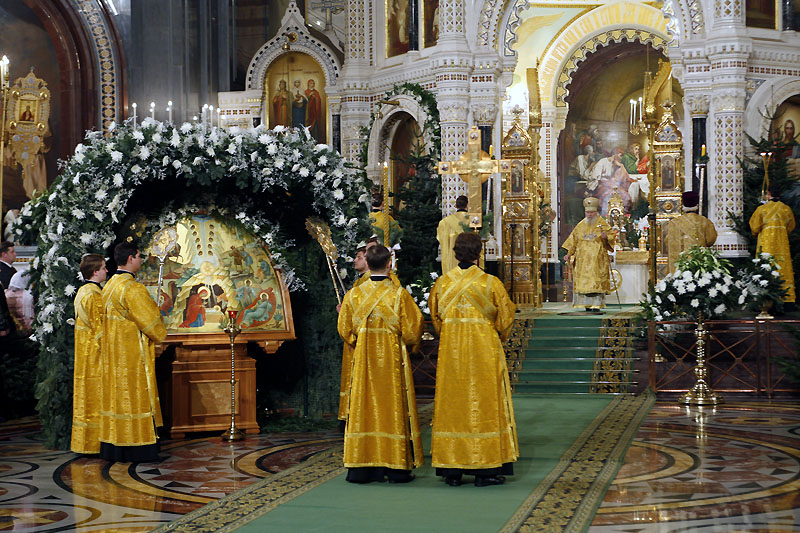
The reasons for this difference are interesting and, as I’ll discuss further in this post, are more to do with the role of the church in society than with science.
The Tropical Year
Astronomers call the period of time that the Sun takes to return to exactly the same position in the cycle of the seasons a tropical year. This period has been accurately measured as 365.2421897 days, to the nearest 7 decimal places.
Interestingly the tropical year is very slightly different from the period of time it takes the Earth to orbit the Sun – as described my post The Three Types of Year: Sidereal, Tropical, Anomalistic

A tropical year is the amount of time from a particular point in the cycle of the seasons to exactly the same point in the following year (e.g from one summer solstice to next)
Because the tropical year is slightly longer than 365 days, if we were to use a calendar where every year always had exactly 365 days, then the calendar year would slowly run ahead of the solar year at the rate of slightly less than a quarter of a day per year. In about 400 years the seasons would have drifted by about 97 days. So (in the northern hemisphere), the start of Spring would be at the end of June, the summer solstice, the day with the most daylight, would be at the end of September and the autumn (or fall) equinox would be at the end of December. To prevent this happening we add an extra day (February 29) every four years, calling it a leap year.

This is the basis of the Julian calendar, named after Julius Caesar, who introduced it in the year 45 BCE, which was used by all Christian countries until 1582. However, if we always have a leap every four years, this will result in a year which is on average 365.25 days long, which is slightly longer than the length of the solar year. This slight over correction will cause the calendar to drift backwards gradually from the natural calendar by 7.8 days per 1000 years .
Between 325, when the Julian calendar was first used by the church to define the date of Easter and 1582, the calendar had drifted back by 10 days. So the spring equinox, the first day of Spring, when the day and night are roughly 12 hours long, was on March 11 (whereas in 325 it had been on March 21), the day which had the most daylight was Jun 11 and the shortest day was December 11. The spring equinox is used to calculate the date of Easter so the date range on which Easter could fall had drifted back by 10 days.
Introduction of the The Gregorian Calendar
To prevent the calendar used by the church from drifting any further from the seasons, in 1582 Pope Gregory XIII introduced a refinement where a century year (e.g. 1600, 1700, 1900, 2000, 2100) could only be a leap year if it was divisible by 400. So 1700, 1800, 1900 would not be not leap years, but 1600 and 2000 would be. He also proposed that the calendar be brought back in line with the seasons so the spring equinox would once again fall on March 21. This required that 10 days be omitted when moving from the old to the new calendar. Pope Gregory’s calendar, which is the one that nearly every country in the world uses today, is called the Gregorian calendar. On average each year is 365.2425 days, which is very close to the length of the solar year.
The Gregorian calendar was adopted by the Catholic countries in Europe in 1582. Spain, which at the time included Portugal and much of Italy, adopted it on 4 October 1582. The next day was 15 October 1582, the days from 5 October to 14 October were missed out
. 
However, the Protestant and Orthodox countries in Europe refused to adopt the Gregorian calendar initially, feeling that it was a plot by the Catholic church to impose its power over non-Catholic countries. This caused confusion over dates when some countries had converted to the Gregorian Calendar and other countries still used the Julian Calendar. Conventions such as 10/20 February 1667 were used to indicate that an event took place on 10 February 1667 in the Julian Calendar, which was the same day as 20 February 1667 in the Gregorian Calendar.
The Rollout of the Gregorian Calendar
Eventually, all the Protestant countries switched over to the Gregorian Calendar. In particular, Great Britain and its colonies, which at the time included America, adopted the Gregorian calendar on Wednesday 2 September 1752, which was followed by Thursday 14 September 1752. The eleven days from 3 September to 13 September were missed out.
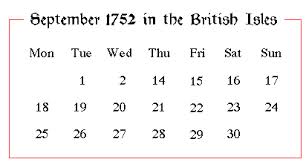
According to some accounts rioters took to the streets, demanding that the government “give us back our 11 days.” In America, meanwhile, Benjamin Franklin (1705-1790) took a more positive view of the phenomenon and wrote that
“it is pleasant for an old man to be able to go to bed on September 2, and not have to get up until September 14”.
The Orthodox countries of Eastern Europe were even slower to adopt the Gregorian Calendar. The Soviet Union didn’t adopt it until after the revolution in 1918 and Greece didn’t adopt until 1923.
Interestingly, even though all the Orthodox countries have adopted it for civil purposes, most Orthodox churches still use the Julian Calendar and will not accept a calendar which they see as being imposed by the Catholic Church. Although Orthodox Christians do celebrate their Christmas on the day marked December 25 on their calendars, they are celebrating on a completely different day to the rest of the Christian world, as it is actually January 7 in the Gregorian Calendar.
Other Calendars used in the World
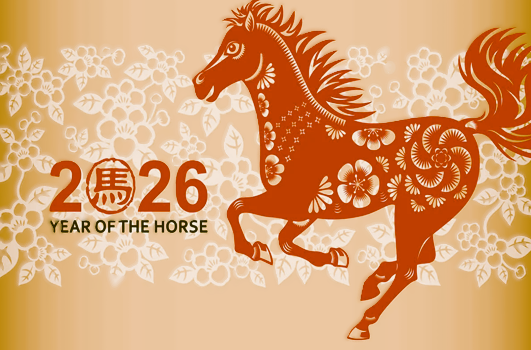
Nearly all countries outside Europe and America use the Gregorian Calendar for administrative purposes, often alongside a more traditional calendar. For example, China uses the Gregorian Calendar for public or business affairs such as most national holidays, but uses the traditional Chinese calendar, in which years have names rather than numbers, as well. In the traditional Chinese calendar there can be 353, 354, 355 383, 384, or 385 days in a year and the first day of the new year occurs in late January or February. The current year runs from 17 Feb 2026 to 5 Feb 2027 and is the Year of the Horse.
What will happen to the Calendar over the next millenia
The Julian Calendar is slowly drifting away from the Gregorian Calendar at the rate of 7.8 days per thousand years, so if the Orthodox church doesn’t adopt the Gregorian calendar then date of Orthodox Christmas will slowly get later and later. In 2,000 years time Orthodox Christians would be celebrating Christmas on around January 23 (in the Gregorian Calendar) and in 10,000 years time they would be celebrating Christmas at the end of March.
But even though the Gregorian calendar is a much better match to the tropical year than the Julian calendar, it is not a perfect fit, and it will be necessary to omit more leap years in future to keep it fully in line with the seasons.

For each calendar the average length of year is given in days. The leap yrs/ 400 yrs column gives the number of leap years over a four hundred year period.
The rules for the Gregorian calendar give slightly too many leap years, an additional 0.12, over the four hundred year cycle. So, a leap year needs to be omitted every 3300 years to keep the calendar fully in line with the seasons. As discussed in my post The Earth’s rotation and time, over a longer period the gradual lengthening of the day means that there will be fewer days in a tropical year, and leap years will be needed less frequently
And finally
I hope you have enjoyed this post. You may be interested in these other posts from Explaining Science
- The Equinoxes the two times of year when the length of day and night are almost equal.
- The solstices when the either the North Pole or South Pole is tilted at the maximum angle towards the Sun.
- And for those of you who like a little mathematical detail, an explanation of why the Earth is spiralling out from the Sun at rate of 1.33 cm per year
- The Three Types of Year: Sidereal, Tropical, Anomalistic all of which have different lengths
Revised and updated February 2026
Discover more from Explaining Science
Subscribe to get the latest posts sent to your email.

 Explaining Science
Ati scris foarte frumos despre Christmas Day and The Calendar
LikeLike
I celebrate Christmas twice. On 25th, since I live in Canada, my family has big celebration, and 7 the, since I’m European orthodox
LikeLiked by 1 person
Thank you for your kind comment. I’m glad you found the post interesting.
The Science Geek
LikeLike
A fascinating, detailed account, combining science and history with impressive flair. This is an especially interesting topic to me, as my wife and I come from eastern orthodox and protestant backgrounds. Well done!
LikeLike
Interesting! Thanks for the like and Happy New Year!
LikeLike