
Updated 4 February 2026
As
The accidental discovery of the cosmic microwave background (CMB) by Penzias and Wilson in 1964 proved to be one of the greatest scientific discoveries of the early twentieth century and since then has made a huge contribution to our understanding of the Universe. One of the first things it achieved was to provide confirmation of the big bang theory against its rival the steady state
Evidence against the Steady State Theory
Although the big bang theory is generally accepted today, in the mid 1960s many astronomers still believed in the rival steady state theory according to which the Universe is infinitely old and will exist for an infinite time in the future and, taken as a whole, doesn’t evolve or change over time.
However, in the 1960s evidence was beginning to mount against the steady state theory, as observations of distant objects showed that bright radio sources were more common earlier in the Universe’s history then they are today. This indicated that the Universe had been changing over time.
In 1963 a new class of astronomical objects called quasars were discovered. These are incredibly bright objects which can be up to 1,000 times the brightness of the Milky Way, but are very small when compared to size of a galaxy. Quasars are only found at great distances from us, meaning that the light from them was emitted billions of light years ago.

A quasar. Image from ESO
The fact that quasars are only found in the early Universe provided more evidence that the Universe has changed over time, further calling into question the steady state theory.
The existence of the cosmic microwave background proved to be the final nail in its coffin. Although Fred Hoyle, one of the originators of the steady state theory, did come up with a convoluted theory to account for the CMB, virtually no other astronomers were convinced by his explanation. The big bang theory, on the other hand, predicted the existence of the CMB, and therefore its discovery provided further confirmation of its validity.
Prediction of the Cosmic Microwave Background
By coincidence, at the same time as Penzias and Wilson were making their discovery, the astronomers Robert Dicke (1916-1997) and Jim Peebles (1935-) had performed some detailed calculations on the conditions in the early Universe. These calculations also predicted the existence of the CMB and were about to start a search for it using a sensitive radio-telescope (see note 1).
Before they could start their search, they were made aware that Penzias and Wilson had detected a weak microwave signal which was the same strength in all directions. This turned out to be exactly what they were about to start looking for. According to some accounts, Dicke said to his colleagues on hearing of the discovery:
“well boys we’ve been scooped” [2].
Penzias and Wilson had not predicted the CMB and, when they published their results, did not explain their accidental discovery. Nevertheless, it was they who were awarded the Nobel prize, rather than Dicke and Peebles, who had done the calculations which explained Penzias and Wilson’s observations.
Cosmic Microwave Background Astronomy
The Motion of the Milky Way
One fascinating thing that measurements of the microwave background allow us to determine is the speed and direction in which our cosmic neighbourhood is moving with respect to the rest of the Universe. The Sun is one of around 400 billion stars in the Milky Way galaxy, and the Milky Way is one of over 2 trillion galaxies in the observable Universe [1]. Our galaxy, together with the large spiral galaxy in the constellation Andromeda and around 50 smaller galaxies form a collection of galaxies bound together by gravity, called the Local Group.

What our Local Group might look like from a distance of millions of light years (image from NASA)
When we look at the CMB in more detail, it is not exactly the same in all directions but rather has some fluctuations in its strength. One cause of these is the fact that as the Earth moves around the Sun at a speed around 110,000 km/h it causes the CMB to be fractionally stronger (or warmer) if we observe it in the direction in which the Earth is moving around the Sun, and fractionally weaker (cooler) if we look in the opposite direction, due to the Doppler shift.
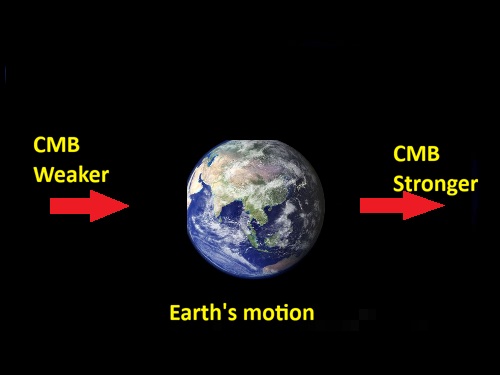
The Sun orbits the centre of the galaxy at a speed of nearly 800,000 km/h, taking about 250 million years to do a complete orbit. If we subtract the fluctuations in the microwave background due to the Earth’s motion around the Sun, then there is still a variation in the microwave background caused by the Sun’s motion around the centre of our Milky Way galaxy.

In addition our Milky Way is moving with respect to the centre of the Local Group.
If we subtract the unevenness in the CMB due to the motion of the Sun around the galactic centre, and also our Milky Way’s motion with respect to the center Local Group, we are still left with an unevenness in the microwave background.
It appears strongest (hotter) towards a point which lies in the constellation Hydra and weaker (cooler) at the opposite point in the sky. This because the Local Group is moving at 2 million km/h towards this point [5]

The digram above is part of a sky chart showing the constellation Hydra. The blue dot marks the point towards which our Local Group of galaxies is moving.
A window on the very early Universe
The radiation we observe today as the CMB was emitted when the Universe was around 400,000 years old. Before this time the Universe consisted of a plasma through which radiation cannot pass, so this marks a limit as to how far back in time we can see, as no radiation emitted before this time can ever reach us.

This means that the CMB is the oldest radiation we can see in the Universe. It is an imprint of how the Universe looked like when it was 400,000 years old. In the 1970s and 1980s calculations on the early Universe predicted that there should be a slight unevenness in the way matter was distributed. Over billions of years matter condensed around these clumps of slightly higher density to form the structures we observe today.
It was also predicted that this initial unevenness should leave an imprint we could observe today. The CMB radiation should be slightly hotter in the regions where the density of matter was fractionally greater than the average value, and fractionally cooler where it was lower. These tiny fluctuations proved very elusive to find and were only discovered in 1992 by the Cosmic Background Explorer (COBE) satellite, which discovered temperature variations of about 1 part in 100 000 above and below the mean value. The resolution of the COBE maps were poor at 7 degrees (roughly 14 times the diameter of Moon) so very little detail could be seen. Nevertheless the discovery of these fluctuations were judged to be such an important finding in our understanding of the early Universe that it won two of its discoverers, George Smoot and John Mather, the 2006 Nobel Prize for physics [3].
The maps from COBE were greatly improved by those from the NASA WMAP spacecraft and further still by the ESA Planck mission which has much better resolution. A map of the Cosmic Microwave Background from Planck is shown below.
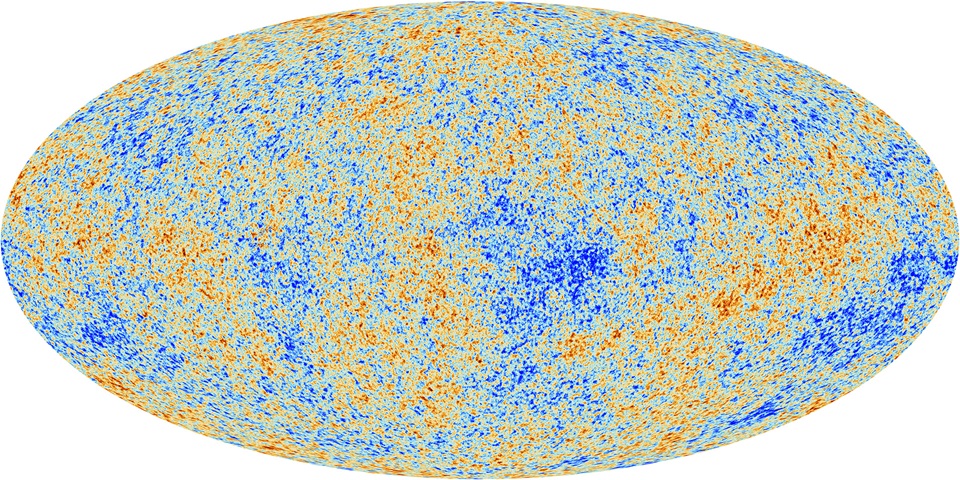
A map of the microwave background from Planck. The red areas show regions where the radiation is slightly stronger than the average level (shown as green) and the blue areas where the radiation is slightly weaker
CMB Cosmology – An Overview
I won’t go into this in any detail here, but studying the cosmic microwave background allows cosmologists to measure many of the undamental parameters that describe our Universe. The tiny temperature fluctuations measured by Planck, WMAP and Earth-based observations reveal the total matter density and the density of dark matter and ordinary matter.
The overall geometry of the universe—whether it is flat, open, or closed—can be inferred from the angular scale of the peaks in the CMB . Measurements of these peaks also determine the Hubble constant, which sets the Universe’s expansion rate. Additionally, the CMB constrains the age of the universe, The CMB’s polarization patterns provide information about the density of dark energy. Together, these parameters form the foundation of the standard cosmological model. The online tutorials by the comologist Wayne Hu [4] provide an excellent introduction to this subject.
Notes
- Interestingly, the cosmic microwave background was first predicted by George Gamow, Ralph Alpher and Robert Herman in 1948. However in the 1940’s the communication between various group was not as good as it is today and this prediction was ignored by most of the astronomical community and there was no effort made before Penzias and Wilson’s discovery to look for it. Dicke and Peebles claimed to be unaware of this early prediction when they did their own calculations.
- In fact our the Milky Way and Andromeda are on a collision course and will collide in about 4 billion years’ time. The is described in more detail in my previous post: The Ultimate Fate of the Universe.
References
[1]NASA (2016). Hubble Reveals Observable Universe Contains 10 Times More Galaxies Than Previously Thought – NASA Science. [online] science.nasa.gov. Available at: https://science.nasa.gov/missions/hubble/hubble-reveals-observable-universe-contains-10-times-more-galaxies-than-previously-thought/.
[2] Levine, A. G. (2009) The Large Horn Antenna and the Discovery of Cosmic Microwave Background Radiation, Available at:https://www.aps.org/programs/outreach/history/historicsites/penziaswilson.cfm (Accessed: 21 August 2025).
[3] NobelPrize.org. (2006) The Nobel Prize in Physics 2006. [online] Available at: https://www.nobelprize.org/prizes/physics/2006/summary/. (Accessed: 4 February 2026).
[4] Hu Wayne (2008) CMB Intermediate. [online] Available at: https://background.uchicago.edu/~whu/intermediate/intermediate.html. (Accessed: 4 February 2026).
[5] Scott, D. and Smoot G. F. (2015) Cosmic microwave background, Available at:http://pdg.lbl.gov/2015/reviews/rpp2015-rev-cosmic-microwave-background.pdf(Accessed: 28 August 2025).
Discover more from Explaining Science
Subscribe to get the latest posts sent to your email.

 Explaining Science
[…] my next post I talk about the significance of the cosmic microwave background and why it has been important to […]
LikeLike
The answer to your question is as follows….
According to Einstein’s theory of relativity there is no ‘absolute’ space against which motion can be measured. So the question ‘Is the CMB moving?’ doesn’t really make sense unless we specify with respect to what the CMB is moving.
However, he Cosmic Microwave Background provides a ‘natural’ frame of reference against which motion can be measured and, as I talked about in the post, our Local Group of galaxies is moving with respect to this natural frame of reference.
Hope this is clear 🙂
The Science Geek
LikeLiked by 1 person
Wonderful post. I’m a little confused by your fourth note. Is the CMB moving?
LikeLike
So interesting. I wonder why or what happened that we can’t see beyond a certain point in the past. Is it a veil?
LikeLiked by 2 people
The reason why we can’t see further back in time than the recombination time is that before that time the Universe was opaque to radiation. Radiation cannot passed thorough a plasma. So no radiation emitted before that time can ever reach us.
LikeLiked by 2 people
So plasma kinda sounds like a veil. 🙂
You can tell I’m not a science-y person but I am very interested in science. I appreciate your patience with me.
LikeLike
Awesome! 🙂 I just found ytour article by scrolling through my home page, and it’s so cool! I am writing about cosmic background radiation too at the same time!!
LikeLike
[…] via The cosmic microwave background part II — The Science Geek […]
LikeLike
Excellent description of CMB. Very informative and well written.
LikeLike
Thank you
LikeLike
At least to share.
LikeLike
Yes it was a real stroke of luck for Penzias and Wilson
LikeLike
Yes, it seems like Dicke and Peebles really deserved the prize.
LikeLiked by 1 person
To share at least.
LikeLike
Rather tough on Dicke and Peebles I always think, but that’s the way science works I guess.
LikeLiked by 2 people
Love the blog! I write science fiction (although not hard) and I find your blog informative and accessible. Great stuff. Truly.
LikeLiked by 2 people
Thank you
The Science Geek
LikeLike