
Revised and updated 15 January 2026
Many of my readers will recall that was a solar eclipse on 21 August 2017 . For lucky viewers in a narrow band of territory running west to east across the US, it was visible as a total eclipse – the Moon completely obscured the Sun and it suddenly went darker for a short period of time.

Image from NASA
Although there is, on average, a total eclipse somewhere in the world every 18 months, for a particular eclipse the region where a total eclipse can be seen is relatively small. Unless you are an eclipse chaser – a person who travels long distances to see as many solar eclipses as they can, you will probably only get a chance to see a total eclipse within 1000 km of where you live once or twice in your lifetime. Before the 2017 eclipse the last time that one had been visible in the contiguous US was back in February 1979. Although there was a total eclipse visible from a region of central USA in 2024

Image from NASA
The path of totality, where a total eclipse was visible is shown as the blue band in the map above. Places either side of the blue band saw a partial eclipse, when the Sun is only partially obscured and the further away from it you were, the smaller the fraction of the Sun that will be covered. Unfortunately for those of us in the UK the eclipse was barely visible just before sunset.

Image from timeanddate.com click on the diagram to show the map in greater detail
The path of the eclipse as it moved across the US is shown above. The total eclipse began over the Pacific Ocean and reached the Pacific coast of America in Oregon just West of the state capital Salem at 10:16 am local time. The table below shows the eclipse times from some cities which were in its path.

Data from timeanddate.com click on the table to zoom in
Because the chance to see a total solar eclipse is so rare, millions of people – perhaps some of you -made journeys of hundreds and in many cases thousands of miles to view it. Hotels and campsites were be fully booked – and many states on the path of totality used the sudden influx of millions of people to promote other tourist sites as well.
Why do we have eclipses
It is common knowledge that solar eclipses occur when the Moon passes in front of the Sun, obscuring some or all of its light. This is shown in the diagram below, although the distances and sizes of the Earth, Moon and Sun aren’t to scale.
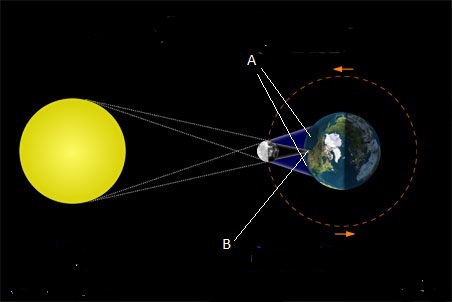
In the diagram above, the regions labelled A see a partial eclipse. Only in the small region labelled B does the Moon fully obscure the Sun and a total eclipse is seen.
From the diagram above you would expect the Moon to pass in front of the Sun every month and there to be an eclipse every month. This is clearly not the case.
The Moon’s obit around the Earth is actually tilted at about five degrees with respect to the Earth’s orbit around the Sun, as shown in the diagram below.
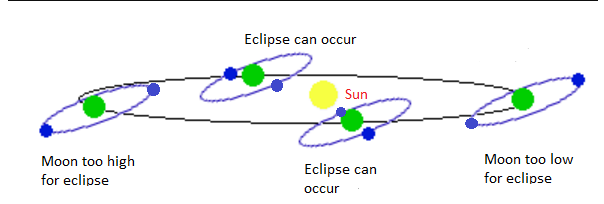
This means that during most lunar months the Moon will pass just below or just above the Sun rather than obscuring it. There are only two time windows in a year when it is possible for a solar eclipse to occur (see note ).
The other reason why we can have eclipses is that, although the Moon is much smaller than the Sun – roughly 400 times less in diameter, by a strange coincidence it is also roughly 400 times closer to the Earth than the Sun. This means that, when viewed from the Earth, the Sun and the Moon appear to be almost exactly the same size. If the Moon were closer to the Earth, or larger in size, then solar eclipses would be more frequent and would last longer. If the Moon were further away, or smaller, then we would only have what is called an annular eclipse where the disc of the Moon is too small to fully cover the Sun.
Variation in the apparent size of the Sun and Moon
The Moon, rather than moving in a circular orbit, moves in an elliptical (oval-shaped) orbit around the Earth. This means that its apparent size as seen from Earth varies. It appears largest when it is closest to the Earth and smallest when it is furthest away. The apparent sizes of large objects in the sky are measured in degrees. 1 degree is roughly how big a British 1 pence or US 1 cent coin would appear to be if you held it up at a distance of approximately 1.2 metres (4 feet) away from your eye. When it is at its closest, the Moon is 0.558 degrees in diameter and at its furthest away it is 0.491 degrees in diameter.
The Earth also moves in a elliptical orbit around the Sun. So the apparent size of the Sun varies as seen from the Earth, but the variation is not as a great as the apparent variation in the size of the Moon. When the Earth is at its closest to the Sun, the Sun is 0.545 degrees in diameter and when the Earth is at its furthest away the Sun is 0.526 degrees in diameter.
This variation means that there are times when the Moon lies directly in front of Sun, but, because it appears to be slightly smaller, we only see an annular eclipse.
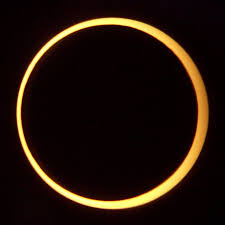
An annular eclipse- image from NASA
Duration of a Solar Eclipse
The maximum time that anyone saw a total eclipse on 21 August 2017 was just over 2 and half minutes. The are a number of factors leading to a longer eclipse. The main ones are
- the Moon should be as close to the Earth as possible making its apparent size as large as possible
- the Earth should be as far as possible from the Sun making the Sun’s apparent size as small as possible.
Another less important factor is that the eclipse should occur at a point on the Earth when the Sun and the Moon are directly overhead. This gives an additional but very small boost to the apparent size of the Moon relative to the Sun.

This diagram, which is greatly exaggerated, shows that when the Moon is directly overhead (A) it is very slightly closer to the Earth then when it is at the horizon (B). This causes the moon to appear to be slightly (1.8%) larger in diameter.
All of these conditions will be achieved for an eclipse which is predicted in South America near the equator on 16 July 2186 and will be up to 7 and half minutes in totality [1]. Bearing unprscendented adavances in medical science 🙂 , I will not be around to see it, and neither will you!
However here is a list of all the solar eclipses from the middle of this year (2026) until the end of the decade. Hopefully you will be able to see one of these.
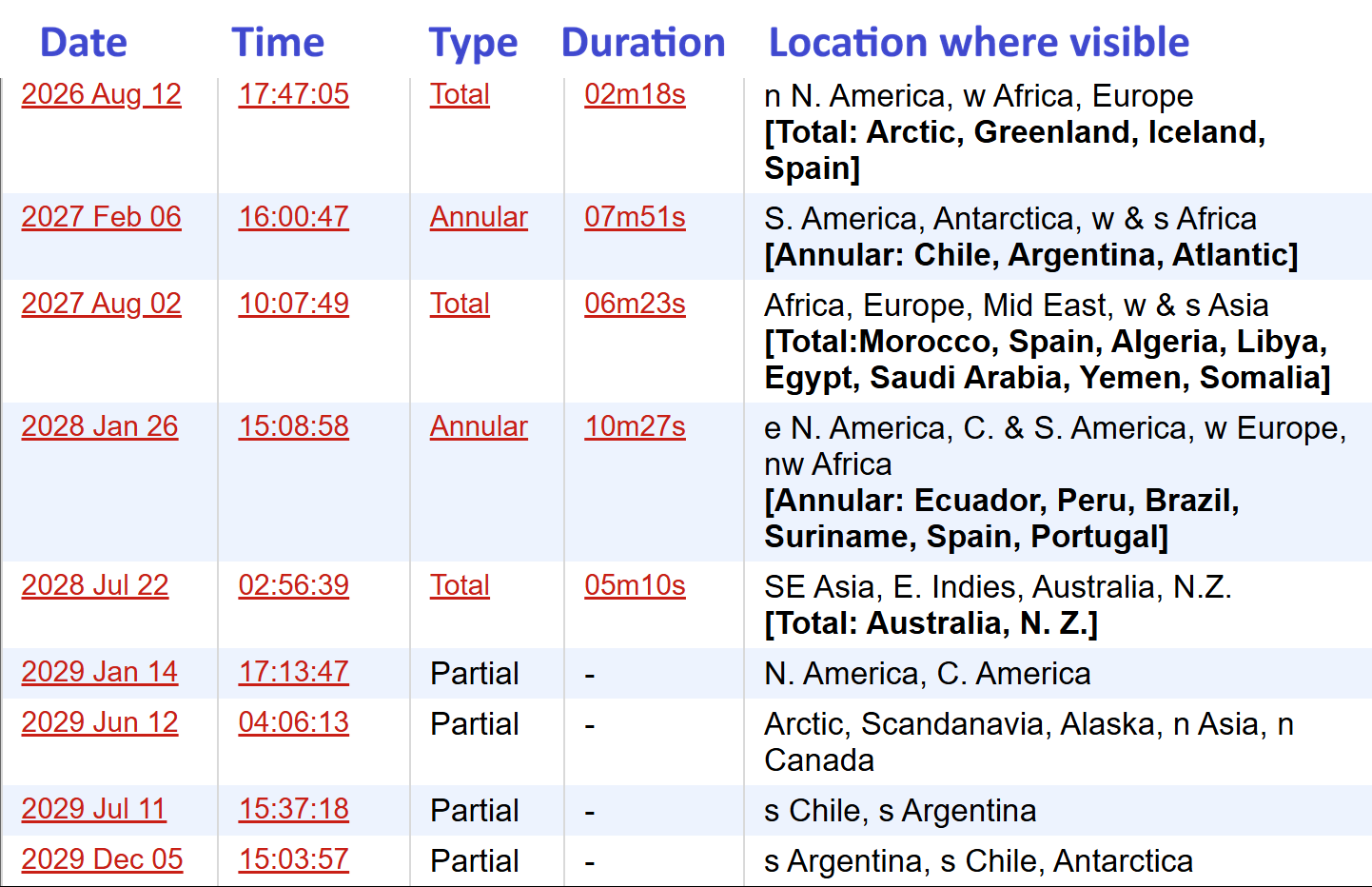
Source [2] The time is the time in UTC of the centre of the eclipse, the duration is the durattion of the total phase for a total eclipse or the annular phase for an annular elipse.
And finally…
I hope you have enjoyed this post. You may also be interested in these related posts
The total Lunar Eclipse in January 2019
The Transit of Venus. This occurs when Venus slowly moves across the disk of the Sun and has been important to the development of astronomy as a science
Notes
The two times in a year when a total eclipse can occur aren’t the same every year but change from year to year. This is due to an astronomical effect called precession of the line of nodes.
References
[1] Espinak, F and Meeus J (2011) Five millennium canon of solar eclipses: -1999 to +3000, Available at: https://eclipse.gsfc.nasa.gov/SEpubs/5MCSE.html (Accessed: 16 Jan 2026).
[2] Espenak, F. (2011). NASA – Solar Eclipses: 2021 – 2030. [online] eclipse.gsfc.nasa.gov. Available at: https://eclipse.gsfc.nasa.gov/SEdecade/SEdecade2021.html. (Accessed: 16 Jan 2026).

 Explaining Science
Total will be amazing. I saw the one in Austria in 1999.
LikeLike
Yes it will be starting in a few hours for those lucky enough to see it.
LikeLiked by 1 person
I forgot for a second that you are safely (unluckily this time?) in Blighty, as I expected to inquire as to your plans to see this next attraction.
I’ve abandoned my own travel plans, partly for the high-season flight costs but also from my innate pessimism; i.e. that I will be trapped under a highway overpass in traffic miles from the ‘front row-centre’ seat I deserve.
I’ve now circled April 8 2024 on my bucket list calendar . Less than 100 km from my once-home in PA/USA . I only should live that long.
Incidentally, amateur radio operators plan to look for anything dramatic and newsworthy in propagation which relies on the layers of the troposphere for ‘bounce’.
I’ve had conversations myself over long paths which ‘died’ almost mid sentence from solar flares. Like with Eddington, this event gives us a nice chance to compare ‘before’, ‘during’, and ‘after.
And as always; thanks for investing the time in this truly sweet site/ JS/4X1UX
LikeLiked by 1 person
Reblogged this on Two Sister Tarot.
LikeLike
What a beautifully-written post! (As a fellow ‘geek’ I scan articles instinctively for mis-statements, and find none here.)
I’m still hoping to inherit somehow the funds to fly from here in Israel back to the States late August. Worth the ticket? IDK, knowing that one was once at a rare ‘sweet spot’ in the dance of celestial mechanics conveys an imagined ‘authority’ to any of his future pronouncements on the Universe? Ha, more likely I’m looking for a defensible reason to abide, even briefly, the grotesque creature they’ve made president. I’ll take a long solar-powered shower upon returning.
Thanks so much for your having discovered my post/ JS
LikeLike
I’ve mapped my spot, about 40 miles north of town, and plan on taking grandkids there. Can’t wait.
LikeLiked by 1 person
Lucky you !
I have still never seen a total eclipse. In Manchester where I live we will only see a very slight partial eclipse
LikeLike
I’m in Idaho in the Western US. Boise is a few miles south of the total eclipse.
LikeLike
Interesting
LikeLiked by 1 person
Great post. Very informative stuff.
LikeLiked by 1 person
Thank you. I am enjoying your blog too
LikeLiked by 1 person
The diagram was re-used from an earlier post about the lunar eclipse in 2015 😉
https://thesciencegeek.org/2015/09/05/lunar-eclipse-28-september-2015/
It applies to both lunar and solar eclipses which can only occur in a time window. However I agree that the position of the blue dot is for a lunar and not a solar eclipse, which might appear a little misleading and in addition, the text “Moon too high/low for an eclipse is misleading”
When I get the opportunity I will redraw the diagram.
The Science Geek
LikeLike
Doesn’t this illustration show condtitions for a lunar eclipse?
moon-tilt1.gif
LikeLiked by 1 person