
Lunar libration is a ‘wobble’ caused mainly by the Moon’s elliptical orbit and axial tilt. It allows us to see about 59% of the Moon’s surface over time, effectively revealing 18% of the ‘far side’ that would otherwise be hidden. This post discusses this interesting phenomenon.
Updated 7 January 2026
Many people think that the whole of the Moon’s far side is entirely hidden from view. This isn’t quite true. There is a region around the boundary between the near and far sides which is sometimes visible due to a phenomenon called libration. Libration causes the Moon to appear to wobble from side to side and up and down when viewed from Earth. As a result, 18% of the Moon’s far side can sometimes be seen; so only 82% of the far side, or 41% of the Moon as a whole is completely hidden from view.
What are the three types of lunar libration?
There are three different causes of lunar libration. The first is due to the tilt of the Moon’s rotation axis, the second is due to the ellipticity of the Moon’s orbit and the third, which has nothing to do with the Moon’s rotation or orbit is much smaller, and is due to the size of the Earth.

Libration type 1 – Wobble caused by the Moon’s axial tilt
The Moon’s rotation axis is tilted by 6.68 degrees with respect to the plane of its orbit around the Earth. If, at a particular time, the Moon’s North Pole is at its greatest tilt towards the Earth then half an orbit later its South Pole will be at its greatest tilt.

The diagram below shows a two dimensional slice through the Earth-Moon system. The Moon’s near side is shaded light grey and the Moon’s far side is shaded dark grey. If you take a location on the far side near its South Pole, marked with an ‘X’ in the diagram then, at time A, no one on Earth can see location X as there is no direct line of sight. Location Y on the far side but near the Moon’s North Pole is visible.

For clarity, the sizes of the Earth and the Moon in relation to the distance between them has been exaggerated.
Half an orbit later (marked as time B), the Moon has also completed half a rotation on its axis. Location Y cannot be seen from Earth, but Location X can.
Libration type 2 – caused by the Moon’s varying speed in its orbit
The Moon takes the same time(27.32 days) to complete a single orbit around the Earth as it does to rotate once on its axis. Its rotation speed is constant. Because the Moon moves in an elliptical orbit, its orbital speed varies, being faster when it is closer to the Earth and slower when it is further away. This causes the Moon to swing from side to side when viewed from Earth.
The next diagram is from a view point looking “downwards” above the plane of the Moon’s orbit around the Earth. Although there is strictly speaking no up and down in space 😊
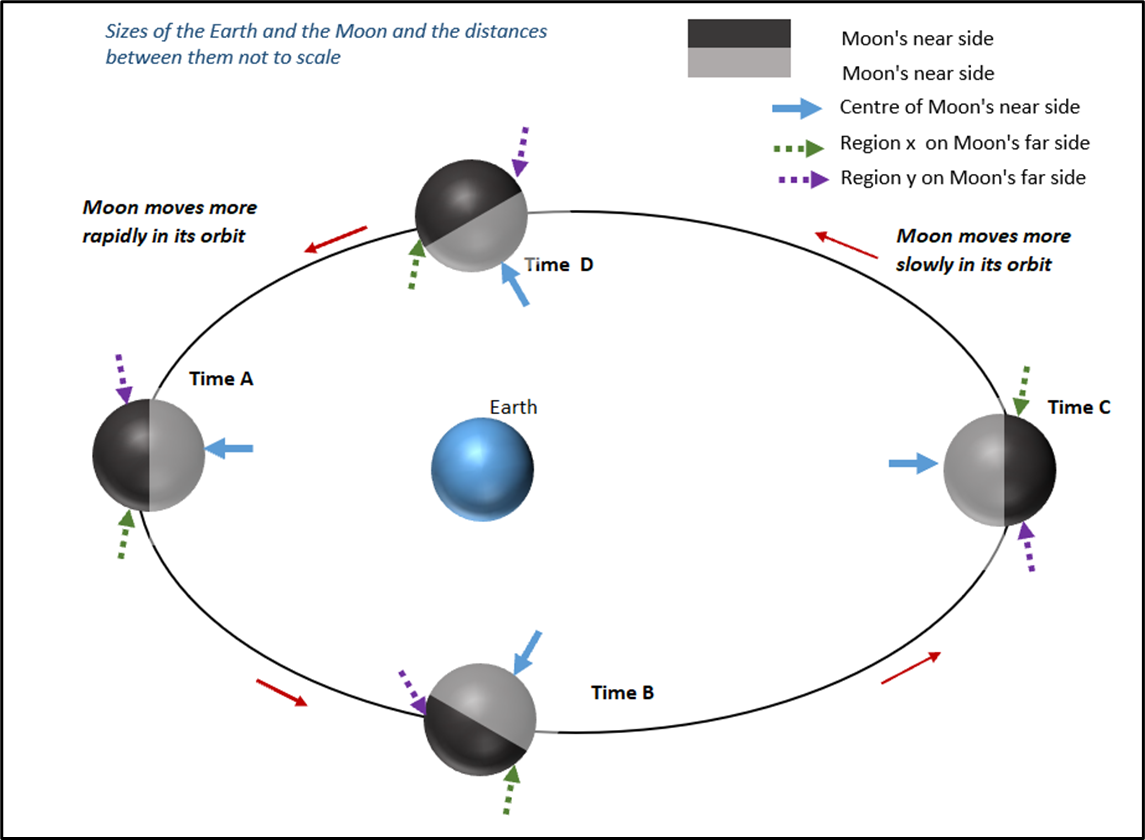
- If we start at time A when the Moon is at its closest to the Earth, regions x and y which are on the far side of the Moon, just beyond the near side/far side boundary can’t be seen directly from Earth.
- Between A and B, the Moon is closer to the Earth than average and moves more rapidly in its orbit. The distance between its position at time A and its position at time B is also less than one quarter of an orbit. So, the Moon covers this distance in less than 6.83 days. In this time the Moon has made less than a quarter of a turn on its axis. Region y is now visible from Earth.
- Between B and C, the Moon is further from the Earth than its average value and so is moving more slowly in its orbit. The Moon covers the distance between B and C in more than 6.83 days and makes more than a quarter of a turn on its axis .
- At C, the Moon’s rotation has caught up and it has done half an orbit and half a rotation on its axis since A. Neither regions x nor y are visible from Earth.
- Between C and D, the Moon is further from the Earth than its average value and moving more slowly in its orbit. It covers the distance between C and D in more than 6.83 days. The Moon does more than a quarter of a turn on its axis. As a result, at C region x becomes visible from Earth.
- Between D and A, the Moon is closer to the Earth than its average value and is moving more rapidly in its orbit. It covers the distance between D and A in less than 6.83 days. It returns to position A having performed exactly one orbit and rotated once on its axis. Once again neither regions x nor y are visible from Earth
Libration type 3 – caused by the Earth’s rotation
This carries an observer first to one side and then to the other side of an imaginary line joining the Earth’s and the Moon’s centres. This allows them to look first around one side of the Moon and then around the other as the Earth rotates.

- At moonrise, marked with an A, a viewer can see the green region of the Moon, but not the orange region.
- At moonset, marked with a B, a viewer can see the orange region of the Moon, but not the green region.
Of the three types of libration, this has the smallest effect. Interestingly, it is latitude dependant. At the equator it can bring up to 0.5% of the Moon’s far side into view. in Manchester, England (latitude 53.5oN) it is 0.25% and at the Earth’s poles it is zero.
And Finally…
I hope you have enjoyed this post. It is part of series of a series of posts on the Moon, other related posts include:
- Are lunar stationary orbits possible? (the lunar equivalent of geostationary orbits)
- Humans living and working on the Moon
- The Apollo missions which landed humans on the Moon in the 1960s and 1970s
- How Latitude and longitude are defined on the Moon
- How the Moon causes tides
Also, if you’ve not done so already you may wish to take a look at my Short Guide to the Moon e-book


 Explaining Science
[…] where libration – a subtle wobble – offers glimpses of up to 18 percent of the far side.[6] Latitude libration peaks at 6.68 degrees, occasionally exposing polar edges, but deep craters stay […]
LikeLike
Thanks for your informative post. The Earth-Moon system gives us some interesting effects when we watch it for long periods. NASA compiled this video that shows an animation of the librations you described so well. https://svs.gsfc.nasa.gov/vis/a000000/a005400/a005415/phases_2025_fancy_360p30.mp4
LikeLike
Thanks Jim, and it is a great video
Steve
LikeLiked by 1 person
Dear Steve,
Thanks for the explanation. I must admit that although of course I was aware of libration, I’d never put any serious thought into an explanation of all the details. You must have have put a lot of effort into ensuring the clarity of the diagrams.
So maybe you’ll excuse me for raising a minor quibble. (I didn’t want to do so publicly because I didn’t want it to sound like a criticism):
Libration type 2, note 2: We’re viewing Earth’s – and the Moon’s – north pole from space, hence the Moon’s orbital rotation and its spin are anticlockwise. When we proceed from time A to time B, the purple arrowhead in now visible from Earth (point y not x).
And note 5: When we arrive at time D; the earthlings can now see the green arrowhead (point x rather than y).
Well, whenever you’ve put a lot of work into something it’s inevitable that somebody will raise a trivial point Best Regards, David.
LikeLike
Thank you for pointing this out David, I have updated the text to reflect what is in the diagram 🙂
LikeLike