Understanding Solar Day Length Variation

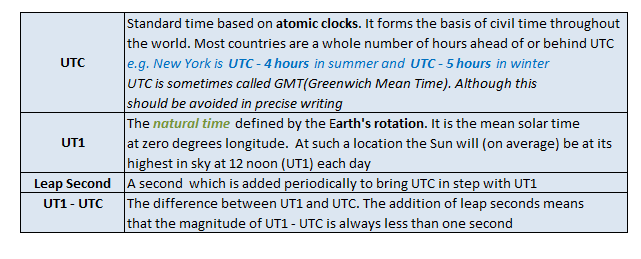
Revised and updated 18 December 2025 July 25,  is one of the four days a year in which the length of the solar day,  the natural day measured by the rising and setting of the Sun, is 24 hours. I have written about this in previous posts but I thought it be worth mentioning it… Continue reading Understanding Solar Day Length Variation
Starlink and other Large Satellite Constellations

  Back in 2019, the year before the pandemic,  many of you will have seen images  of long ‘trains’ composed of up to sixty SpaceX Starlink satellites crossing the sky in a straight line. These pictures hit the headlines not only because of the number of satellites, but because of their brightness. A 'train' of… Continue reading Starlink and other Large Satellite Constellations

The Lyrids 2023

The night of  22/23 April 2023 will be the peak of the Lyrids, one of the most famous prolific meteor showers. Meteors (also known as shooting stars) are bright streaks of light caused by small lumps of rock or metal called meteoroids hitting the Earth’s atmosphere at very high speed. As they pass through the atmosphere they get… Continue reading The Lyrids 2023

Roger Penrose – Cycles of Time

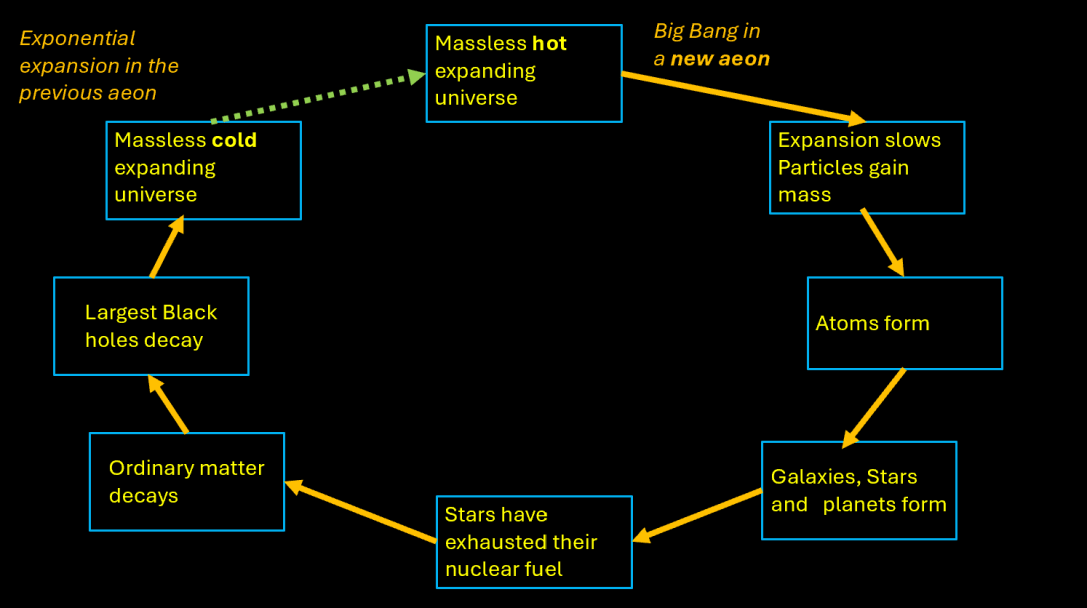
Updated 18 December 2025 In another post I talk in more detail about conformal cyclical cosmology (CCC). Roger Penrose's model of the Universe where it passes endlessly through a possibly infinite number of cycles (or aeons) each of which starts with a big bang and ends with a rapidly expanding empty universe.  This fascinating idea… Continue reading Roger Penrose – Cycles of Time

No more leap seconds

With all the events going on in the world it passed almost unnoticed that a decision was made recently to abolish the leap second. The resolution  was made on 18 November 2022 during a meeting held in Paris  held by the International Bureau of Weights and Measures. What is a leap second? The length of… Continue reading No more leap seconds