
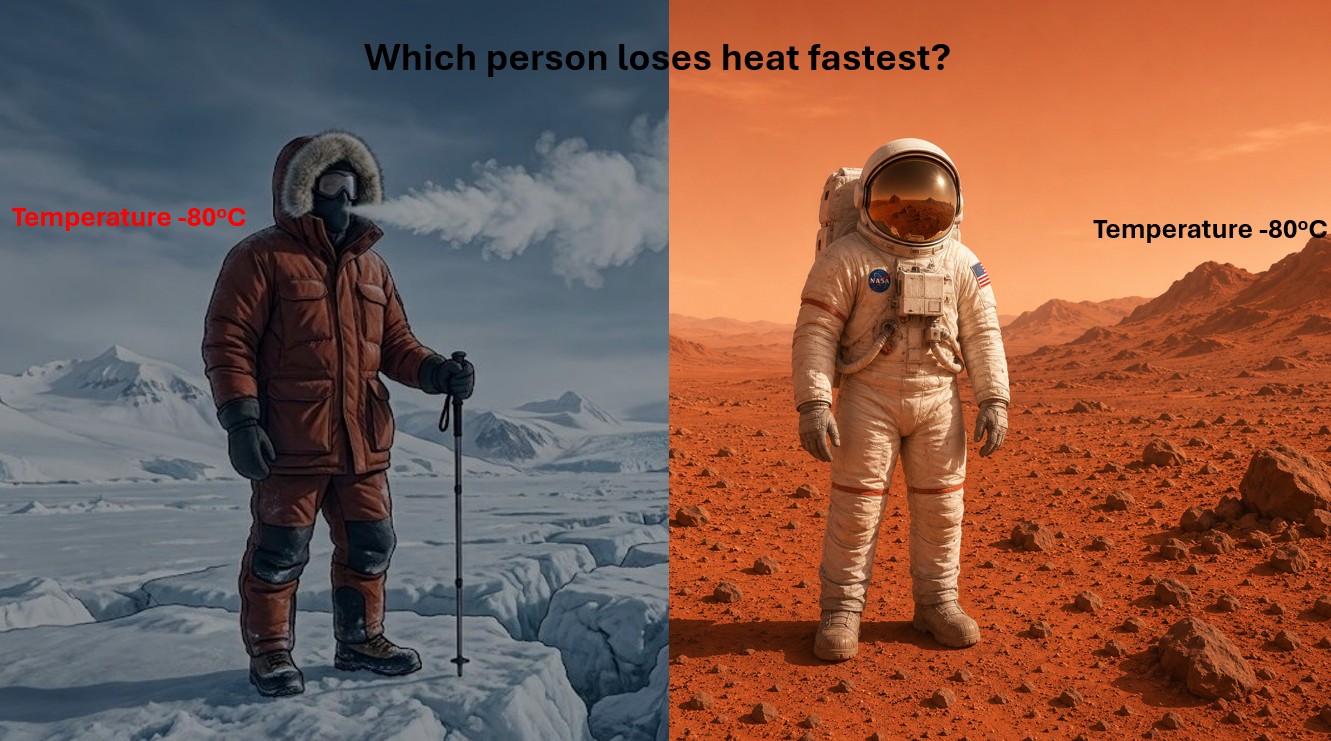
In this article I consider the ways in which humans wearing protective cold weather clothing in the Antarctic winter at -80oC, and insulated spacesuits on Mars, also at -80oC, lose heat to the environment and arrive at the interesting conclusion that it is easier to stay warm on Mars at very low temperatures. This will be an important factor if/when humans build colonies on Mars.
Heat loss from the body in Antarctica at -80oC
Let’s first consider the case of a polar explorer on of Antarctica at -80oC and then go on to look at an astronaut on Mars, highlighting the differences between the two environments and explaining why these cause different rates of heat loss.
The importance of insulated clothing in a cold environment
Human skin temperature is around 30oC. If our polar explorer were wearing thick specially designed multi-layer insulated polar garments, heat conduction from their skin through the layers of the garment to its outer surface exposed to the elements is minimised. The temperature of the surface of the garment would be close to the environment’s temperature.
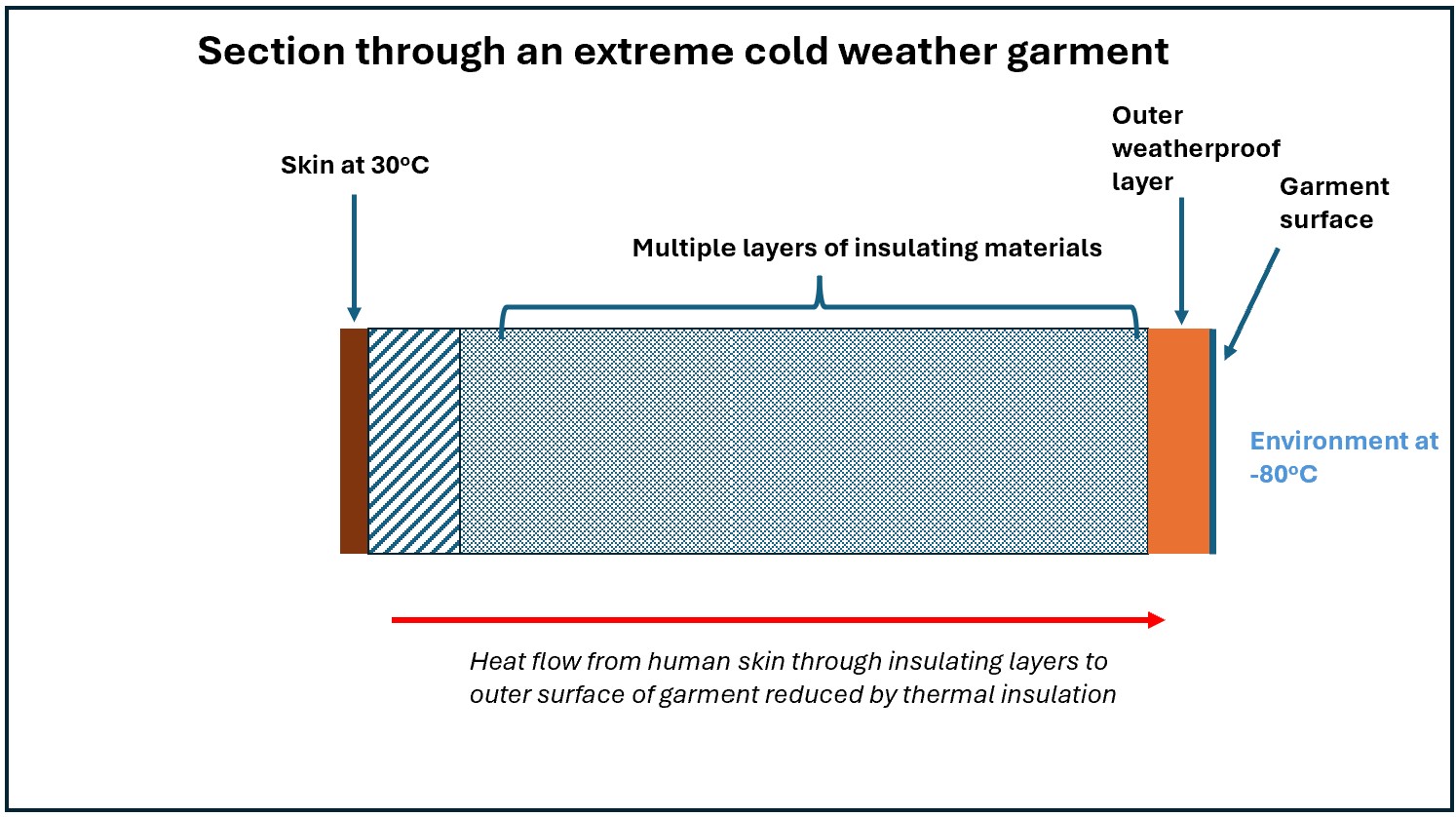
The calculations assume that the temperature of the surface of the clothing is only 10 degrees Celsius above the surroundings.
The details of the calculations are in the Further Information section at the bottom of this post.
What are the mechanisms of heat loss from a human on the cold Antarctic ice
Heat is lost in four ways: Convection to the cold air, radiation to the cool surroundings, exhaled in the breath and conduction through the boots.
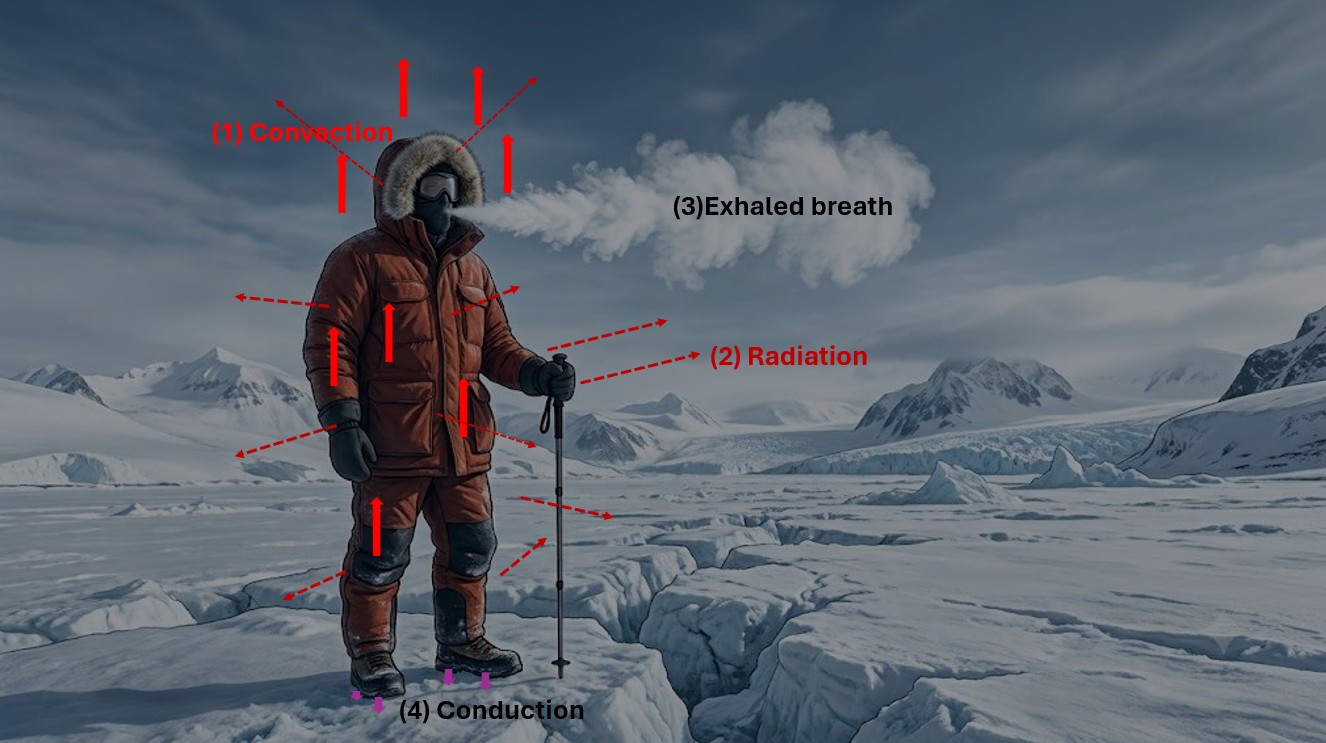
Mechanism 1 – Heat loss by convection from the clothing surface
Because the outer surface of the clothing is warmer than the atmosphere heat is lost by convection to the cooler surrounding air.
The rate of heat loss is given by the formula.
hA(TS – TE)
Where
- h is the convective heat transfer coefficient. In still air it has a value of about 4. If a breeze is blowing heat is carried away more rapidly, and it is much higher – about 20.
- A is the garment’s surface area
- TS is the temperature of the garment’s outer surface (-70oC).
- TE is the temperature of the environment (-80oC).
In still air the rate of heat loss by convection would be around 100 watts and if a breeze is blowing, it is five times higher at 500 watts.
Mechanism 2 – Heat loss by radiation
All objects which are warmer than their surroundings radiate heat. The heat loss by radiation is the second largest mechanism of heat loss and works out at 42 watts.
Mechanism 3 – Heat loss by respiration
The polar explorer breathes in air at -80oC. This inhaled air contains very little moisture. As it passes through the nasal passages and upper respiratory tract, the air is warmed and moisture added.
The human body loses heat by respiration in two ways.
- The cold air is warmed by the body and is exhaled at a much higher temperature.
- Energy (latent heat) is needed to evaporate liquid water from the linings of the lungs into water vapour.
Adding the two together gives the total heat lost by respiration of around 30 watts
However, the human body has not evolved to breathe at temperatures as low as -80oC. Breathing air as cold as this will damage the upper respiratory tract and the sensitive tissues in the lining of the nose. If anyone attempted to breathe air at -80oC through their mouth it would cause frostbite to the lining of the mouth, the tongue and the throat.
Worst still, as the cold air hit the airways it would cause a cold shock. The smooth muscles would go into spasm and tighten. It would feel like a severe asthma attack—the airways would constrict, making it difficult to draw another breath.
To prevent this happening, people who work in Antarctica during the winter use a cold-weather mask when they venture outdoors. The mask traps warmth and moisture in its material. When air is breathed in, it passes through warm, damp fabric, pre-heating and pre-humidifying it.
I will assume the use of a cold weather mask reduces the rate of heat loss by respiration down to 10 watts.
Mechanism 4 -Heat Loss by Conduction
The polar explorer’s boots are in direct contact with the frozen ground. Heat is lost by conduction from their feet through the soles of their boots. Of the four mechanisms of heat loss this is the smallest, if the boots are thick and well insulated the rate of heat loss would be around 7 watts.
Can our Polar Explorer stay warm on the Antarctic ice?
The answer to the this question is a guarded Yes, depending on what our explorer is doing and the wind speed.
Case 1) Heat loss from the body in still air
Adding the four numbers together gives an estimated rate of heat loss of 159 watts. An adult human generates about 100 watts of heat when standing still which gives a heat deficit of 59 watts. To keep warm,our polar explorer would shiver, raising their heat output to around 200 watts.
So the answer is Yes but our explorer would be shivering with cold.
Case 2) Heat loss from the body if a breeze were blowing
If there were a breeze blowing the total rate of heat loss increases to around 559 watts. So, if our explorer were standing still they would have a heat deficit of around 459 watts. Their body temperature would fall, and they would be in danger of hypothermia. The body would switch to survival mode where short bursts of high intensity shivering could raise the heat output to around 500 watts.
So the answer is Yes (just about!!) and only for a short period but our explorer would be extremely cold and uncomfortable.
Case 3) Heat loss from the body when doing vigorous activity
If our explorer were taking part in a vigorous activity, then the balance is different. The total rate of heat loss would be:
- 199 watts if the air were still
- 599 watts if a breeze were blowing
If we assume that the human body generates 500 watts of heat when exercising vigorously, and our explorer is in still air without a breeze, there would be a heat surplus of 301 watts and in their well-insulated polar clothing they would be at risk of overheating in such an extremely cold environment! If a breeze were blowing they would need to generate extra heat by shivering
Can someone stay warming in the Antarctic winter if not wearing insulated clothing?
The anwer to this question is a resounding no. Without insulated clothing death by hypothermia would occur.
If we re-run the calculation so that rather than wearing well-designed polar clothing, our explorer is foolishly wearing casual outdoor clothes, the numbers look very different.
Their clothing is what someone might wear when going for a walk in southern England in a January afternoon where a typical temperature is +8oC. It would not have the multiple layers of insulation to drastically reduce the flow of body heat escaping. The clothing surface would be far warmer than in the previous example.
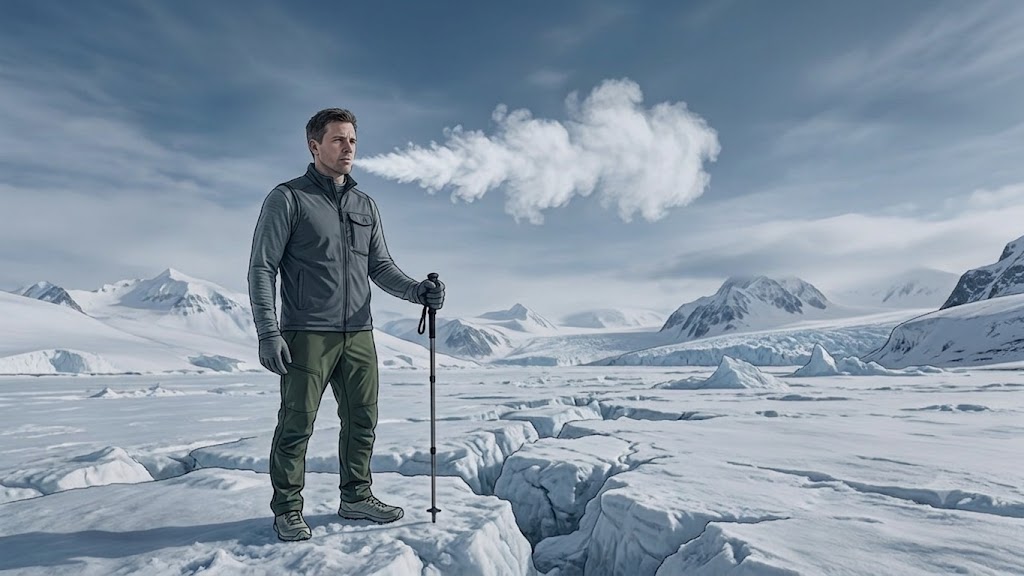
If we assume the outer surface of the clothing is at a temperature of 0oC and re-run our calculations, then we have the following.
Heat loss by convection
The warmer temperature of the clothing’s outer surface makes this much higher. In still air the rate of heat loss would be 800 watts. If a breeze were blowing, then it would be a staggering 4000 watts.
Heat loss by radiation
The warmer temperature of the clothing outer surface causes the rate of heat loss to be much higher – around 561 Watts
Heat loss by respiration
If we assume our foolish explorer is not wearing a cold weather mask, the rate of heat loss by respiration would be 30 watts.
Heat loss by conduction
Rather than wearing specially designed polar boots, we will assume that our foolish explorer is wearing casual outdoor shoes with rubber soles of thickness 1 cm. The thermal conductivity of rubber is much higher than the special material used in polar boots. In this case the rate of heat loss would jump to 264 watts.
This is a massive rate of heat loss from our explorer’s feet. It would be an extremely unpleasant experience and would lead to freezing of the feet and severe frostbite.
Total heat loss
Adding the numbers together gives a rate of heat loss of 1655 watts in still air and 4855 watts if there were a breeze blowing. In either case there is a massive heat deficit, which the body could not make up by increasing its heat output by intense shivering or vigorous exercise.
The body temperature would rapidly fall and our foolish polar explorer without adequate protection would quickly succumb to death by hypothermia.
Heat loss from a human on Mars at -80oC
At the Martian equation temperatures drop to -80oC at dawn, at higher latitudes it get even colder. Let’s assume our Martian astronaut is wearing a well-designed spacesuit, which has multiple layers of thermal insulation to reduce heat loss. The insulation isn’t quite as effective as the polar clothing worn by our Antarctic explorer and the temperature of the surface of the spacesuit from which heat is lost to the surroundings is -60 oC – twenty degrees warmer than the environment. If we look at the way the four mechanisms of heat loss work, the numbers are very different .

Heat loss by Convection.
The thin Martian atmosphere means the convective heat transfer coefficient is far smaller than it is on Earth. Measurements using data from the Phoenix lander [2] have estimated a value of 0.15 in still air and 1 if a breeze were blowing. This makes the rate of heat loss by convection much lower – 8 watts for still air and 50 watts, if a 15 km/h breeze is blowing.
Heat loss by radiation
This is around 90 watts.
Heat loss by respiration.
It is very likely that the astronaut’s spacesuit would be a closed loop system. The gases exhaled would have their carbon dioxide and water removed and be recycled to be breathed in again. There would be no venting of exhaled gases to the Martian atmosphere and the heat lost by respiration would be zero.
The spacesuits worn by the Apollo astronauts when they were walking on the surface of the Moon also had a closed loop system.
Heat loss by conduction.
Assuming the spacesuit boots had similar properties to the polar explorer boots the rate of heat loss by convection would be unchanged at 7 watts.
Conclusions heat loss from an astronaut on Mars
Adding up these values gives an estimated rate of heat loss of 105 watts. If a breeze were blowing, this would rise to 147 watts.
Astronauts on Mars would have a life support system in their spacesuits. This would consume around 50 watts of power – generating heat in the process. This heat needs to be added to the heat generated by the astronaut’s body. Therefore, the total rate of heat generation inside the astronaut’s spacesuit would be:
- 150 watts when standing still, which would approximately balance the rate of heat loss from the spacesuit.
- 550 watts when exercising vigorously , which would provide a large heat surplus. To prevent the astronaut overheating, heat would need to be removed by a cooling mechanism built into their spacesuit.
So, the challenge when wearing a well-insulated spacesuit would be keeping cool. Confined inside their spacesuits, Martian astronauts would not be able to lose heat by sweating. There would need to be a cooling mechanism which astronauts could adjust according to their level of activity. Spacesuits worn by Apollo astronauts on the lunar surface and by astronauts on spacewalks have such a cooling system.
Heat loss from the Martian surface at 0oC
In the early afternoon, near the Martian equator, temperatures rise to around 0oC [1]. If we assume the temperature of the outer surface of the spacesuit is just above the environment at 5oC and re-run the calculations, then we get:
- Rate of heat loss by convection in still air is 1.9 watts. If a breeze were blowing,then it would be 12.5 watts
- Rate of heat loss by radiation 56 watts
- Rate of heat loss by respiration- because the spacesuit is a closed loop system this would be zero
- Rate of heat loss by conduction 1.8 watts
Total Rate of Heat loss
If we add these four numbers together then we get the following numbers when the astronaut is standing still so their energy generation is at a minimum.
- 60 Watts in a still atmosphere – giving an overall heat surplus of 90 watts when the astronaut was standing still.
- If a breeze were blowing, this would rise to 76 watts – giving an overall heat surplus of 74 watts when the astronaut was standing still.
In both cases, breeze and still atmosphere the astronaut would need to activate the cooling system in their spacesuit -even when standing still and despite the outside temperature being zero degrees Celsius.
In fact , the heat surplus would be larger than this. In addition to the heat generated by the astronaut’s body and life support systems, there would be significant solar heating because the Sun would be at a high elevation in the Martian sky.
Further information
All the calculations and all the assumptions made are given in the attached document which can be downloaded from here.
https://explainingscience.org/wp-content/uploads/2026/07/heat-loss-from-antarctica-and-mars.pdf
References
[1] Nasa.gov. (2013). Steady Temperatures at Mars’ Gale Crater – NASA Science. [online] Available at: https://science.nasa.gov/resource/steady-temperatures-at-mars-gale-crater/. (Accessed 21 July 2026).
[2] Gendron, S., Wang, G., Jiang, X., Nikanpour, D., Davis, J.A., Lange, C.F. and Stéphane Lapensée (2010). Phoenix Mars Lander Mission: Thermal and CFD Modeling of the Meteorological Instrument based on Flight Data. Available at https://www.researchgate.net/publication/268574708_Phoenix_Mars_Lander_Mission_Thermal_and_CFD_Modeling_of_the_Meteorological_Instrument_based_on_Flight_Data
Accessed 21 July 2026
Discover more from Explaining Science
Subscribe to get the latest posts sent to your email.

 Explaining Science
Hi Steve,
Apologies for the late response; thanks for an interesting article.
But the PDF is a really impressive tour de force, both for the large amount of data collection you’d have had to do, and for the patient calculations!
When the long-awaited Mars landing finally happens, depending on latitude, we’ll need careful calculation to decide how long we can leave the spaceship for, taking into account the amount of walking & other physical activity such as digging, involved.
A lithium-ion battery of 1 kWh capacity should be adequate to drive the spacesuit’s cooling equipment for a few hours. It would have a mass of 2 or 3 kg, but in Martian surface-gravity that wouldn’t be too burdensome.
(On further thought, the battery wouldn’t deliver any useful output if allowed to reach -80C, so would need insulation & possibly its own separate temperature regulating system.)
Regards, David.
LikeLike
Thank you David,
As always some interesting observations.
LikeLike
All this is fascinating, but now I’m wondering about heat loss in space. How is heat lost in vacuum? All these folks talking about orbital data centres are obviously off their crackers, but how does heat dissipate in space? Does it?
LikeLiked by 1 person
All bodies above absolute zero radiate electromagnetic radiation. This how the Sun’s light gets to Earth!
If a body is warmer than its surroundings it will be a net emitter of radiation and will cool down. If a body is cooler than its surroundings it will be a net absorber of radiation and will heat up.
If we consider a satellite in Earth orbit which is say at a temperature of 27 degrees Celsius (300 K), then when it is in the Earth’s shadow, then the effective temperature of its surroundings is just above 2.7 degrees Kelvin, the temperature of the cosmic microwave background, and it would radiate heat away and cool down. ( The “just above” qualification is because it would also receive thermal infrared radiation from the night side of the Earth )
This is how James Webb telescope remains cool by using sunshades.
When it emerges sunlight the side of the satellite facing the Sun would absorb the Sun’s rays and heat up rapidly
LikeLiked by 2 people
Very interesting calculations and not a topic I have thought about before. Now I am wondering how much heating would be needed inside a Martian house, and whether solar panels on the roof could supply this!
LikeLiked by 1 person
Thanks,
I have topic in the pipeline about Mars bases and yes I am confident , although I haven’t done the detailed calculations , solar panels should be able to provide all the heating.
LikeLiked by 2 people