
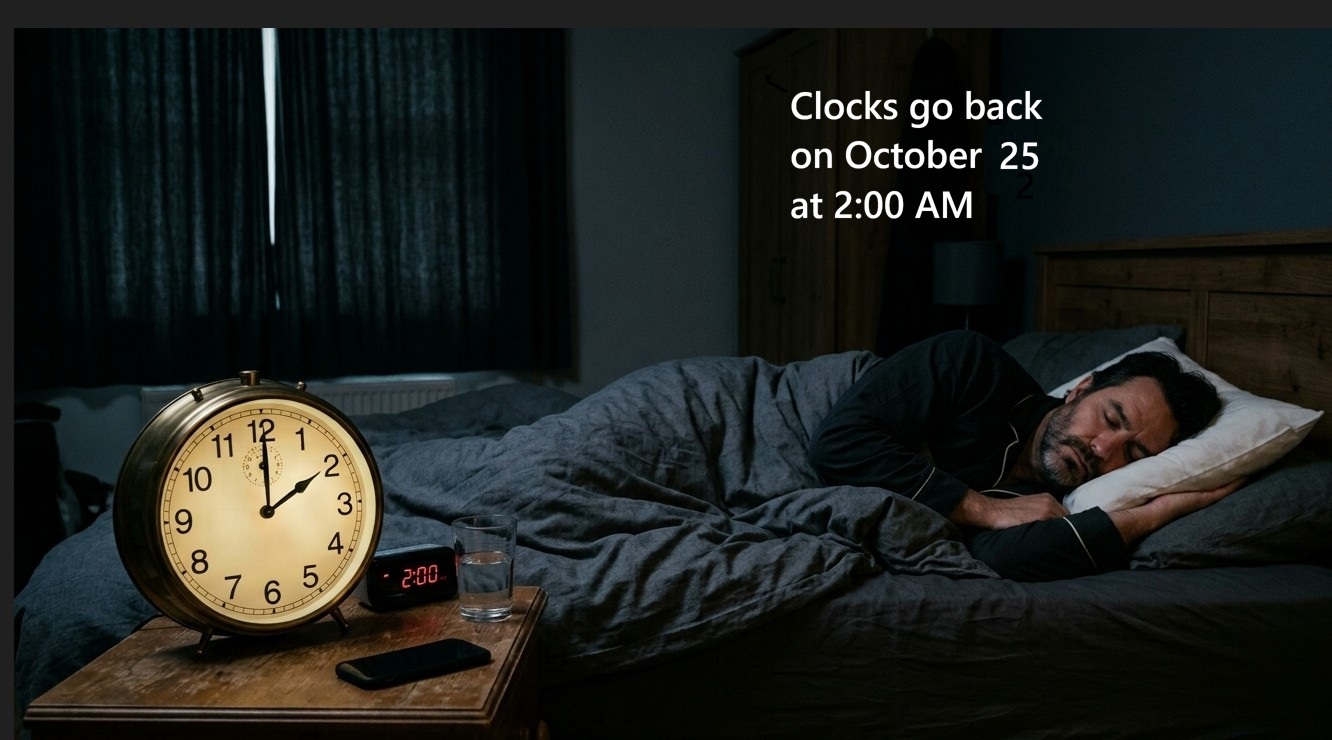
At 2 AM local time on Sunday 25 October, the UK like most of Europe will put it clocks back by one hour as Daylight Saving Time (DST) ends. Most of the USA will follow a week later. In this post give an overview of DST, its pros and cons, why this practice is falling into disuse.
The beginning of DST
The first place in the world to use DST was the town of Port Arthur, Ontario. In 1908, a local businessman, John Hewitson petitioned the town council to adjust the clocks one hour forward in the summer months so the locals could enjoy an extra hour of summer sun. The council agreed and the town turned its clocks ahead one hour from June to September. [1]
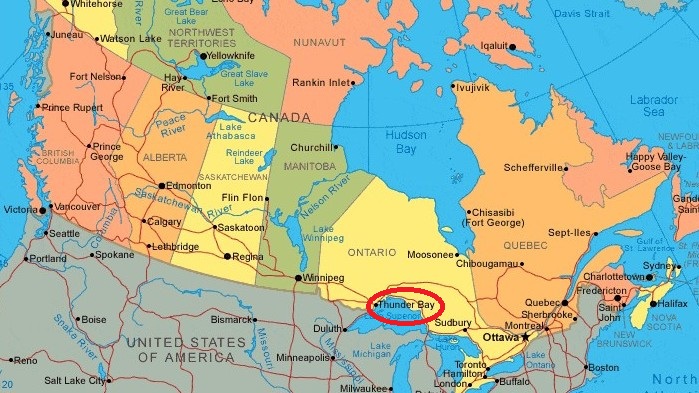
Port Arthur is now part of the City of Thunder Bay, Ontario.
However, the idea didn’t catch on quickly and it wasn’t until first world war that DST became established in Europe and North America. Two of the Central Powers (Germany and Austria-Hungary) adopted it in April 1916 followed by many European countries later that year. The US started using DST in 1918. The key justification for its use was that by having an extra hour of daylight in the evening, it reduced the need for energy in the stretched wartime economies.
What are the benefits of Daylight Saving Time?
Applying DST shifts the day. People lose an hour of daylight in the morning and gain an hour of daylight in the evening. Its advocates state the extra hour of daylight in the evening can be put to good use – allowing people to do outdoor activities in the evening with less need for artificial light. In general, the hour of daylight lost in the early morning is of lesser importance. It occurs before most people have started their daily activities. For example, on 21 June 2026, the Sun rose in London at 4:43 AM and set at 9:21 PM. If the UK didn’t observe DST it would have risen at 3:43 AM and set at 8:21 PM.
Supporters of DST claim it reduces energy usage for heating and lighting. Although this may have been true in the past, this benefit is now less certain. Modern LED light-bulbs are very energy efficient compared to older incandescant bulbs. In many southern states of the US, DST causes energy consumption to rise because it is slightly warmer in the evening – increasing the energy used on air conditioning. Also the lighter evenings means that people, on average, go out in their cars more.
I think a more balanced viewpoint is that:
- In cooler climates like the UK and much of northern Europe, where it is uncommon for people have air conditioning at home, then Daylight Saving time does reduce energy usage as less energy is used for lighting and possibly for heating in the evenings.
- However in warmer climates, where domestic air conditioning is more common, DST probably causes an increase in energy consumption
Disadvantages of DST
One disadvantage of DST is that the twice yearly clock shifts are disruptive to sleep patterns and need to be manually applied in many clocks, watches and older central heating timers. On the day of the change there can be disturbance to plans and people can arrive an hour late or early for appointments.
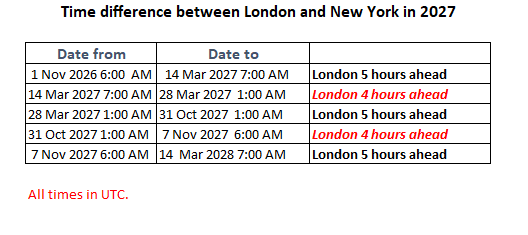
Another issue is that countries which observe DST do not change their clocks at the same time. For example, New York, like most of the US, puts it clocks forward at 2 AM (local time) on the second Sunday in March and back at 2 AM (local time) on the first Sunday in November. Whereas London, like the rest of the EU, put its clock forward at 1 AM (UTC) on the last Sunday in March and back at 1 AM (UTC) on the last Sunday in October. Therefore, for most of the year New York is five hours behind London, but there are two periods when the time difference is four hours. This can cause confusion e.g. when people have a transatlantic phone call or online meeting in either of these periods.
A further complexity is that the very small (and diminishing) number of countries in the Southern Hemisphere which still use DST put their clocks forward at the start of their spring (which corresponds to the Northern Hemisphere autumn) and back at the start of their autumn (which corresponds to the Northern Hemisphere spring).
For example, if we consider Chile and New York in the year 2020, For five months of the year Chile was on the same time as New York. For roughly four and a half months Chile was two hours ahead and at other times one hour ahead. A recipe for confusion!

Source [2]
Which countries use DST now?
Recently, a number of countries have abolished the twice-yearly clock changes.
In 2011 Russia switched to permanent summer time. This was announced amid research claiming that changing the clocks caused Russians ‘stress and illness’. However, many Russians didn’t like the darker mornings in winter caused by having the clocks permanently advanced. For example, in Moscow, the Sun didn’t rise until 9:57 AM on the date of the winter solstice. So, in 2014 Russia switched to permanent winter time to bring the civil time more in step with the solar time. Belarus, which has close political and economic ties with Russia also stopped the twice-yearly clock changes in 2011, but unlike Russia remains on permanent summer time (UTC+3).
Other populous countries which have recently abolished DST include:
- Iran (population 93 million) in 2023
- Turkey (population 88 million) in 2018
- Argentina (population 47 million) in 2009.
- Brazil (population 215 million) in 2020
- China (population 1.44 billion) in 1991.
- Iraq (population 48 million) in 2007.
- South Korea (population 51 million) in 1988.
- Uzbekistan (population 38 million) in 1991.
Although oddly Egypt (population 118 million) started using DST in 2023 after stopping it in 2015.
Today, about one billion people (roughly 12% of the world’s population) live in a place which observes DST –shaded green in the map below

For more details see (https://www.timeanddate.com/time/dst/statistics.html )
Failed Attempt to abandon DST in the EU

On March 26, 2019, the European Parliament voted in favour of backing the EU Committee draft directive to stop the one-hour clock change in the European Union. This was widely reported in the press at the time e.g. https://www.bbc.co.uk/news/world-europe-47704345 and was supposed to be implemented in 2021. It followed an EU-wide public consultation in 2018 which showed 84% of respondents wanting to scrap the biannual clock changes.
However, the public consultation was poorly publicised. In total only 4.6 million people (less than 1% of EU population) expressed an opinion. Even though the UK was still in the EU the vast majority of UK citizens, were unaware it was taking place. In fact I have yet to meet anyone who at the time knew about it !
If the proposal had been adopted each country in the EU would have to have decided whether to remain on permanent summer time or permanent winter time. However, to move forward it needed the agreement of all EU member states and nothing has happened to progress this since 2019. In reality, with all the other event taking place in the world governments of European nations do not see the abolition of DST as an important matter.
The Future of DST in the USA.
In the US, individual states are allowed to opt out and remain on permanent winter time. Hawaii and Arizona are the only states which do so. Interestingly, states are not permitted to remain on permanent year-round summer time. In 2014 a poll of around 1000 American adults found that only a minority (33%) were in favour of the clock changes, 48% were against and the remainder unsure.
In July 2026 the House of representatives passed the Sunshine Protection Act which would abolish the clock changes and move the country onto permanent Daylight Saving Time. However there a number of steps needed before it can become law and previous attempts to introduce such leglislation have failed. One issue is that, even if the clock changes are abolished there is a strong and vocal minority in Congress who would prefer to remain permanently on winter time (also known as standard time)
Explaining Science Poll on whether to abolish DST
Shortly after the autumn 2021 clock change. I created a poll to see how my readers felt about the switch.
In total there were 503 replies and although I would by no means suggest that readers of my blog are typical of the public in general 🙂 the results are nevertheless interesting.
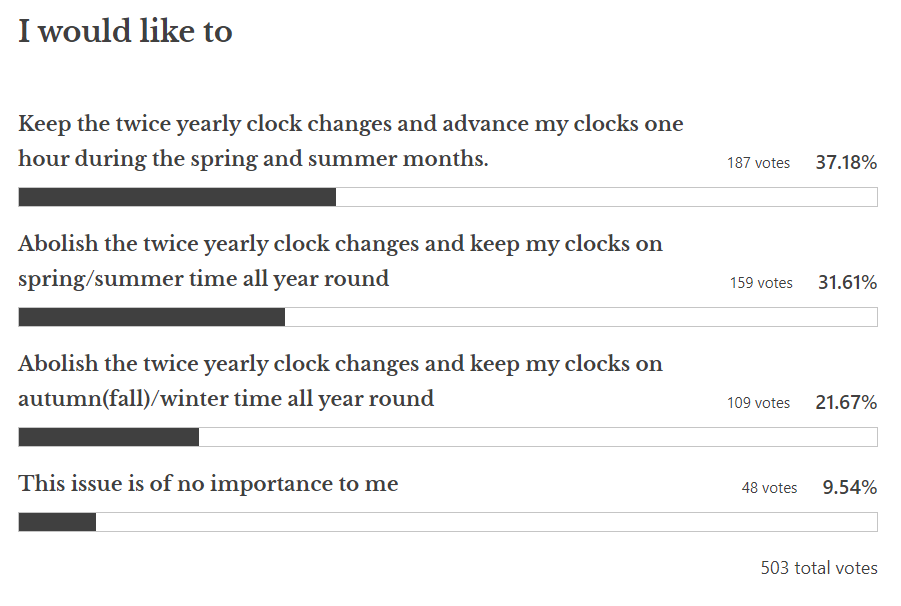
As you can see, none of the three options gained more than 50% of the vote. Although there was a majority for abolishing the twice-yearly task of advancing the clocks in spring and then putting them back in autumn(fall), there was no overwhelming majority for remaining on daylight saving time all year round. A substantial minority would like to remain on permanent winter time.
DST in the Future
DST is falling out of use and now out of the 8.1 billion people in the world only one billion live in area where it is observed. If the EU does eventually abolish DST, this figure will reduce to half a billion. Perhaps, in fifty years time, people will look back on DST as an arcane activity practiced in the twentieth and early twenty-first century?
And finally ….
I hope you have enjoyed this post. Some other related posts which may be of interest are
- The March Equinox which doesn’t always fall on March 21
- The difference between the Gregorian and Julian Calendars
- Time and time zones throughout the world.
You may also find this video on the Expaining Science YouTube channel interesting
References
[1] Buckle, A. (2018). The history of daylight saving time. [online] Timeanddate.com. Available at: https://www.timeanddate.com/time/dst/history.html [Accessed 12 Oct. 2026].
[2] Timeanddate.com. (2020). Daylight saving time 2020 in Chile. [online] Available at: https://www.timeanddate.com/time/change/chile?year=2020 [Accessed 13 Oct. 2026].
Discover more from Explaining Science
Subscribe to get the latest posts sent to your email.


