
Breakthrough Starshot announced back in 2016, was an extremely ambitious project to send a fleet of miniature spacecraft powered by powerful lasers to Proxima Centauri, the nearest star to our Solar System.
Our nearest star Proxima Centauri
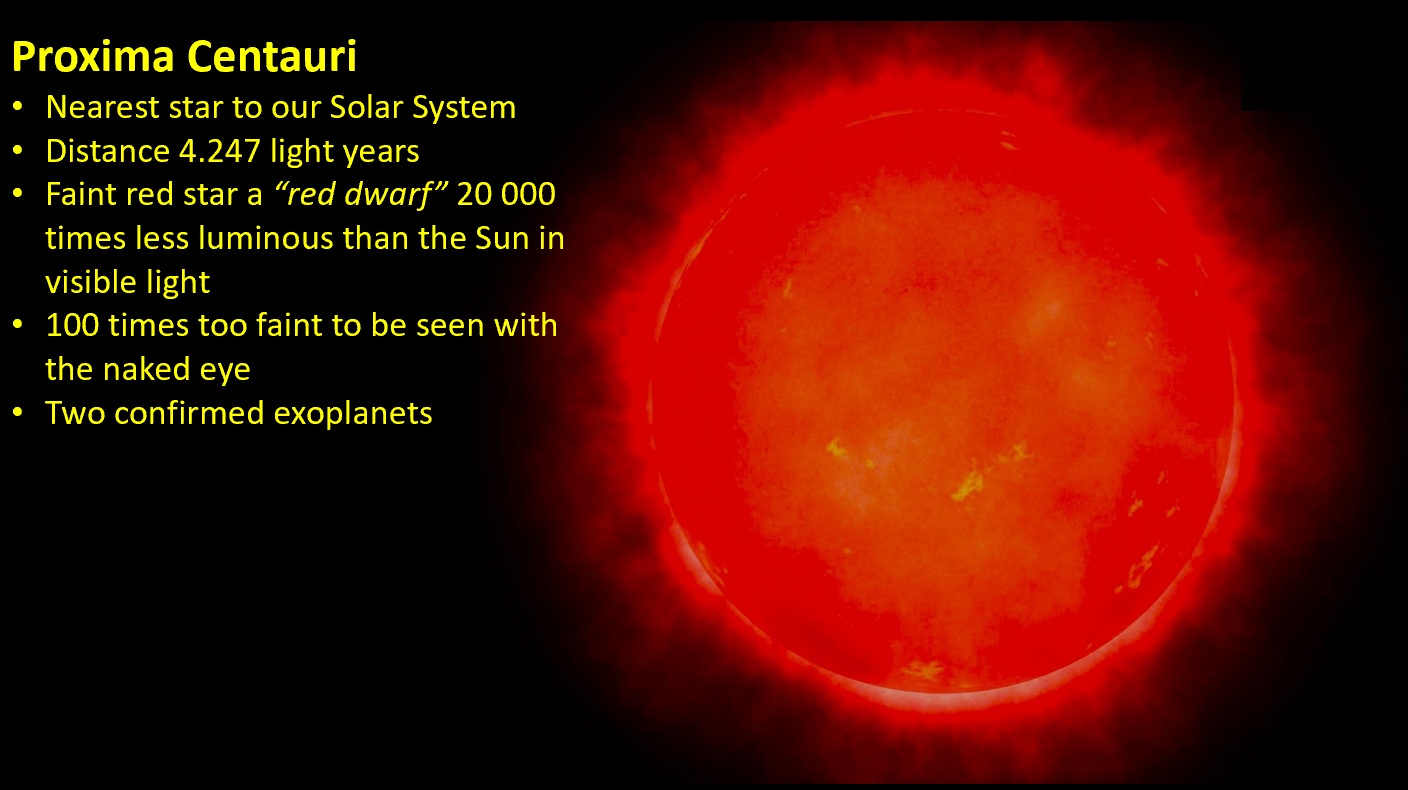
Proxima Centauri is a member of the Alpha Centauri star system and lies a mere 4.3 light years away from us. It is a faint cool star known as a red dwarf, being 20000 times less luminous than the Sun in visible light. Despite being so close, it is 100 times too faint to be seen with the naked eye.
It has two confirmed exoplanets, Proxima Centauri b, discovered in 2016 [1] and Proxima Centauri d discovered in 2022 [2].
Proxima Centauri b – an Earth-like world?
Of its two exoplanets, Proxima Centauri b is of particular interest. It was detected by measuring the tiny gravitational wobble a planet exerts on its parent star.
- As Proxima Centauri moves towards Earth, its spectral lines shift slightly toward shorter, bluer wavelengths (blueshift).
- As it recedes away from Earth, the spectral lines shift toward longer, redder wavelengths (redshift)
The limitation of this method is that we can only measure the component of the star’s motion along the line of sight. The mass of the exoplanet depends on the inclination of its orbit, and this in the case of Proxima Centauri b is unknown.
- If it were orbiting edge on, as seen from Earth, its mass would be 0.97 Earth masses.
- If it were orbiting at an angle of 47 degrees, which is the same inclination as Proxima Centauri’s rotation axis, its mass would be 1.44 Earth masses.

Is there life on Proxima Centauri b?
It is unknown whether or not Proxima Centauri b could support life
The planet lies only 7.3 million km from its parent star (about 5% of the distance from the Earth to the Sun) – taking only 11.8 days to complete an orbit. Despite being so close to Proxima Centauri, the star’s low luminosity means that the surface temperature of Proxima Centauri b is likely to be similar to that on Earth. Its Earth-like mass means it is likely to be a rocky planet with similar surface gravity to the Earth.
It is not known, whether or not the planet has an atmosphere and whether it could support life. One issue is that Proxima Centauri, is a variable star, varying by a factor of two in luminosity over an 84 day period. On top of this, it is also a flare star and will suddenly and unpredictably have a temporary increase in brightness by a factor of five. This flaring up could cause large fluctuations in the planet’s temperature making the existence of complex life forms on its surface difficult. Another problem is the planet is likely to be tidally locked with one side permanently facing Proxima Centauri and thus in permanent daylight and the other side in permanent darkness. This is discussed in more detail in my post on the Trappist 1 planetary system. But perhaps life exists on Proxima Centauri b which has adapted to these conditions?
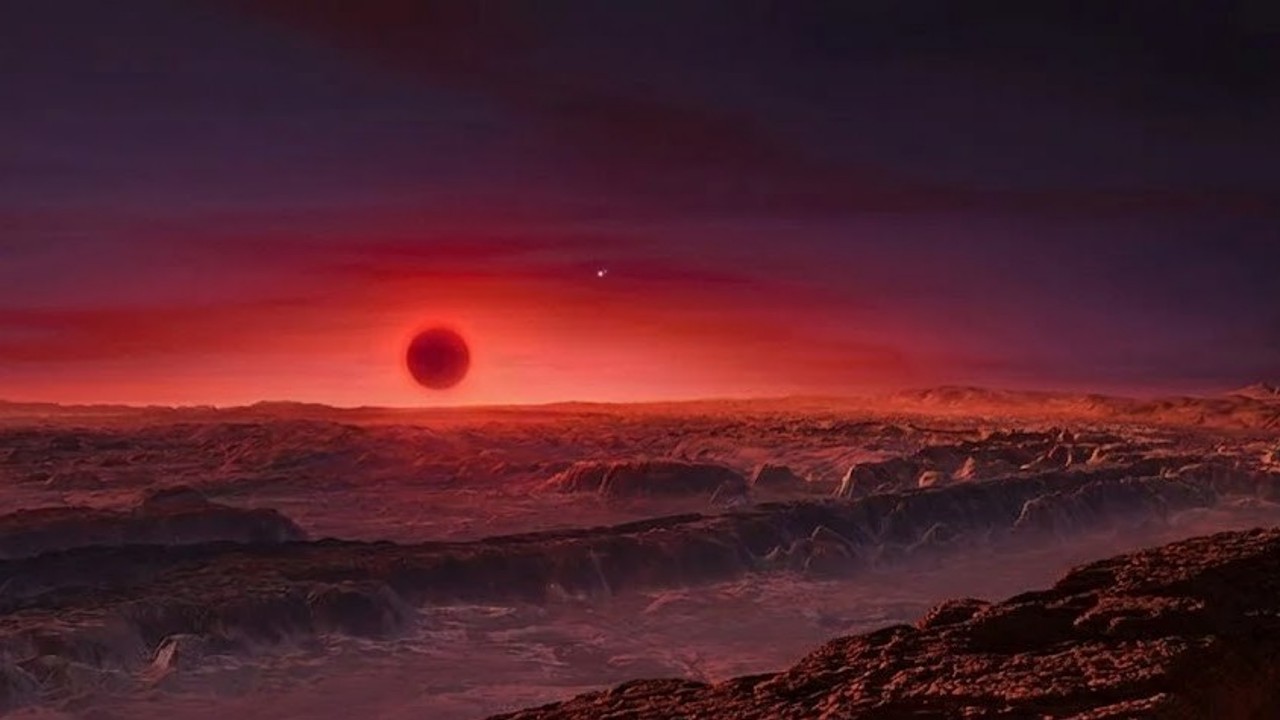
Clearly no one knows what the surface of Proxima Centauri b looks like. This image below is an artist’s impression which may or may not be accurate.
How long would it take to get to Proxima Centauri?
Proxima Centauri and its exoplanets are clearly interesting targets to explore, and the possibility of an Earth-like world so close to our Solar System is a fascinating one. But with our current technology of spacecraft powered by chemical rockets, it would take well over 10,000 years to get there.
Solar sails provide an interesting alternative technology for space travel. They require no fuel and instead use sunlight hitting a sail to provide a weak but continuous thrust which over a long time can produce significant changes in a spacecraft’s velocity . It is possible that solar sails could be used in future by uncrewed spacecraft to travel within the inner Solar System. But the intensity of sunlight falls rapidly as the inverse square of the distance from the Sun. So, this would not be a realistic method of propulsion to travel to the outer Solar System – let alone get to Proxima Centauri.
Breakthrough Starshot
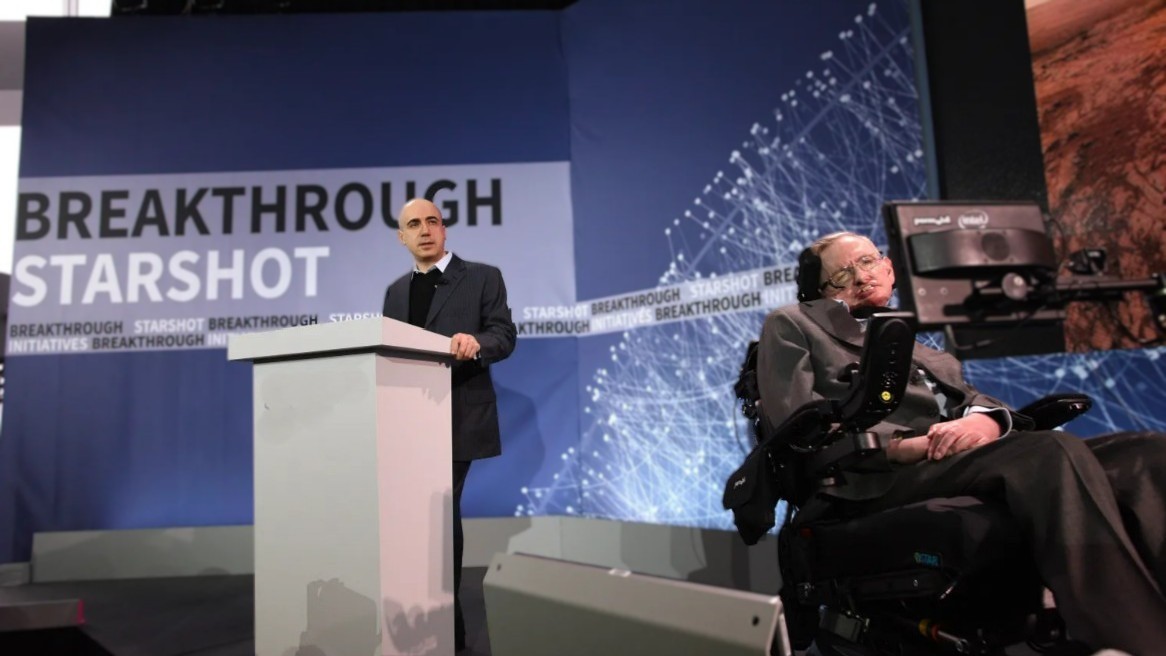
In 2016, Yuri Milner, the billionaire Internet investor behind the Breakthrough Initiatives ,together with Mark Zuckerberg (chairman and CEO of Meta) and the cosmologist Stephen Hawking (1942 – 2018) announced Breakthrough Starshot [3], an extremely ambitious project to develop the technology to enable spacecraft to get to Proxima Centauri in a journey time of 22 years.
Summary of the Breakthrough Starshot Proposal
The proposal was to send a fleet of identical spacecraft. They would be extremely light, perhaps only weighing a few grams and were given the name starchips. Each starchip would be attached to an ultra-light sail -having an area of around 16 square metres, but only a few hundred atoms thick. Rather than using sunlight which has an intensity of 1.36 kilowatts per square metre, at the Earth’s distance from the Sun, the sails would be propelled by a large array of ground based lasers. The intensity of the light hitting the sail would be around 10 Gigawatts per square metre, 10 million times higher than the intensity of the Sun’s light (at the Earth – Sun distance).
I did a rough back of envelope calculation when writing this post which confirmed that a 10 Gigawatt per square metre laser beam spread over an entire sail would give a thrust of 1 000 newtons. If we assume the mass of the spacecraft and the sail combined is 10 grams, then this would give an acceleration (thrust divided by mass) of 100 000 ms-2 . This is massive acceleration and is about 10 000 times the force Earth’s gravity.

This acceleration would only need to be maintained for ten minutes to accelerate the spacecraft to about 20% of the speed of light. Once it had reached this target velocity, it would then coast to its destination. At this speed the journey to Proxima Centauri would take 22 years.
Because the starchip has no significant means of propulsion other than its sails, once the initial acceleration had ceased it wouldn’t be able to adjust its trajectory if it were going off course. The risk of failure of an individual spacecraft is high. For example, many would be lost due to collisions with interstellar dust on the long journey, equipment failure or would simply miss the target. Therefore, the proposal was to send thousands of starchips – only a small percentage would ever reach their destination and send data back to Earth.
The Immense Technical Challenges of Breakthrough Starshot
- It is well beyond current technology to build a functional spacecraft with camera(s), navigation gear, comms equipment, the sail itself and the power supply weighing around 10 grams in total The power supply would have to be a miniature nuclear battery, as solar panels would be useless given the lack of sunlight.
- The sails would have to reflect back extremely close to 100% of the light hitting them. If 99.9% of the light were reflected, meaning only 0.1% of light was absorbed heating up the sail, 16.7 Megawatt-hours of heat energy would be absorbed in a 10 minute period. With such a vast amount of heat, the sail would be vapourised. This “extremely close to 100% reflected back target” will be very difficult to achieve, the first solar- sail powered spacecraft IKAROS only reflected 90% of the light hitting its sail.
- The communication with Earth is another interesting problem. The transmitter would have to be powerful enough to send a signal 4.3 light years back to Earth. This is 1500 times further than the spacecraft Voyager 1, the most distant object humans have ever launched. The proposal was to transform the sail into an antenna to transmit the data back to Earth.
Because so many new technologies were needed the Breakthrough Starshot proposal was to spend an initial $100 million over 5 years on research and development. Assuming that the results from this first phase were positive, there would be a much bigger investment to build a low power prototype. If this was successful a massive amount would be spent to build the fleet of spacecraft and ground-based laser array to take us to the nearest star. (It was unclear who would provide the massive amount of money for this final phase !!! 😊 )
What is the current status of Breakthrough Starshot?
After the initial optimism of the high profile media launch in 2016 there was a flurry of activity in the following year, but this faded away.
The Breakthrough Starshot website is still up and running but there have been no major announcements from the project team and no new content has appeared on the website for over five years. According to a Scientific American article published in 2025 the project has been quietly put on hold. [4]
I think the technical challenges in building the fleet of starchips are well beyond today’s technology and although it does not break the laws of physics, it belongs more in the realm of science-fiction.
And Finally…
There is a short video on the Explaining Science YouTube channel about Breakthrough Starshot.
In addition, this video describes more of the science behind solar sails.
References
[1] Anglada-Escudé, G., Amado, P.J., Barnes, J., Berdiñas, Z.M., Butler, R.P., Coleman, G.A.L., de la Cueva, I., Dreizler, S., Endl, M., Giesers, B., Jeffers, S.V., Jenkins, J.S., Jones, H.R.A., Kiraga, M., Kürster, M., López-González, M.J., Marvin, C.J., Morales, N., Morin, J., Nelson, R.P., Ortiz, J.L., Ofir, A., Paardekooper, S.-J., Reiners, A., Rodríguez, E., Rodrίguez-López, C., Sarmiento, L.F., Strachan, J.P., Tsapras, Y., Tuomi, M. and Zechmeister, M. (2016). A terrestrial planet candidate in a temperate orbit around Proxima Centauri. Nature, [online] 536(7617), pp.437–440. doi:10.1038/nature19106. Accessed 14 August 2026.
[2] Faria, J.P., Mascareño, A.S., Figueira, P., Silva, A.M., Damasso, M., Demangeon, O., Pepe, F., Santos, N.C., Rebolo, R., Cristiani, S., Adibekyan, V., Alibert, Y., Allart, R., Barros, S.C.C., Cabral, A., D’Odorico, V., Marcantonio, P. Di, Dumusque, X., Ehrenreich, D., Hernández, J.I.G., Hara, N., Lillo-Box, J., Curto, G.L., Lovis, C., Martins, C.J.a.P., Mégevand, D., Mehner, A., Micela, G., Molaro, P., Nunes, N.J., Pallé, E., Poretti, E., Sousa, S.G., Sozzetti, A., Tabernero, H., Udry, S. and Osorio, M.R.Z. (2022). A candidate short-period sub-Earth orbiting Proxima Centauri. Astronomy & Astrophysics, [online] 658, p.A115. doi:10.1051/0004-6361/202142337. Accessed 14 August 2026.
[3] Overbye, D. (2016). Reaching for the Stars, Across 4.37 Light-Years. The New York Times. [online] 12 Apr. Available at: https://www.nytimes.com/2016/04/13/science/alpha-centauri-breakthrough-starshot-yuri-milner-stephen-hawking.html [Accessed 12 Aug. 2026].
[4] Scoles, S. (2025). The Quiet Demise of Breakthrough Starshot, a Billionaire’s Interstellar Mission to Alpha Centauri. [online] Scientific American. Available at: https://www.scientificamerican.com/article/the-quiet-demise-of-breakthrough-starshot-a-billionaires-interstellar/ [Accessed 13 Aug. 2026].
Discover more from Explaining Science
Subscribe to get the latest posts sent to your email.


If this project is now on hold, as you seem to imply Steve, it would be interesting if they could report on how close they believe they could get to producing miniature space probes with navigation, stabilisation, high resolution multi-wavelength cameras, instrumentation, data processing and management, power supply, temperature control and communications systems etc in a starchip weighing only ten grams.
I also wonder how such a tiny starchip could generate enough power to send messages strong enough to be readable on Earth – and what would be the size of the Earth receiving dish it will be sending communications to.
It seems a very bold scientific endeavour to me but good luck to them, because robotic spacecraft are our only hope of exploring beyond our solar system. I expect they could be on pause, waiting to see how far silicon chip miniaturisation can go before proceeding again.
LikeLike
Yes,
I assume the project must be on hold because after the initial announcement back in 2016 , Breakthrough starshot seems to have just faded away. It would be interesting/useful if there was an update on the website https://breakthroughinitiatives.org/initiative/3
Giving a definative statement that it had been put on hold AND
summarising what areas of technology had been investigated, what problems had been encountered amd what the next steps for any future initiatives shoud be
LikeLiked by 1 person
Hi Steve,
Thanks; I’d been hoping that sooner or later you’d find time to comment on this project. I’m sure we’d been wondering why all the initial publicity had subsided.
It seems to me that two more items constitute slight problems – among numerous others – for the mission’s credibility:
(1) The ‘spacechips’ have no means of slowing down as they’re approaching their destination —except by radiation pressure from the star & friction from gas within the alien planetary system.
(Worse still, contact with any dust: I suspect that the kinetic energy of even a 1μg. dust particle approaching at 0.2c would be remarkably destructive).
Also the ‘chip’ would have very little time for useful observing. Approaching – & then disappearing – at 60,000 km/s means that its instrumentation would need to be remarkably good for it to measure anything.
(2) If we indulge in another flight of fancy & populate one of the remote planets with intelligent aliens, their technology would almost inevitably be far beyond our 250-year-old one. And they might not take kindly to a vast swarm of small, suspiciously high-speed objects directed at them.
Regards, David.
LikeLiked by 1 person
Thanks David for some fascinating observations. I think, in reality, the project proved to be unrealistically ambitious
LikeLike