
These are some of my latest posts
-
How the length of a day changes over the year

The length of a solar day varies throughout the year, ranging from about 23 hours 59 minutes 38 seconds in mid-September to 24 hours 30 seconds around Christmas. This variation is caused by the Earth’s elliptical orbit and axial tilt, affecting the Sun’s apparent motion and leading to differences in natural time measured by sundials…
-
Is There Anyone Out There? updated post
Thank you to everyone who has downloaded my books. One recent commenter pointed out that the links in the post point to the Amazon UK website and it was unclear how someone based outside the UK would download the books. I have therefore updated the post to make it easier for readers outside the UK to…
-
Is There Anyone Out There ? An e-book about SETI
Updated 22 January 2026 Is there anyone out there? The question of whether or not alien intelligent life exists elsewhere in the Universe has fascinated humankind for hundreds of years. Until relatively recently, this was merely the stuff of science fiction, but since the middle of the twentieth century astronomers have been able to seriously…
-
The Steady State Theory
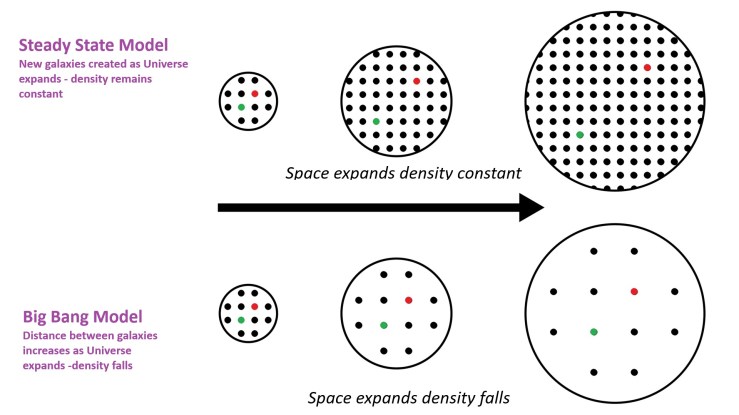
Revised Auust 2026 There is also a video about the Steady State theory on the Explaining Science YouTube channel. The Steady State theory is an elegant alternative to the Big Bang theory of the origin of the Universe . It was very popular among astronomers in the 1950s, but is now obsolete. What is the Steady…
-
20 July 1969 The First Men on the Moon
It has been a very exciting week for space exploration with the pictures sent from New Horizons as it flew past Pluto on Tuesday. Monday next week (20-th July) marks the 46-th anniversary of the first landing on men on the Moon, which was one of the iconic events of the last century. To celebrate this anniversary…
-
New Horizons
On 14 July 2015 the New Horizons Spacecraft will fly past the dwarf planet Pluto which lies on the edge of our Solar System. This is the culmination of a nine and half year voyage which started when it was launched in back in January 2006. Artist’s Impression of New Horizons passing Pluto – Image…
-
The June Solstice
The June solstice, which for most of the world will fall on June 21 this year, is the longest day in the northern hemisphere and the day when the Sun is at its highest in the midday sky (see note). The origin of the word solstice is from the Latin words sol, which means Sun, and sistere, to stand…
-
Jun 30 2015 – Leap Second
On June 30 2015 an extra second will be inserted into the very end of the day. This extra second is called a leap second. Why do we need leap seconds? Although we take the average length of a day to be 24 hours, the mean solar day, or average “natural” day measured by the…
-
Ultimate Fate of the Universe.
This post, which is the latest in my series on cosmology, is about the ultimate fate of the Universe, a subject which has engaged scientists, philosophers and religious leaders for centuries. There are many possible endings to the Universe, but the outline I will present here, which is sometimes called “The Big Freeze”, is the most commonly held…
-
The Future of humanity
As described in my previous post (The Future of the Sun), in about 5 billion years time the Sun will swell up to at least 100 times its current diameter and this will make the surface of the Earth far too hot to sustain life. What Sunrise might look like when the Sun is a red…

