
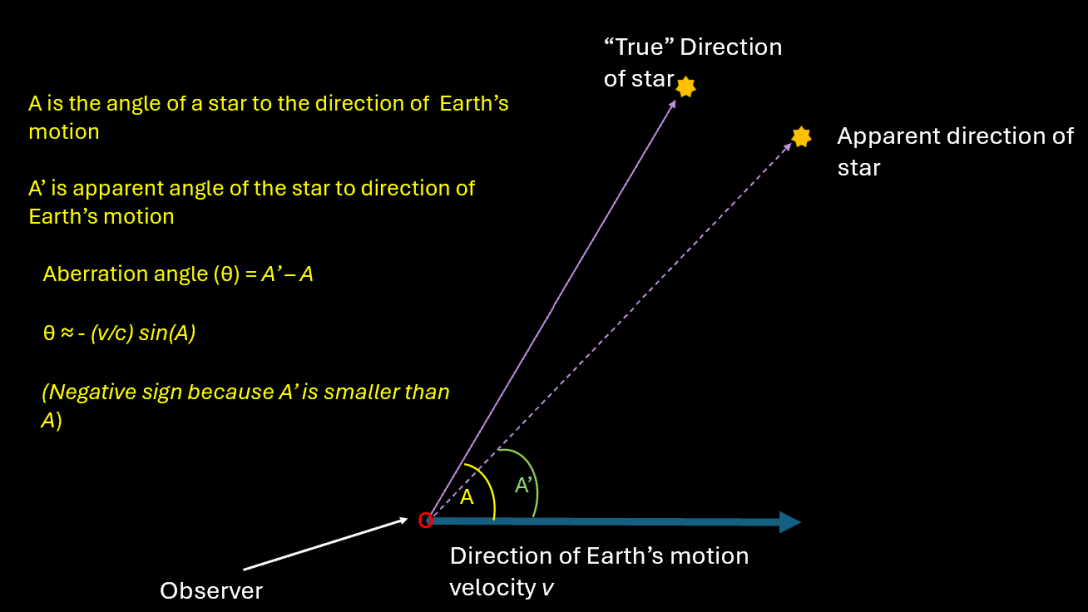
Stellar aberration was discovered by James Bradley in 1727. He observed unexpected star position shifts, confirming the heliocentric theory and enabling light speed measurement. Today, it's explained by Einstein's theory of relativity.
Stellar aberration was discovered by James Bradley in 1727. He observed unexpected star position shifts, confirming the heliocentric theory and enabling light speed measurement. Today, it's explained by Einstein's theory of relativity.
Updated 14 December 2025 As I complete this post from my home in Manchester, England, it is 4:30 pm and already dark outside. Many people think that it will continue to get dark earlier each day in the afternoon until we reach the winter solstice , which in 2025 occurs on 21 December in the… Continue reading The darker mornings.
Updated 14 December 2025 Today it is generally accepted fact that the Earth is one of eight planets which revolve around the Sun, that the Sun is one of 400 billion or so stars in our Milky Way galaxy and that the Milky Way is one of hundreds of billions of galaxies in the observable… Continue reading Geocentric Cosmology
Anybody who has looked up into the western sky after sunset in the past month will have noticed a brilliant white object - the planet Venus, sometimes called the Evening Star. It is brighter than any other planet and ten times brighter than the brightest star Sirius. The "Evening Star" Venus next to the Moon… Continue reading The Evening Star-Venus.
Venus, is the brightest planet and third brightest natural object in the sky. It has an orbit closer to the Sun that the Earth, which it is mainly a daytime object and exhibits phases similar to the Moon. Galileo's observations of these phases supported heliocentrism, contrasting the geocentric model favored by the Church.
 Explaining Science