Revised and updated 2 February 2026
At certain times anyone looking in the eastern sky just before sunrise will have notice a brilliant white object – the planet Venus, sometimes called the Morning Star. It is much brighter than any other planet and is the third brightest natural object in the sky after the Sun and the Moon.

Image from NASA. Venus in the pre-dawn morning sky. The less bright object near to Venus is the planet Jupiter. Venus appears as a disc in the image because it is so bright that it has flooded the camera with light. To the naked eye Venus appears as a point of light.
The orbit of Venus
Venus is the planet which passes closest to Earth. At its closest approach it is only 40 million km, roughly 100 times the distance from the Earth to the Moon (Williams 2015). Because not only is it nearer to the Sun but it also moves faster in its orbit, a year on Venus lasts only 225 Earth days,

The orbit of Venus in shown above. As you can see, because Venus orbits the Sun inside the Earth’s orbit, to an observer on Earth it always stays close to the Sun. This means that for most of the time Venus is only above the horizon in the daytime when it is difficult to see.. The points marked as A in the diagram are known as the greatest elongations and are the points where, to an observer on Earth, Venus appears to be the greatest distance from the Sun in the sky. At these times, although Venus is still visible mainly in the daytime, it is also visible for a few hours at night before sunrise or after sunset. This effect is greater at higher latitudes, because the path of Venus through the sky has a shallower angle.
This is also true for Mercury. The other planets orbit outside the Earth’s orbit and therefore can be seen in the middle of the night at certain times.
Venus during 2025 and 2026
Venus is both closer to Sun and moves faster in its orbit than the Earth. The Earth and Venus are like two runners in a race. It takes on average 584 days for Venus to gain a lap on the Earth and for them line up in the same position with repect to each other and the Sun.
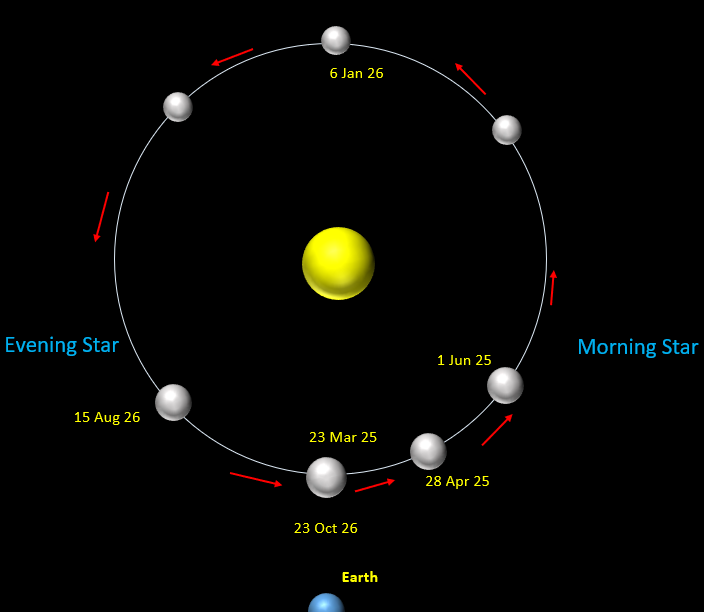
Venus and seen from Earth in 2025 and 2026
On 23 March 2025 Venus passed between the Earth and the Sun. Astronomers call this the inferior conjunction. It appeared very close to the Sun in the sky and for a couple of weeks either side of this date was difficult to observe – lost in the Sun’s glare.
As seen from Earth, Venus moved away from the Sun and appeared in morning in the east, before sunrise as the morning star. For example, on 28 April 2025 , the date of writing this post, it rose at 4:32 am local time in Manchester England. This was 68 minutes before sunrise.
It then continued to appear further away from the Sun in the sky. On 1 June 2025 it reached its greatest morning elongation when it was about 46 degrees from the Sun in the sky. On that date in Manchester it rose at 3:24 am, which is 82 minutes before sunrise.
It then started to move closer to the Sun in the sky. On 6 January 2026 it was almost directly in a straight line with the Earth and the Sun. Astronomers call this the superior conjunction. It appeared very close to the Sun in the sky and for a couple of weeks either side of this date its proximity to the Sun made it difficult to see.
After this, Venus will moved away from the Sun and now in February 2026 can be seen briefly evening in the west, after sunset, as the evening star. On 15 August 2026 it will reach its greatest evening elongation when it will appear about 46 degrees from the Sun in the sky. On that date it will set at 9:33 pm, in Manchester, 56 minutes after sunset.
After then it will start to move closer to the Sun in the sky. On 23 October 2026 it will once again be at inferior conjunction and the whole cycle will repeat again
Transit of Venus
Because the orbit of Venus is tilted with respect to the orbit of the Earth, at inferior conjunction Venus normally passes just below or just above the Sun. Occasionally things line up so that Venus passes directly in front of the Sun when seen from the Earth. This is called a transit of Venus and the planet appears as a small dark dot against the bright disc of the Sun. This is a rare occurrence. It happened back in the year 2012, and it won’t happen again until 2117 [2]

Image from Wikimedia Commons
The Phases of Venus
As seen from the Earth, Venus goes through a full set of phases in a similar way to the Moon, although, because Venus appears so small, these are only visible through a telescope.

Starting with with a “new Venus”, at inferior conjunction shown as A above, when Venus is between the Earth to the Sun and the sunlit part of Venus faces away from us making the planet almost invisible, over a 584 day cycle the sunlit part of the Venus gets larger or waxes through to a crescent phase (B), to a half Venus (C) at the greatest elongation, to a full Venus at superior conjunction (D), when the whole Earth-facing side is illuminated.
It then gets smaller or wanes back to a half Venus (E) at greatest elongation, then to a crescent (F) and then finally back to a new Venus at inferior conjunction
Galileo’s discovery of the Phases of Venus
The first person to notice the phases of Venus was the Italian astronomer Galileo Galilei (1564-1642).

Image from Wikimedia Commons
In 1543, just before his death, Nicolas Copernicus had published the theory of heliocentrism – that the planets orbit the Sun. However, in Gallileo’s time, the teaching of the Catholic church favoured the geocentric theory of the Universe, the widely held view that the Earth was the centre of the Universe and the stars, planets, the Sun and the Moon were in orbit around it. Indeed certain verses of the bible could be interpreted as supporting that viewpoint, such as
Psalm 104:5 “the Lord set the earth on its foundations; it can never be moved.”
However, the phases of Venus and the way that it appears smaller when it is a full Venus can only be fully explained by Venus orbiting the Sun, not the Earth. Therefore, Galileo concluded that the geocentric theory was incorrect. Unfortunately for Galileo, in 1616 the Catholic church declared heliocentrism to be heresy. Heliocentric books were banned and Galileo was ordered to refrain from holding, teaching or defending heliocentric ideas.
However Galileo continued to defend heliocentrism, so in 1633 The Roman Inquisition tried Galileo in 1633 and found him “vehemently suspect of heresy”, sentencing him to indefinite imprisonment. Galileo was kept under house arrest until his death in 1642.
However the facts cannot be disputed. When viewed through a telescope Venus does show changes in size and shape, which can only be satisfactorily explained in a heliocentric model. Eventually, in 1758, the the Catholic Church dropped the general prohibition of books advocating heliocentrism.
Venus viewed through the telescope
Through a telescope Venus appears to be a featureless object. This is in contrast to Mars where surface detail can be clearly seen.
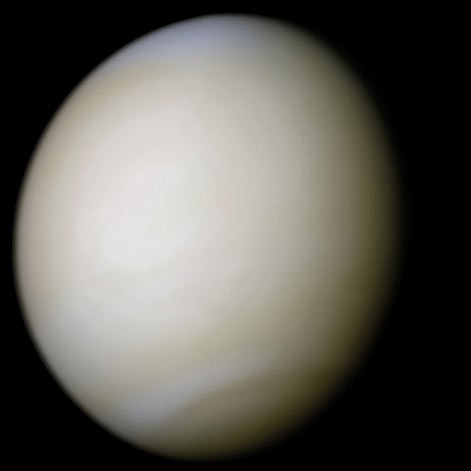
Venus through a telescope -Image from NASA
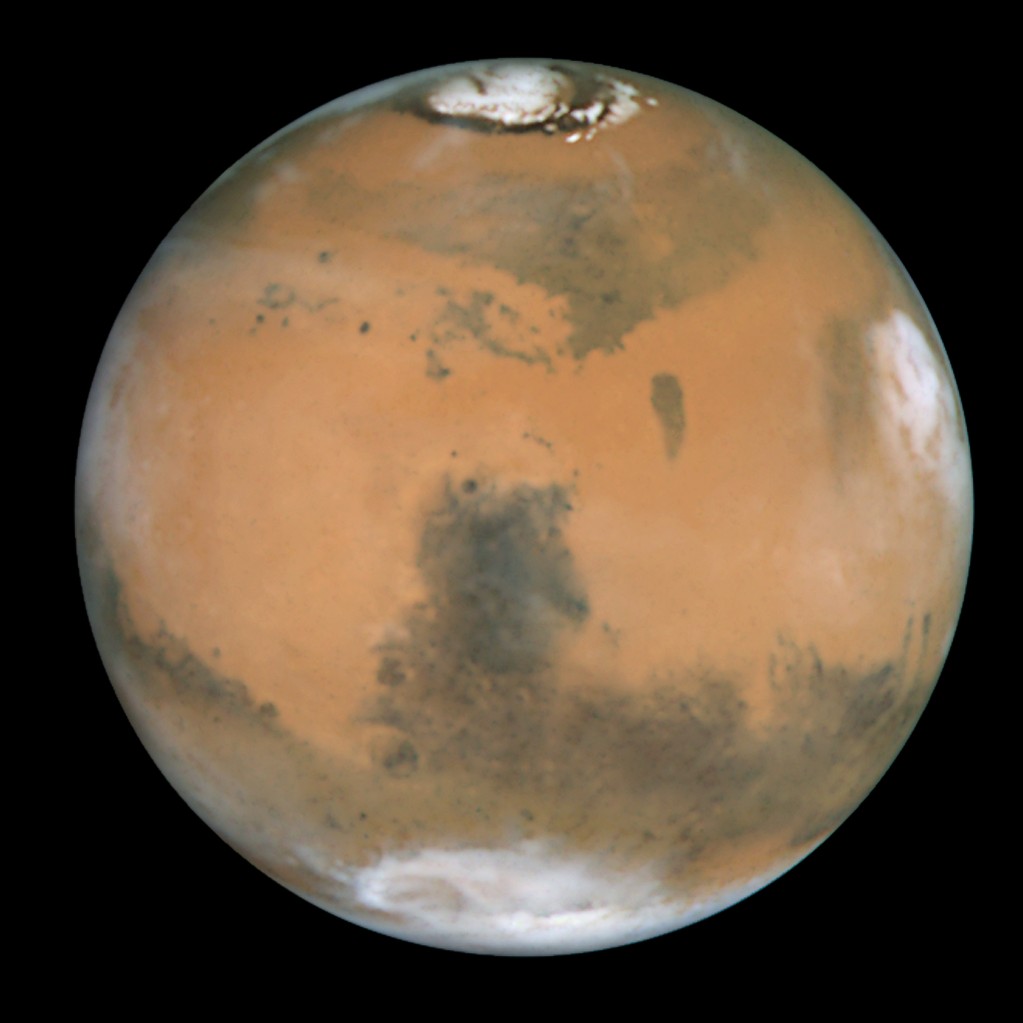
Mars through a telescope_image from NASA
This reason why we can’t see any details on Venus is because the planet is completely covered in thick clouds which reflect most of the sunlight back into space and prevent us from seeing details underneath. So despite it being the closest astronomical object to the Earth other than the Moon, little was known about Venus until the 1960s. Without any surface markings to follow as the planet spins on its axis it was difficult to estimate how long a day on Venus is. This wasn’t discovered until 1961 when astronomers bounced radar signals of the planet and studied their echos.
It wasn’t until the Venus was visited by spacecraft in the 1960s that we knew how hot the surface and how thick the atmosphere were. Indeed, before then many scientists thought that conditions on Venus underneath the clouds were similar to Earth and there are many science fiction stories written before the 1960s where Venus is inhabited by alien life forms. However, it turns out that the surface temperature is an incredibly hot 460 degrees Celsius on average, which is hot enough to melt lead, and the atmospheric pressure at the surface is a crushing 92 times the surface pressure of the Earth. The bright clouds turns out to be made out of highly toxic and corrosive sulfuric acid.
And finally…
I hope you have enjoyed this post. It is part of series of Explaining Science posts on Venus. Some of the other posts include:
- Why is Venus so bright compared to other planets
- Terraforming Venus so that humans could live and work there.
- Could humans live in the Venusian atmosphere? And why would they want to?
- The Transit of Venus
I have written a short Guide to Venus e-book about our sister planet.
In addition there’s a video on the Explaining Science YouTube Channel which describes Venus’s orbit and phases.
References
[1] Williams, D (2024) Venus Fact Sheet, Available at:http://nssdc.gsfc.nasa.gov/planetary/factsheet/venusfact.html (Accessed: 10 November 2025).
[2] McClure, B (2012) Everything you need to know: Venus transit on June 5-6, Available at: http://earthsky.org/astronomy-essentials/last-transit-of-venus-in-21st-century-will-happen-in-june-2012 (Accessed: 10 November 2025).
Discover more from Explaining Science
Subscribe to get the latest posts sent to your email.


[…] https://thesciencegeek.org/2015/11/10/the-morning-star-venus/ […]
LikeLike
Lots of good information here!
LikeLiked by 1 person
Thank you
LikeLike
Cool post, man! This post makes me want to buy a telescope and observe other planets and stars in the night sky!
When it comes to Venus I am very interested in terraforming it.
LikeLike
Thank you
LikeLike
Speaking of space you should check out my latest article on the Jovian moon Ganymede! A future post may be about Titan.
LikeLike
Thanks you Anvil and yes, you’re right, we first accurately measured the distance from the Earth to the Sun using the transit of Venus. I may write a future post about this
The Science Geek..
LikeLike
Lovely post.Thank you. My Favourite Planet.
Didn’t we discover the distance to the Sun using a transit of Venus?
A nice thing to show kids is that they can see Venus in phase without a telescope thanks to the now ubiquitous iPhone/iPad (other smart phones/ tablets are available).
Simply take a shot of Venus at it’s brightest ( I can’t remember its reflective %? – either way, in my experience it’s when it’s so bright kids go “Wow, What’s that?” ) then use the camera digital zoom to enlarge – Voila! A beautiful crescent of light and an easy ‘in’ to Copernicus, Kepler, Galileo, Heliocentrism, Catholicism, Parallax etc’.
The great thing is that they can then show this to others.
I last did it with an iPhone 3 so would expect much better results with more modern camera phones – (never thought of doing it with Jupiter in opposition?)
Glad I found your blog through your ‘like’. Cheers. Looking forward to reading more.
Anvil.
LikeLiked by 1 person
[…] the Earth, but a little hotter because it is closer to the Sun. As mentioned in my previous post “Venus – The Morning Star“, Venus is completely surrounded by thick clouds and what was beneath the clouds was a […]
LikeLike
I’ll be darned. I have been seeing it on my morning bike ride but assumed it was Jupiter, and that the smaller object was Venus!
LikeLike
Reblogged this on LexaLovesFUNFASHIONFOOD and commented:
Thanks for this! As a child I wished on the Evening Star. I found out as a teenager that this Star was actually the Planet Venus. I endeavored to find out as much as I could about the stars, constellations and planets. I was/am facinated by the significance of conjuctions, alignments and the paths/trajectory as well as the forces of the universe/nature in tgis world. As an adult, I still marvel at the Star of the Morning aka Evening Star aka Venus and my wishes have become affirmations!
@thesciencegeek
I always learn something new when I read your posts/blog…;)
LikeLike
Thank you for your comments and I am glad you find my blog interesting 🙂
I am planning to write some more posts about Venus over the next few months.
LikeLike
Thanks for this! As a child I wished on the Evening Star. I found out as a teenager that this Star was actually the Planet Venus. I endeavored to find out as much as I could about the stars, constellations and planets. I was/am facinated by the significance of conjuctions, alignments and the paths/trajectory as well as the forces of the universe/nature in this world. As an adult, I still marvel at the Star of the Morning aka Evening Star aka Venus and my wishes have become affirmations!
I always learn something new when I read your posts/blog…;)
LikeLike
Thank you for your kind comments., glad you find my interesting.
The Science Geek
LikeLike
We would have love to see the transit of Venus in 2012. It must have been a “quite” spectacle. We are looking forward December when the moon occults Venus. It is always a feel good moment when you see that shining planet in the early morning hours
The red moon this past month was so exciting too.
LikeLike
I’ve been enjoying the views of Venus each clear morning. I’m looking forward to December 7 when the moon occults Venus around the noon hour. I’m hoping for clear skies so I can photograph it.
LikeLike
Yes that will a good sight to see.
It is surprising how many people think that you can’t see Venus in the day.
The Science Geek
LikeLiked by 1 person
Ill keep an eye out for her!
LikeLike
She is well worth seeing 😉
LikeLiked by 1 person