
Revised August 2026
Pulsars were first detected in 1967 by a research student, Jocelyn Bell. when she was taking observations for her PhD thesis.

Jocelyn Bell in 1967
Her PhD supervisor, Anthony Hewish (1924 -2021), went on to win the Nobel prize in 1974 for the discovery of pulsars, and Jocelyn Bell’s contribution was overlooked. Many at the time felt that she should have been given at least a share in the prize, since she was the person who had initially spotted the signal from the first pulsar.
The British astronomer Fred Hoyle was particularly vocal on the issue and stated publicly that Bell should have been given a major share of the prize to acknowledge her contribution. Jocelyn Bell herself said very little about the controversy in the years immediately afterwards. The few statements she made were, in general, supportive of the Nobel prize committee’s decision. In the 1960’s and 1970’s it was commonplace for the senior person leading a team of scientific researchers to get the credit for a major discovery on behalf of the entire team. This is probably still true today.
Bell went on to have a successful academic career and throughout her life has been a passionate advocate for getting women more involved in science. From 2002 to 2004 she served as the president of the Royal Astronomical Society, the organisation for British Astronomers being the first ever woman to hold that role. She later served as the first ever female president of the Institute of Physics. In 2006, nearly 40 years after the discovery, she said in an interview in The Guardian newspaper:
In those days, it was believed that science was done, driven by great men . . . And that these men had a fleet of minions under them who did their every bidding, and did not think. It also came at the stage where I had a small child and I was struggling with how to find proper childminding, combine a career, and before it was acceptable for women to work. And so I think at one level it said to me ‘Well men win prizes and young women look after babies.’
She received long overdue recognition in 2018, when she was awarded the $3 million Special Physics Breakthrough Prize for the discovery.
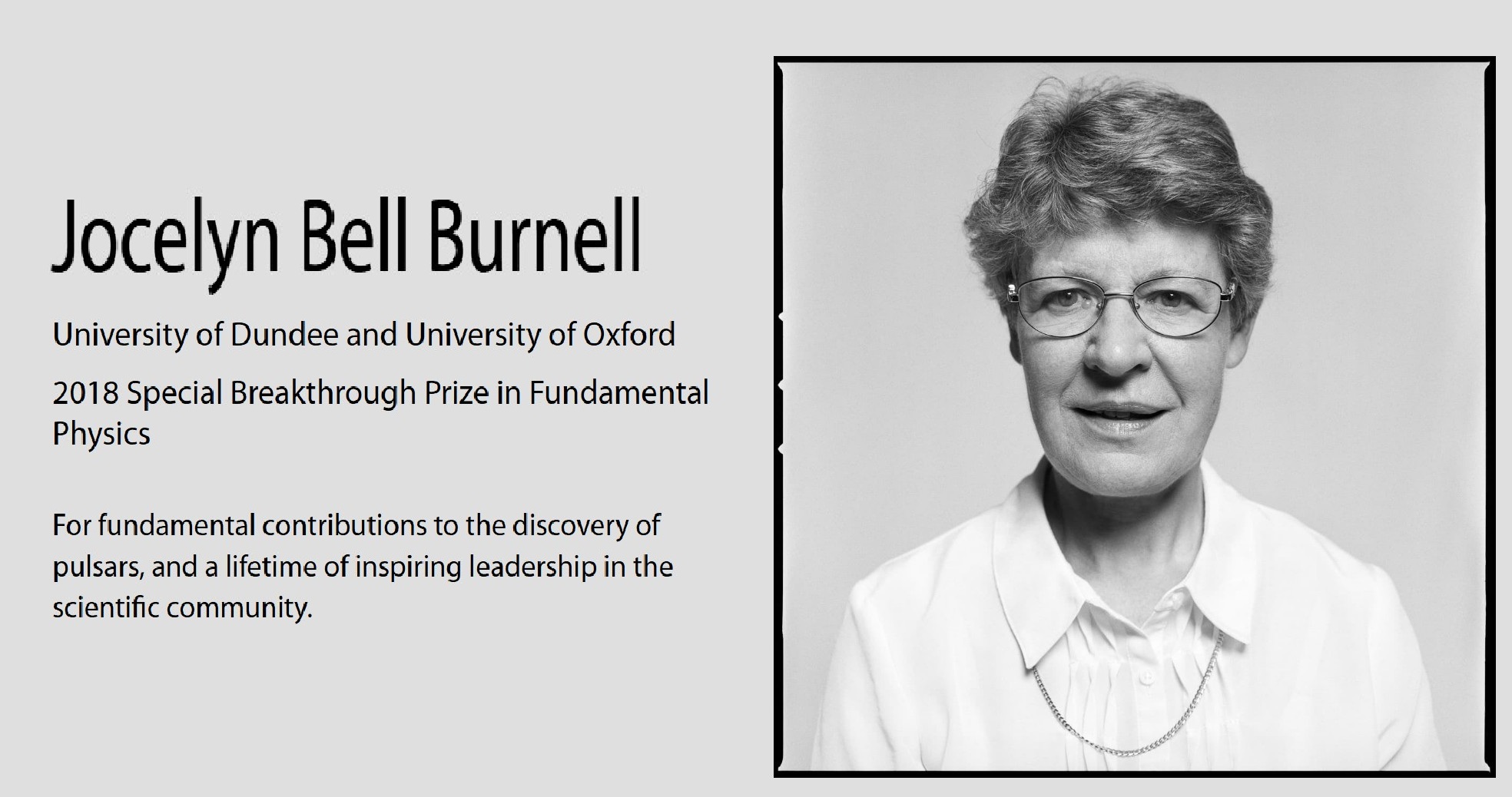
Source https://breakthroughprize.org/Laureates/1/L3830
Previous recipients of this prize include Stephen Hawking (1942 -2018), researchers at Cern who discovered the Higgs boson, and physicists on the Ligo experiment who detected gravitational waves.
According to an article published by the BBC , Bell has decided to donate her entire winnings to set up a fund to help women, under-represented ethnic minority and refugee students to become physics researchers.
Bell who by then was 75 years old told the BBC:
‘I don’t want or need the money myself and it seemed to me that this was perhaps the best use I could put it to.’
The Breakthrough Prizes
The Breakthrough Prizes are funded by the billionaire investor and a philanthropist Yuri Miller who also funds the breakthrough initiatives, which included the highly ambitous plan Breakthrough Starshot to send a fleet of miniature spacecraft to our nearest star Proxima Centauri. This is described in the video below.
Discover more from Explaining Science
Subscribe to get the latest posts sent to your email.

 Explaining Science
Really nice post! I still can’t believe I met her!
LikeLike
Yes you were very lucky. I am sure she is an amazing woman
LikeLike
Good! 😀
LikeLike
🙂
LikeLiked by 1 person
[…] Source link […]
LikeLike
She is such a noble lady.
LikeLiked by 1 person
Yes it really was an exceptional thing to do.
The Science Geek
LikeLike
Good for her. Well-deserved.
LikeLiked by 1 person
I’m delighted for her!
LikeLike
Me too
LikeLiked by 1 person
Reblogged this on Astronomy Topic Of The Day and commented:
This is fantastic news with a happy ending that is decades overdue!
LikeLiked by 1 person
Brilliant article and it’s about time Jocelyn was recognized, albeit late in life. What a superstar (pun intended) too, to donate her winnings to help women, the under-represented and refugee students to become physics researchers.
LikeLiked by 3 people
Very true !
LikeLiked by 1 person